
Industry Portal
Related News
- 00
0000-00
Automotive Exterior and Vision Systems: Supplier Qualification Checklist - 00
0000-00
How to Evaluate an Automotive Exterior Systems Manufacturer for OEM Program Supply - 00
0000-00
Automotive Component Sourcing in China: How Buyers Verify Quality, Cost, and Supply Risk - 00
0000-00
Headlight Thermal Management Standards: Testing LED Heat Dissipation and Reliability - 00
0000-00
ECE-Compliant Waterproof Lighting: What Tests Prove Road-Ready Sealing?
Automotive Exterior and Vision Systems: Supplier Qualification Checklist
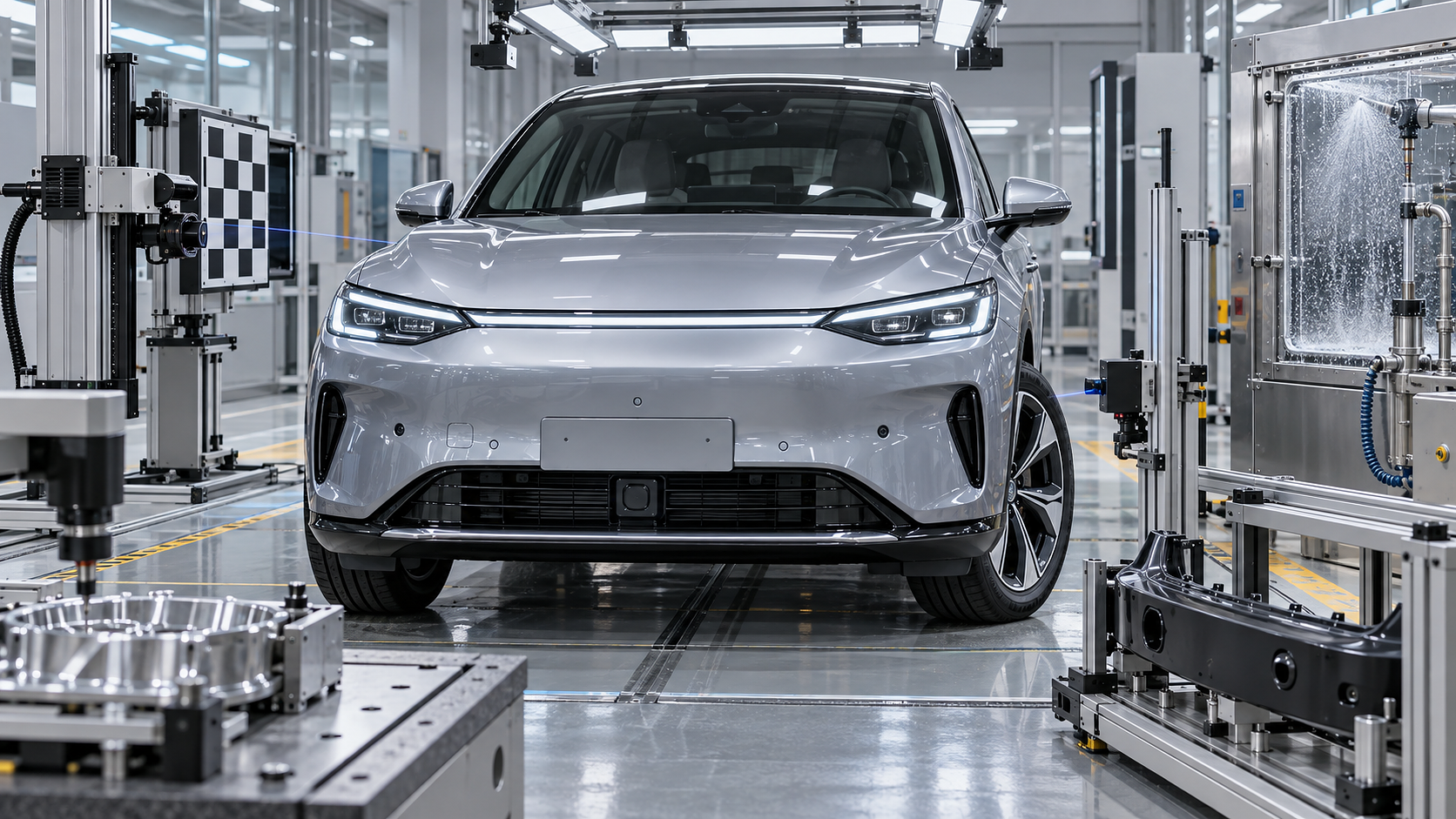
Automotive Exterior and Vision Systems: Supplier Qualification Checklist
Automotive Exterior & Vision Systems procurement is often treated as a price-and-capacity exercise until a launch delay, field-quality issue, or homologation gap exposes the weakness of that approach. Exterior and vision components sit at an awkward intersection: they are highly visible to customers, closely linked to vehicle safety, and increasingly connected to software, electronics, energy efficiency, and regulatory compliance.
A sunroof leak may become a warranty problem. A wheel with inconsistent dimensional control can affect balance, brake clearance, and vehicle appearance. A tire specification that looks acceptable on paper may compromise EV range, cabin noise, or wet grip. A headlamp supplier can meet an initial photometric target yet struggle with thermal stability, optical consistency, or local approval requirements. The purchasing decision therefore needs to assess more than unit price.
For teams sourcing electric sunroof systems, aluminum alloy wheels, high-performance tires, LED headlamp assemblies, and automotive sensor switches, qualification should be treated as a risk-filtering process. The objective is not to find a supplier that claims to do everything. It is to identify whether that supplier can repeatedly deliver the right component, for the intended market, at the required maturity level and through the full service life of the program.
Start With the Vehicle Program, Not the Supplier Presentation
The first qualification mistake usually happens before the supplier is contacted: the sourcing brief is too generic. “LED headlamp,” “18-inch wheel,” or “smart sunroof” is not a usable procurement specification. It does not establish the vehicle architecture, target markets, environmental exposure, design intent, expected annual volume, validation responsibilities, or lifecycle expectations.
A supplier that performs well on a conventional internal-combustion vehicle may not be ready for an NEV platform. The higher vehicle mass and immediate torque response of many EVs place different demands on tires and wheels. Low-drag wheel styling can alter brake airflow and complicate thermal performance. Smart LED headlamps may require coordination among optics, electronics, thermal design, body controllers, and software teams. In these projects, the component boundary is rarely as simple as the purchasing package suggests.
Before issuing an RFQ, define the non-negotiables. These normally include applicable regulations, fitment interfaces, performance targets, appearance requirements, validation ownership, factory location preferences, launch timing, service-parts horizon, and whether the supplier is expected to support engineering changes after SOP. If a requirement remains open, label it as open. Hiding uncertainty in a specification simply pushes cost and timing risk downstream.
The Core Supplier Qualification Checklist
The checklist below is not intended as a box-ticking exercise. Evidence matters more than a polished slide deck. A supplier may answer “yes” to every capability question; the useful follow-up is always, “Show the process, the control point, and the person accountable for it.”
A formal quality certification can be relevant, but it should not become the whole decision. Certification indicates that a management system exists; it does not prove that the supplier can hold optical alignment on a complex lamp, control wheel porosity, manage roof-system water testing, or maintain sensor-switch performance across temperature and contamination exposure. The product-specific evidence is where the real qualification work begins.
Evaluate the Component-Specific Risks
Exterior systems are not interchangeable categories. The procurement team should adjust its scrutiny to the actual failure modes of the part being sourced.
Electric sunroof systems: water, noise, motion, and integration
For sunroof systems, it is tempting to focus on the visible glass panel and opening size. The harder questions concern sealing, drainage, mechanism durability, wind noise, anti-pinch behavior where applicable, roof-module dimensional variation, and serviceability. Electrochromic or other dimming technologies add electrical, optical, thermal, and control-system considerations. Ask which tests the supplier performs internally, which are performed externally, and how design changes are validated after tooling has been released.
A low quote may exclude responsibility for vehicle-level NVH tuning, water-management debugging, or assembly-line support. Those exclusions need to be visible in the commercial comparison, not discovered when pre-production builds begin.
Aluminum wheels: lightweighting cannot be separated from process control
Wheel sourcing requires a clear view of the manufacturing route, whether low-pressure casting, forging, or another approved process. Procurement should understand what the selected route means for design freedom, cost, lead time, finishing, and the required validation plan. A wheel is also an aerodynamic and thermal component on an EV. Highly enclosed styling may improve airflow around the body but can alter cooling conditions around the brake area; this must be considered with vehicle engineering rather than treated as a purely visual issue.
Review controls for raw material, casting or forging consistency, machining, coating adhesion, runout, cosmetic inspection, and traceability. For custom or premium aftermarket wheels, brand protection and repeatable finish quality can matter as much as structural performance. Be cautious when a supplier offers aggressive mass reduction without explaining the supporting design validation and process margin.
High-performance tires: do not buy by label alone
Tires remain the vehicle’s only contact patch with the road, and EV applications sharpen the trade-offs. Buyers may seek lower rolling resistance, reduced road noise, strong wet performance, load capability, and durability under high torque. These targets can conflict. A tire selection should therefore be based on the vehicle duty cycle and intended market, not a single headline claim.
Clarify who owns vehicle-level tuning and approval, how specification changes are controlled, and whether the supplier can provide consistent compound and construction management over the program life. If self-sealing technology or other specialized coatings are included, assess the maturity of the process and its implications for repair, handling, storage, and service communication. Rubber and petrochemical inputs can also be exposed to price volatility, so a transparent adjustment mechanism is often more useful than an unrealistically fixed long-term quote.
LED headlamps and sensor switches: hardware, software, and heat all meet here
Modern headlamp assemblies are no longer simple lighting products. Adaptive beam functions, glare-free masking, projection features, and high-resolution optical systems can involve firmware, electronic control, optical calibration, thermal management, mechanical sealing, and diagnostic communication. A supplier qualification should establish exactly who owns the system requirements, software updates, cybersecurity-related interfaces where relevant, and responsibility for compliance evidence in each sales region.
The same caution applies to photoelectric and mm-wave-based sensor switches used for automatic lighting, rain sensing, blind-spot-related functions, or body-network interaction. Ask how the supplier manages false activation, environmental contamination, electromagnetic compatibility requirements, connector durability, and software version traceability. A sensor can function correctly on a bench while behaving differently behind a windshield, bumper material, coating, or vehicle-specific electrical architecture.
Price Comparison Should Expose Cost, Not Hide It
The lowest piece price is not necessarily the lowest landed program cost. This is especially true when exterior systems require expensive tooling, imported electronics, specialized coatings, validation support, packaging protection, or local service inventory. Procurement should request a commercial breakdown that makes the assumptions visible: tooling amortization, material indices where relevant, packaging, logistics terms, warranty exposure, engineering changes, prototype charges, and end-of-production obligations.
Comparing quotes without aligning technical scope creates false savings. One headlamp supplier may include validation fixtures and optical adjustment equipment while another excludes them. One wheel quotation may include a specific coating system and inspection level while another assumes a less demanding finish. One tire supplier may price only the base product, while the vehicle program still needs a separate approval and tuning package.
This does not mean every cost must be fixed at nomination. It means uncertainty should be priced or governed deliberately. For aluminum and rubber-intensive products, establish how raw-material movements will be handled. For electronic assemblies, examine component obsolescence risk and the supplier’s plan for alternate sourcing. A commercial agreement that ignores known volatility tends to fail under pressure.
Audit the Factory, but Follow the Information Flow
A factory audit remains valuable, particularly for safety-relevant or appearance-critical components. Look beyond cleanliness and equipment age. Observe whether operators understand critical characteristics, whether nonconforming material is clearly controlled, whether gauges are maintained, and whether production records can be traced from incoming material to finished shipment.
The more revealing part is often the information flow. When a defect is found, how quickly does the supplier identify affected lots? Can engineering, quality, purchasing, and sub-tier suppliers work from the same revision level? Does the plant know which process parameters are truly critical, or does it collect large volumes of data without acting on it? Good suppliers are not defined by the absence of problems. They are defined by how quickly they contain, explain, and prevent recurrence.
For global programs, audit the logistics and escalation path as well. A technically capable supplier can still create risk if the approved plant is distant from the assembly location, service-parts planning is weak, or critical sub-components depend on a single unmonitored source.
Make the Nomination Decision With a Risk Register
A practical nomination decision should record the open risks, their owners, evidence required, and closure timing. This is more useful than burying concerns in meeting notes. Risks may include incomplete regional compliance planning, unavailable test capacity, unproven tooling, unstable raw-material sourcing, software ownership ambiguity, or an unresolved vehicle interface.
Not every open item should stop nomination. Some can be managed through phased approval, supplier development actions, dual-source planning, or specific contractual milestones. The key is to distinguish a manageable development risk from a supplier capability gap. If a supplier cannot explain a core process, cannot provide traceability expectations, or cannot commit to the engineering support the program requires, price concessions are unlikely to compensate for that weakness.
In Automotive Exterior & Vision Systems procurement, the strongest sourcing decisions connect vehicle aesthetics, dynamic driving perception, compliance, and total cost early enough to influence the design. That perspective is increasingly important as lightweight wheels, quiet EV tires, intelligent lighting, roof systems, and body sensors become more technically interdependent. The right supplier is not simply the one that can ship a component. It is the one that can defend the component’s performance when the vehicle, the market, and the production schedule become less forgiving.