
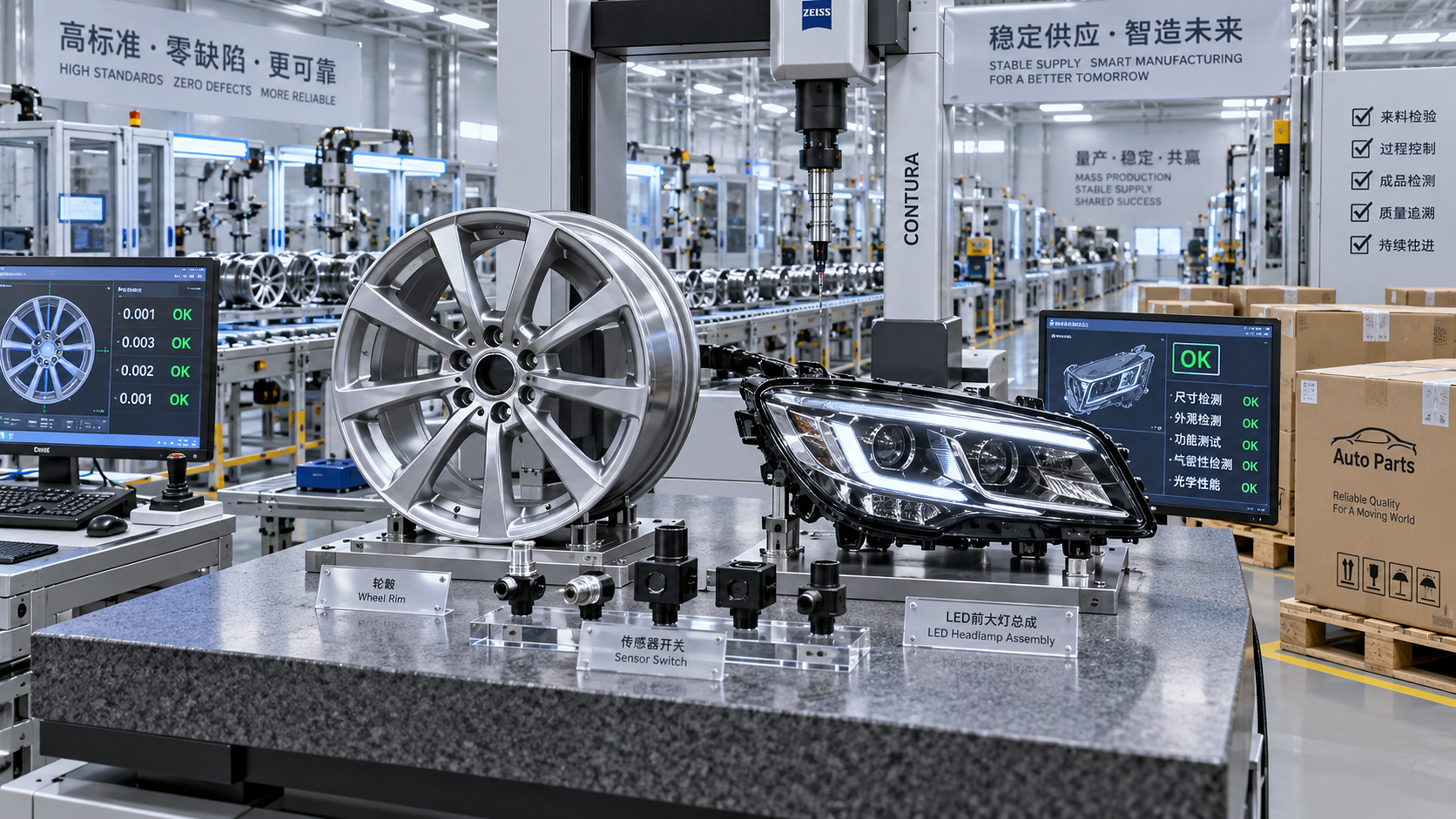
Automotive Component Sourcing in China: How Buyers Verify Quality, Cost, and Supply Risk
Automotive component sourcing China gives procurement teams access to competitive capacity, EV-focused engineering, and broad supplier choice, but a low quotation rarely proves genuine commercial value.
For wheels, tires, LED headlamps, sunroof systems, and sensor switches, successful sourcing depends on verified quality systems, total landed cost, regulatory readiness, and continuity planning.
This guide helps automotive buyers assess Chinese suppliers systematically, compare offers beyond unit price, and reduce avoidable quality, compliance, logistics, and supply disruption risks.
What Buyers Really Need to Verify Before Choosing a Chinese Supplier
The core search intent behind automotive component sourcing China is practical supplier evaluation. Buyers need a repeatable way to determine whether quoted capability can survive production reality.
Procurement teams are rarely looking only for a factory directory. They need evidence that a supplier can meet technical specifications, launch schedules, cost targets, and customer compliance obligations.
The most important question is not whether China can manufacture a component. It is whether a specific supplier can deliver that component consistently at the required performance level.
For exterior and vision systems, this distinction matters because failures can affect vehicle safety, homologation, warranty exposure, brand perception, and the speed of new vehicle programs.
A wheel supplier may offer attractive tooling economics, yet lack fatigue-test discipline. A headlamp supplier may show advanced optics, yet struggle with moisture ingress control or traceability.
Therefore, buyers should treat supplier selection as a structured risk decision. The right supplier combines engineering maturity, process control, commercial transparency, and recovery capacity when problems occur.
Start With Component-Specific Requirements, Not a Generic RFQ
Many sourcing failures begin before supplier contact. A broad RFQ invites broad promises, making it difficult to compare factories or identify technical assumptions hidden inside quotations.
Define the component architecture, material grade, applicable drawings, functional requirements, validation plan, annual volumes, target markets, and expected program timing before requesting commercial offers.
For aluminum alloy wheels, requirements should include manufacturing route, load rating, impact resistance, corrosion protection, runout limits, finish specification, and relevant wheel certification requirements.
Buyers sourcing tires should document load index, speed rating, rolling resistance targets, wet grip expectations, noise limits, EV torque behavior, and regional labeling obligations.
For LED headlamp assemblies, the RFQ should specify photometric performance, adaptive beam requirements, thermal limits, sealing performance, software ownership, diagnostics, and target ECE or DOT regulations.
Sunroof sourcing requires clear expectations for water management, anti-pinch performance, glass properties, motor durability, wind noise, body integration, and end-of-line functional testing.
Sensor switches need defined electrical interfaces, electromagnetic compatibility requirements, environmental protection ratings, sensing range, false-trigger limits, cybersecurity responsibilities, and vehicle network communication protocols.
A precise RFQ reduces later disputes because suppliers quote against the same assumptions. It also reveals which factories ask technically useful questions rather than responding with generic confidence.
How to Verify Quality Systems Beyond Certificates
IATF 16949 certification is an important starting point for automotive component sourcing China, but it does not independently prove that every production line is suitable for every program.
Buyers should confirm the certificate scope, issuing body, expiration date, covered production site, and whether the quoted component family is actually manufactured within that certified operation.
A factory may hold a valid certificate while outsourcing key processes to less controlled facilities. Ask directly which operations remain in-house and which depend on external processors.
Review the supplier’s APQP and PPAP capability. Strong suppliers can explain how they translate customer requirements into process flow diagrams, control plans, PFMEAs, and validation documentation.
During an audit, trace one part from incoming material through manufacturing, inspection, packaging, and shipment records. This exercise exposes gaps in lot control and change management.
Pay close attention to calibration management, gauge repeatability and reproducibility studies, first-piece inspection, layered process audits, and nonconforming material segregation on the shop floor.
Ask for examples of recent corrective actions. The value lies less in a perfect history than in evidence that root causes were identified, verified, and prevented from recurring.
For safety-relevant components, buyers should also validate test capacity. In-house laboratories can shorten development cycles, although external testing remains acceptable when governance and data ownership are clear.
Use Samples and Production Trials to Test Real Capability
Prototype samples are useful, but they should never be treated as complete proof of mass-production capability. Hand-built samples often receive more attention than ordinary production output.
Buyers should distinguish between engineering samples, tooling samples, pilot-run parts, and serial-production parts. Each stage answers a different question about supplier readiness and process stability.
Request samples from production-intent tooling whenever possible. Confirm that materials, machines, operators, fixtures, inspection methods, and suppliers match the planned serial manufacturing route.
A controlled pilot run should assess cycle time, yield, capacity, dimensional variation, cosmetic consistency, packaging protection, and reaction plans for defects discovered during inspection.
For forged wheels, inspect metallurgy records and fatigue results alongside appearance. For cast wheels, examine porosity controls, X-ray inspection practices, and heat-treatment consistency.
For headlamps, test optical output, thermal performance, vibration durability, condensation behavior, and lens quality. Lighting defects can become highly visible customer complaints after vehicle launch.
For tires, verify compound consistency, uniformity, endurance, high-speed performance, and batch identification. Laboratory results should be connected to actual production lots rather than isolated demonstrations.
Require documented approval gates before moving forward. A disciplined sample process reduces the risk of accepting an impressive prototype that cannot be reproduced economically at volume.
Calculate Total Landed Cost Instead of Comparing Unit Prices
The lowest ex-works price can become the most expensive decision when it creates higher freight costs, reject rates, warranty claims, tariff exposure, or internal engineering workload.
A useful total landed cost model includes unit price, tooling amortization, packaging, inland transport, ocean or air freight, insurance, duties, quality inspections, inventory carrying costs, and expected losses.
For bulky exterior components, packaging design deserves special attention. Headlamps, sunroof modules, and wheels can lose their apparent price advantage when freight volume is poorly controlled.
Ask suppliers to separate material, processing, tooling, testing, packaging, and logistics assumptions. Cost transparency makes negotiations more productive and helps identify unstable cost drivers early.
Raw material movements affect many automotive categories. Aluminum prices influence wheel costs, while rubber, carbon black, steel cord, and energy prices influence tire pricing and availability.
Buyers should establish a documented adjustment mechanism for volatile materials. An index-linked formula is often more predictable than repeated emergency negotiations after market prices change.
Evaluate payment terms alongside price. A lower unit cost may be less attractive if it requires excessive deposits, long cash conversion cycles, or expensive financial risk protection.
Finally, compare cost against expected performance. A supplier able to reduce warranty exposure, improve fuel efficiency, or shorten launch timing can create value beyond a narrow purchase-price calculation.
Confirm Regulatory and Market Compliance Early
Compliance cannot be added casually after a component design is frozen. Automotive buyers must align supplier evidence with the regulations and customer standards governing the final sales market.
For lighting systems, ECE and DOT requirements differ in testing methods, beam patterns, marking, and approval processes. A compliant domestic design may not qualify for export markets.
Wheels, tires, glazing, switches, and sensing components may also require market-specific approvals, environmental declarations, material reporting, and safety documentation depending on their vehicle application.
Ask the supplier to identify every applicable regulation, test report, approval holder, and labeling requirement. Do not rely solely on marketing statements that a product is “export certified.”
Buyers should verify whether test reports apply to the exact design, factory, material, and manufacturing process proposed. Small changes in optics, compounds, or structural geometry can invalidate assumptions.
Compliance review should include chemical restrictions and sustainability reporting. Customers increasingly request IMDS data, REACH declarations, recycled-content evidence, and traceability for carbon-related reporting.
Assign clear ownership for homologation changes. The purchasing team, engineering group, supplier, and vehicle manufacturer should understand who approves design changes and who bears retesting costs.
Assess Supply Risk Through Capacity, Dependencies, and Recovery Plans
Supply risk is not limited to whether a factory has enough machines today. Buyers need to understand bottlenecks across tooling, raw materials, electronics, sub-suppliers, labor, and outbound logistics.
Request a capacity plan that shows installed capacity, committed customer volumes, utilization assumptions, planned expansion, cycle time, yield, maintenance allowance, and peak-demand response capability.
Verify the source of critical inputs. A headlamp assembler may depend on imported LED chips, optical modules, or controllers, while a tire producer may rely on specialized rubber compounds.
Single-source dependencies should be visible in the supplier risk map. They are not always unacceptable, but they require inventory buffers, alternative validation, or contractual recovery commitments.
Ask how the supplier handled previous disruptions, including power restrictions, material shortages, port delays, or quality containment events. Real examples reveal operational discipline better than polished presentations.
Business continuity plans should name responsible personnel, communication timelines, backup equipment, alternate logistics routes, safety-stock policies, and escalation procedures for customer-facing supply interruptions.
Geographic concentration also matters. Sourcing multiple plants within one region may simplify logistics, but it can leave the program exposed to local weather, regulatory, or infrastructure disruptions.
For high-volume or safety-critical programs, consider dual sourcing strategically. Even an approved secondary supplier with limited initial volume can improve negotiating leverage and recovery options.
Build a Practical Supplier Approval Process
A strong approval process makes automotive component sourcing China more repeatable across programs. It replaces informal judgment with evidence-based gates that procurement, engineering, and quality teams can share.
First, screen suppliers through capability documents, certificates, customer references, product portfolios, financial indicators, and export experience in the target market or vehicle segment.
Second, conduct a cross-functional technical review. Engineering should challenge design assumptions, quality should assess controls, and purchasing should evaluate commercial structure and contractual exposure.
Third, complete a factory audit before awarding major tooling or production business. Remote reviews can support early screening, but they are rarely sufficient for final approval.
Fourth, validate samples and pilot production against documented criteria. Record deviations openly, assign owners, and confirm corrective-action effectiveness before serial production release.
Fifth, establish supplier performance reviews covering delivery, defects, responsiveness, cost changes, development timing, and improvement actions. Approval should be maintained through continuing evidence, not granted permanently.
Use scorecards that reflect component risk. A decorative trim supplier and a smart lighting supplier should not necessarily receive identical weighting for software, safety validation, or traceability performance.
Contract Terms That Protect the Buyer After Nomination
Supplier selection is only the beginning. Commercial agreements should convert the verified expectations into enforceable requirements covering quality, delivery, confidentiality, intellectual property, and change control.
Define acceptance criteria, inspection rights, defect containment responsibilities, response deadlines, warranty periods, chargeback methods, and escalation routes before production issues create conflict.
Tooling agreements should clarify ownership, maintenance, storage, transfer rights, replacement responsibility, access to technical data, and conditions for moving tools if supply performance fails.
Change management clauses are particularly important for automotive components. Suppliers should not alter materials, sub-suppliers, tooling, processes, software, or plant locations without written approval.
Include documentation requirements for traceability and shipment release. In a recall or field-quality investigation, incomplete records can greatly increase the buyer’s operational and legal exposure.
Price agreements should state currency terms, material adjustment formulas, annual productivity expectations, packaging responsibilities, payment conditions, and the process for handling extraordinary cost changes.
Contracts cannot eliminate risk, but clear terms improve response speed. They also ensure that commercial negotiations do not override engineering controls after the initial sourcing decision.
Conclusion: Treat China Sourcing as a Verification Discipline
Automotive component sourcing China can provide substantial value for procurement teams seeking competitive manufacturing, fast EV development, and access to specialized exterior and vision technologies.
However, value comes from verified capability rather than attractive quotations. Quality systems, production trials, total landed cost, compliance evidence, and supply continuity must be assessed together.
The best buyers create component-specific requirements, audit real processes, validate serial-intent output, and use contracts that preserve control over changes, tooling, quality, and recovery responsibilities.
For wheels, tires, sunroof systems, headlamps, and sensor switches, disciplined verification protects both program economics and vehicle reputation. It turns supplier selection into a defensible business decision.