
Industry Portal
Related News
- 00
0000-00
Ninth CIIE Welcomes First Exhibits, Michelin Sustainable Tire Set for Asian Debut - 00
0000-00
Buying LED Headlight Assemblies in Europe: Approval and Fitment Checks - 00
0000-00
Automotive Sunroof Systems: How OEMs Can Evaluate Supplier Launch Readiness - 00
0000-00
Fuyao Glass Granted Patent for Intelligent Sunroof Safety Response Device - 00
0000-00
Choosing a Precision Forging Supplier: Tolerances, Traceability, and Lead Times
Buying LED Headlight Assemblies in Europe: Approval and Fitment Checks
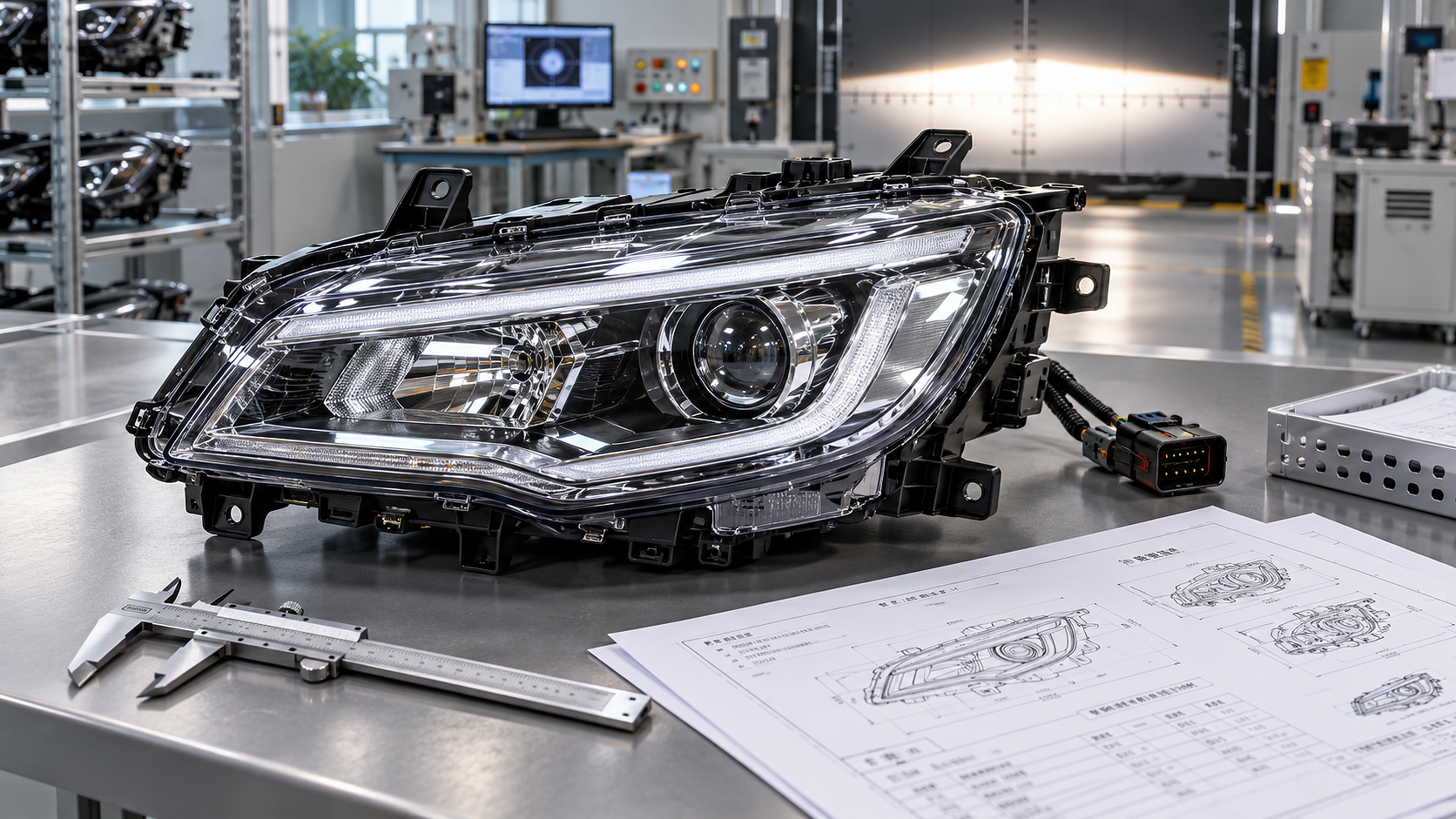
For procurement teams sourcing LED headlight assemblies Europe-wide, a competitive price means little if the units fail approval checks or cannot integrate with the intended vehicle. A lamp may bolt into place yet produce the wrong dipped-beam pattern, trigger diagnostic faults, or lose its adaptive functions. Those problems usually become expensive after the shipment has arrived.
The buying decision therefore needs two separate checks: whether the assembly has the appropriate approval for its intended use, and whether it fits the exact vehicle application mechanically, electrically, and functionally. Neither check replaces the other. Before comparing quotations, define the destination market, vehicle specification, and installation scope—and ask suppliers to prove their claims against that brief.
Define the application before requesting a price
“Fits this model” is not a purchasing specification. Within one model generation, a manufacturer may offer halogen, standard LED, adaptive LED, and matrix LED headlamps with different wiring, controllers, mounting details, and software dependencies. A facelift can introduce further changes even when the vehicle name remains unchanged.
A useful request for quotation should identify:
- Vehicle identity: make, model, platform, production dates, body style, and VIN or relevant equipment codes.
- Original lighting configuration: halogen, xenon, LED, adaptive, or matrix, including the original part numbers and supersessions.
- Destination: country of registration and whether the vehicle operates in right-hand or left-hand traffic.
- Purchase scope: left unit, right unit, matched pair, bare assembly, or assembly supplied with specified electronic modules.
- Commercial application: like-for-like repair, aftermarket replacement, fleet maintenance, or a conversion to a different lighting technology.
That last distinction matters. Replacing a damaged factory LED headlamp is not the same project as converting a halogen-equipped vehicle to LED assemblies. A conversion can affect wiring, levelling, controls, and the acceptability of the vehicle’s lighting installation.
Approval evidence: what a European buyer should actually verify
For road use in European markets applying UNECE lighting requirements, look for the relevant type-approval evidence—not simply a “European specification” description. An E-mark generally includes a capital E and a number identifying the country that granted the approval, together with approval details. That country identifier does not establish the country of manufacture or prove vehicle compatibility.
CE marking is not a substitute for the applicable automotive lighting type approval. Likewise, DOT/SAE markings alone do not establish suitability for a European road-use application. Where several markings appear on one assembly, establish which approval covers each supplied lighting function.
Understand the regulation references without demanding the wrong document
UN Regulation No. 149 addresses road illumination devices and brings together requirements previously covered by regulations including UN R112 and UN R123. Depending on the approval history and applicable transitional provisions, legitimate products may carry approvals under earlier regulations. An older regulation reference is therefore a reason to investigate, not an automatic rejection.
A multifunction headlamp may also incorporate daytime running lamps, position lamps, or direction indicators covered by relevant light-signalling approvals, including UN R148 or applicable predecessor regulations. UN R10 concerns electromagnetic compatibility where applicable; it does not demonstrate that the beam itself meets lighting requirements.
UN R48 addresses the installation of lighting and light-signalling devices on vehicles. This is the important distinction: an approved component does not automatically make every installation compliant. Obtain destination-specific advice when changing the original lighting configuration, especially where levelling, cleaning, or adaptive functions are involved.
Match the paperwork to the supplied part
Request clear photographs of the approval markings on an actual production unit, the relevant approval communication and extensions, and documentation linking the approved type to the supplier’s part number. Check that the manufacturer or approval holder, lamp type, lighting functions, and configuration are consistent.
A generic laboratory report, a certificate belonging to another lamp, or a cropped photograph of an E-mark is weak evidence. If the connection between the documents and the quoted assembly remains unclear, ask for clarification from the approval holder or verification through the relevant authority or technical service. Do this before releasing a production order.
Traffic-side beam patterns: a small wording error with large consequences
Most continental European markets use right-hand traffic, while markets such as the United Kingdom and Ireland use left-hand traffic. Dipped-beam distribution must suit the destination because its cutoff and light distribution are designed to illuminate the road without creating unacceptable glare for oncoming drivers.
Do not rely on “LHD” or “RHD” alone. Suppliers sometimes use these abbreviations to describe steering-wheel position rather than the approved traffic-side application. Put the requirement in plain language: “for right-hand traffic in Germany,” for example, and request confirmation against the assembly’s approval documentation.
Some headlamps provide a travel or tourist mode. That does not necessarily make them an approved permanent replacement for the opposite traffic system. Ask whether switching changes the full operating specification or only temporarily modifies the beam. The answer should come from technical documentation, not an assumption based on a dashboard setting.
Fitment is more than matching the outline of the housing
When buying LED headlight assemblies in Europe, separate compatibility into three layers. This prevents an attractive sample from receiving approval simply because its mounting points appear correct.
Matching connectors do not prove matching pin assignments. Nor does a seller’s “CAN bus compatible” claim explain which messages, diagnostic functions, or software versions are supported. Ask whether the assembly has been validated on the relevant vehicle configuration and what evidence supports that claim.
For intelligent lighting, check the wider system. Depending on the design, adaptive operation can rely on ride-height sensors, steering-angle information, cameras, dedicated controllers, or gateway configuration. A lamp cannot deliver functions that the vehicle lacks the hardware or software to support.
Establish exactly what “complete assembly” includes
One quotation may include LED drivers, control units, levelling motors, covers, seals, and brackets; another may require transferring serviceable components from the damaged lamp. Both may be described as complete.
Request an itemised inclusion list and identify every reused component. Confirm whether transferred or replacement modules require programming, pairing, parameterisation, or other manufacturer-specific procedures. For used or remanufactured units, also establish module identity, repair history, and any restrictions on reuse.
A housing-only price can be commercially sensible when the original electronics are known to be sound. It is a poor comparison against a fully populated unit when those electronics are damaged or unavailable.
Build the comparison around installed cost
The useful purchasing figure is not unit price but the cost of achieving a functioning, correctly aimed, acceptable installation. Separate predictable expenditure from unresolved risks rather than hiding both inside a low quotation.
- Supply cost: assemblies, required modules, freight, insurance, duties where applicable, and packaging.
- Installation cost: removal and refitting, access work, replacement brackets or seals, and any wiring changes.
- Commissioning cost: diagnostics, coding, parameterisation, beam aiming, and any required basic settings or calibration.
- Failure exposure: diagnostic labour, repeat installation, return freight, vehicle downtime, and warranty exclusions.
Keep headlamp aiming distinct from camera calibration. A replacement may require beam adjustment and a diagnostic procedure without requiring camera recalibration; other repairs or manufacturer instructions may make additional calibration necessary. Price the work specified for the exact vehicle, not a generic package.
For fleets and distributors, serviceability deserves its own line in the comparison. Can drivers or control modules be replaced separately? Are replacement brackets available? Is the warranty limited to supplying another unit, leaving removal and refitting costs with the buyer? These details often outweigh a modest difference in purchase price.
Use samples to test the supplier’s claims
For a new supplier or a substantial order, documentary review should lead to a controlled sample assessment. A successful sample does not replace approval evidence, but it can reveal mismatches that a catalogue will not show.
Record the sample’s part numbers, markings, module versions, and packaging condition. Inspect mounting tabs, sealing interfaces, vents, connectors, adjusters, and evidence of previous repair. Fit the sample to a representative vehicle with the specified equipment, then check operation, diagnostics, aiming, and relevant adaptive functions using suitable workshop procedures.
Thermal performance also matters. LED output and electronic reliability depend on heat management, so a quick illuminated bench demonstration proves little about sustained operation. Ask for relevant environmental, vibration, ingress, and thermal validation evidence tied to the supplied design. Do not treat an IP claim alone as proof of automotive durability.
Agree how moisture complaints will be assessed. Temporary misting can occur in vented headlamps, while persistent droplets or pooled water may indicate a problem. Warranty decisions should follow documented manufacturer criteria rather than an undefined promise that the lamp is “waterproof.”
Finally, require production deliveries to match the approved sample configuration. Changes to optical components, drivers, housings, or firmware should trigger review and, where relevant, confirmation that approval coverage remains valid.
Turn unresolved questions into purchase-order conditions
A procurement file should contain more than an email saying “compatible.” Attach the agreed vehicle applications, traffic-side specification, approval references, included components, installation dependencies, warranty terms, and return conditions to the order.
Three release gates keep the decision practical:
- Approval gate: the supplied type and lighting functions are supported by relevant, traceable approval evidence.
- Application gate: mechanical, electrical, and functional compatibility are confirmed for the intended vehicle configuration.
- Commercial gate: the installed-cost comparison includes commissioning, missing components, and realistic warranty exposure.
If a supplier cannot resolve a critical point, classify it as an open risk rather than silently accepting it. “Coding may be needed” is not a costed installation plan; “E-marked” is not a complete approval dossier.
The strongest purchase is not necessarily the cheapest assembly or the most elaborate matrix system. It is the unit whose approval, application, installation requirements, and after-sales responsibilities can all be explained before delivery. For buyers managing LED headlight assemblies across European markets, that clarity is what turns a competitive quotation into a defensible sourcing decision.