Industry Portal
Related News
- 00
0000-00
Pep Boys Road Report: Chicago Tops List as Southern Tire Repairs Rise - 00
0000-00
Forged Lightweight Alloy Wheels: How to Choose the Right Load Rating - 00
0000-00
Vehicle Chassis Lightweighting: Comparing Steel, Aluminum and Composites - 00
0000-00
Nissan and FOOD REBORN Develop Pineapple Leaf Fiber Body Panel - 00
0000-00
Vehicle Exterior Design Surfacing: From Concept Sketch to Class-A Model
Tags
Vehicle Chassis Lightweighting: Comparing Steel, Aluminum and Composites
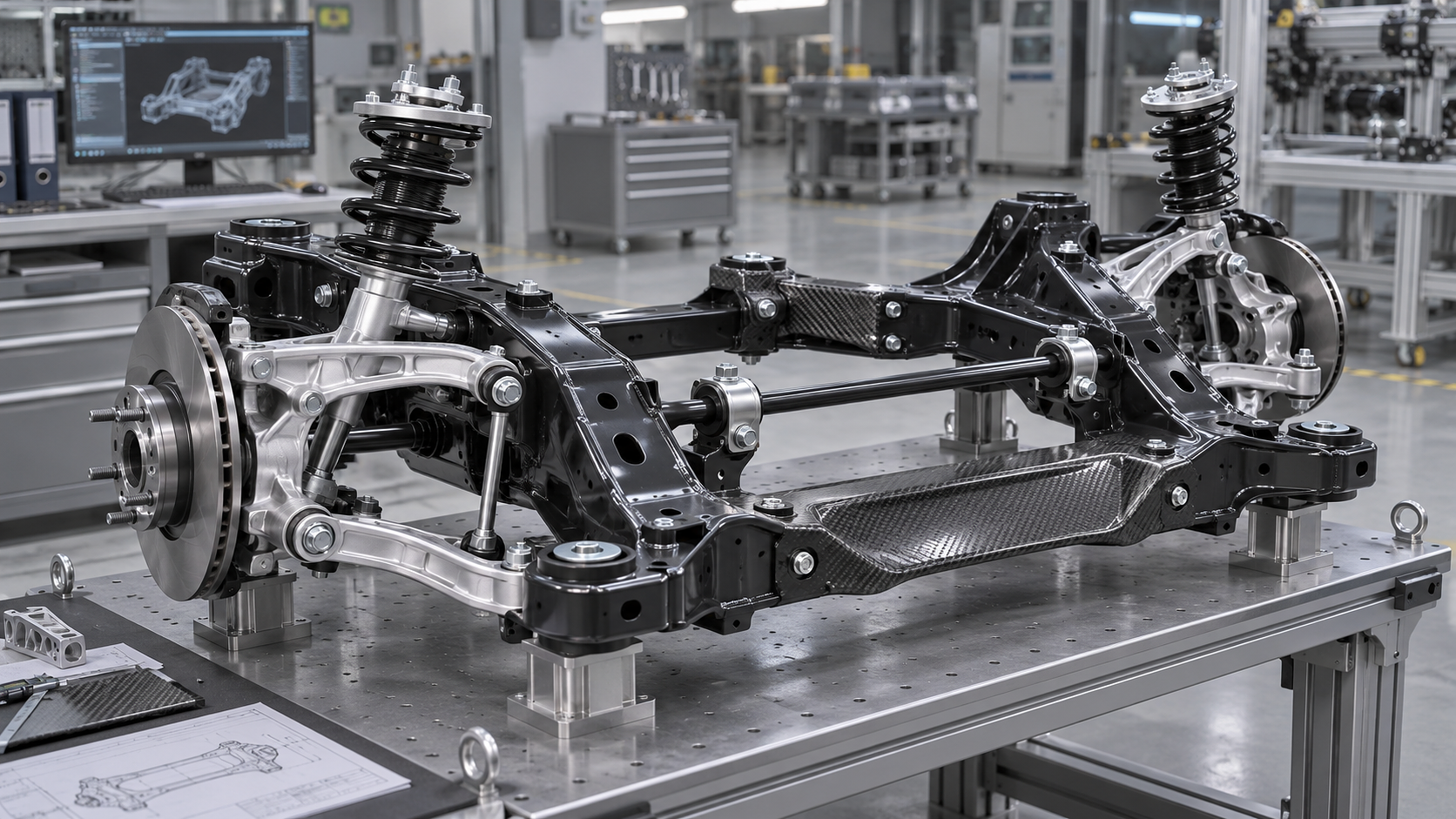
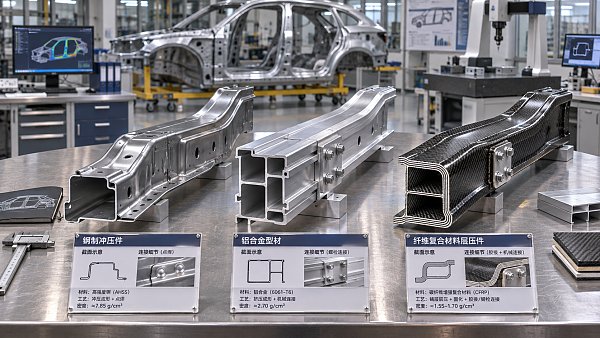
The most suitable vehicle chassis lightweighting solution depends on what limits the part: strength, stiffness, fatigue life, crash performance, cost or production capacity. High-strength steel is often the practical choice when cost and existing manufacturing infrastructure dominate. Aluminum can deliver meaningful mass savings where its larger sections and joining requirements fit the design. Composites can be attractive for selected components with clear load paths and demanding weight targets, provided their manufacturing and inspection needs are acceptable.
Comparing material density alone will not reveal the best option. A lighter material may need thicker walls, larger joints or additional reinforcement to meet the same requirements. The useful comparison is between complete designs that satisfy the same loads, durability targets and service conditions.
Start with the component, not the material
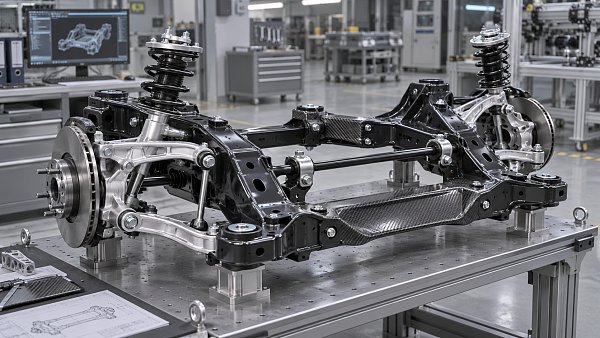
“Chassis” covers parts with very different jobs. A suspension control arm must withstand repeated loads and maintain wheel alignment. A subframe distributes suspension and powertrain loads into the body while influencing noise, vibration and harshness (NVH). A wheel must manage impact and fatigue loads while meeting dimensional, sealing and service requirements.
Those functions lead to different material choices. A stiffness-limited subframe may benefit from a section redesign that makes better use of available space. A compact bracket constrained by packaging may favor a higher-strength material because there is little room to increase its section size. A composite component may work well when loads follow predictable paths, but become more difficult to justify when it needs many metal inserts and complex joints.
Before comparing quotations or simulation results, define the boundary of the assessment: the component itself, its fasteners, joints, local reinforcements, protective treatments and any changes required in surrounding parts. Otherwise, a lighter individual component can appear more effective than it is at vehicle level.
Steel, aluminum and composites at a glance
Steel: a strong baseline, especially when the design can change
Steel remains competitive because it combines a broad range of grades with established forming, joining and supply chains. Advanced high-strength steels can allow thinner sections in parts governed by strength, provided the resulting geometry still meets stiffness, fatigue and crash requirements.
That distinction matters. Increasing steel strength does not automatically make a part stiffer. If deflection or vibration governs the design, reducing thickness may cause the component to miss its target even when its peak stress remains acceptable. Changes to section shape, local reinforcement or load paths may be more effective than a grade change alone.
Higher-strength grades can also introduce manufacturing trade-offs. Formability, springback, weld behavior and tooling wear vary by grade and process. For a control arm or subframe made at high volume, these effects influence scrap, dimensional consistency and total cost. Corrosion protection must cover edges, enclosed areas and joints, not just the visible surface.
Steel is often a sensible starting point for a cost-constrained program, a compact design with severe local loads, or a platform that can reuse existing processes. Its main disadvantage is that an optimized steel design may still be too heavy to meet an aggressive vehicle mass target.
Aluminum: mass savings depend on geometry and interfaces
Aluminum’s lower density makes it a strong candidate for chassis lightweighting, but a direct material substitution rarely captures its full value. Aluminum is less stiff than steel, so a stiffness-limited part often needs a larger section, thicker walls or a different geometry. Castings and extrusions can make those changes practical and may integrate features that would otherwise require separate steel pieces.
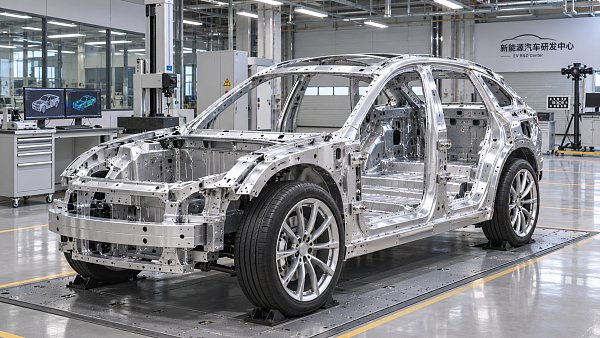
Consider a subframe as a design exercise. An aluminum concept could combine mounting features into cast nodes joined to extruded sections. Its mass advantage depends on the size of those sections, the joints between them, and the reinforcements needed at suspension and body mounts. It also depends on whether the available vehicle package leaves enough room for the new geometry.
Fatigue deserves attention because chassis parts see repeated road loads, including events that concentrate stress around holes, welds and abrupt changes in section. The alloy, manufacturing process, surface condition and joint design all affect performance. A static strength check alone is not enough to qualify a lighter part.
Mixed-material interfaces add another consideration. Where aluminum contacts steel or other dissimilar metals, moisture and road contaminants can promote galvanic corrosion. Coatings, isolation features, drainage and joint design must work together throughout the intended service life.
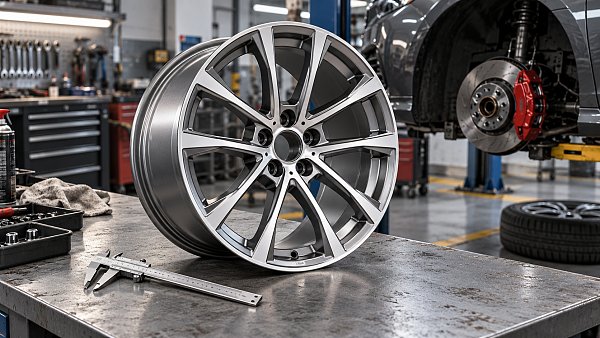
Aluminum wheels illustrate why component-level and vehicle-level thinking both matter. Reducing wheel mass can affect rotating and unsprung mass, while wheel geometry also affects airflow, brake cooling, impact performance and manufacturing cost. A lighter wheel design still needs to meet its full set of load and durability requirements; mass alone is not a purchase specification.
Composites: most useful when the load path is understood
Fiber-reinforced composites offer a different design approach. Their properties depend on the fibers, resin, orientation, manufacturing process and local construction. By placing fibers in the directions that carry load, a designer can create an efficient structure without distributing material equally in every direction.
That flexibility is valuable when the major loads are predictable and the part geometry lets fibers follow them. It is less straightforward around concentrated attachment loads, tight bends, cut edges and regions exposed to impact. A composite suspension component, for example, may still need metal inserts or other reinforced attachment features. Their mass, manufacturing steps and durability must be included in the comparison.
Composites also require a different approach to damage management. An impact can create internal damage that is not obvious from a surface inspection. The design and validation plan should therefore address expected impact events, inspection methods and the residual load capacity required after damage. Temperature, moisture, road chemicals and manufacturing variation may also affect the properties used in analysis.
Production volume can change the decision. Some processes suit complex, lower-volume parts; others are intended for faster production but require different tooling and material forms. A composite concept is more compelling when its mass benefit remains substantial after accounting for inserts, joining, inspection, scrap and the chosen production process.
Compare complete designs under the same loads
A credible assessment begins with a common set of load cases. These should cover normal operation, severe road events, repeated loading, relevant crash interactions and environmental exposure. The alternatives should also share the same targets for wheel alignment, deflection, NVH, packaging and service life.
Pay particular attention to the following areas when comparing concepts:
- Stiffness and strength: Identify which requirement controls each region. A stronger material may allow less material in one area while stiffness still dictates the overall section.
- Fatigue and local details: Compare stress concentrations at welds, holes, transitions, inserts and mounting points, not just stresses in the main member.
- Crash and overload behavior: Assess how each design deforms or fails within the vehicle structure. A component that is strong in isolation can change how loads pass into adjacent parts.
- Joints and corrosion: Include fasteners, adhesives, isolation, sealing and surface treatments, along with their effects on assembly and service.
- Dimensional control: Consider how forming, casting, curing or joining affects suspension mounting accuracy and production variation.
- Validation: Use analysis to narrow options, then assess representative parts and joints under the required structural, durability and environmental conditions.
Material data must match the form being evaluated. A property taken from a flat steel sheet, an aluminum test specimen or a composite laminate does not automatically represent a welded assembly, a complex casting or a locally reinforced joint. Simulation assumptions should reflect the manufacturing process and be checked against representative physical tests.
Put cost, sourcing and service into the same decision
The lowest material price per unit of mass does not necessarily produce the lowest-cost chassis. Compare purchased material, yield, tooling, cycle time, joining, finishing, inspection and assembly. Account for expected production volume and the cost of changing equipment or supplier processes. A part that integrates several functions may reduce assembly work, but a complex integrated part can also be more expensive to replace after damage.
Supplier capability matters as much as the proposed material. For cast aluminum, ask how the supplier controls critical features and demonstrates consistent quality. For high-strength steel, examine forming and joining capability. For composites, examine control of fiber placement, curing, inserts and inspection. In each case, the useful evidence is a process and validation plan tied to the specific part, rather than a general claim about the material.
Service requirements should be established before the design is frozen. Can the component be inspected for relevant damage? Is repair permitted by the vehicle manufacturer’s service strategy, or is replacement required? Are replacement procedures, corrosion protection and parts availability compatible with the intended market? These questions can affect both ownership cost and the choice of architecture.
When a mixed-material chassis makes sense
There is no requirement for every chassis component to use the same material. A vehicle can use a steel subframe, aluminum suspension components and wheels, and a composite part where its directional properties solve a specific problem. This approach allows each component to be selected against its own loads and constraints.
The trade-off is interface complexity. Different thermal behavior, joining methods, corrosion risks and recycling streams must be managed across the assembly. The most efficient material for an isolated part may lose its advantage if it creates heavy joints or expensive changes elsewhere.
For an initial sourcing decision, request competing concepts against the same component specification and comparison boundary. Ask for mass including attachments, the governing load cases, manufacturing assumptions, a validation plan and a cost breakdown at the intended volume. The preferred solution is the one that meets those requirements with a credible production and service path—not simply the one with the lowest calculated material density.
Have questions about this sector analysis, or seeking best practices specific to your niche? Drop us a line below and let the senior consultants at AEVS assist you.
Related News
 Latest Sector NewsVehicle Chassis Lightweighting: Comparing Steel, Aluminum and CompositesExplore vehicle lightweighting solutions for chassis design. Compare steel, aluminum and composites to balance mass, durability, cost and production needs.MORE+
 Latest Sector NewsVehicle Exterior Design Surfacing: From Concept Sketch to Class-A ModelVehicle exterior design surfacing turns sketches into Class-A models. Explore the workflow, surface quality checks, and engineering decisions behind production-ready designs.MORE+
 Latest Sector NewsChoosing OEM-Quality Replacement Tires: Size, Load and Speed RatingsFind replacement tires OEM quality shoppers can trust. Learn how to match tire size, load index, and speed rating to your vehicle and driving needs.MORE+
 Latest Sector NewsChina Seeks Input on Vehicle Modification Rules, Including Wheel and Tire RegistrationChina's proposed vehicle modification rules could require wheel and tire change registration. Discover what the draft means for owners and aftermarket businesses.MORE+
 Latest Sector NewsChina’s NEV Export Surge Opens Opportunities for Quiet Tire SuppliersChina’s NEV export surge creates potential opportunities for quiet tire suppliers. Explore the role of grip, sourcing decisions and trade measures.MORE+
 Latest Sector NewsChoosing a Photoelectric Sensor OEM Supplier: Quality and Lead TimeChoose a photoelectric sensors OEM supplier with confidence. Compare quality controls, lead times and total costs to reduce supply risks and protect production.MORE+
 Latest Sector NewsNatural Rubber Prices Fluctuate as Chinese Tire Buying Provides SupportNatural rubber prices face supply pressure as Chinese tire buying provides support. Explore the latest market trends and what they mean for buyers.MORE+
 Latest Sector NewsVehicle Lightweighting Materials: Comparing Steel, Aluminum and CompositesCompare vehicle lightweighting materials, including steel, aluminum and composites, to find the right balance of mass, cost, durability and manufacturing.MORE+
 Latest Sector NewsVehicle Lightweighting Solutions: Balancing Weight, Safety and PerformanceExplore vehicle lightweighting solutions performance, compare materials and manufacturing options, and discover how to balance weight savings with safety, durability and cost.MORE+
 Latest Sector NewsMichelin Showcases 75% Renewable-Material Tire and Touch Intelligence at CIIEMichelin showcases a 75% renewable-material tire and Touch Intelligence at CIIE. Discover how these innovations aim to address EV performance and sustainability.MORE+
 Latest Sector NewsEU Launches Safeguard Investigation Into Hybrid Vehicle ImportsEU hybrid vehicle import investigation: explore potential safeguard measures, implications for exporters and what to watch in official updates.MORE+
 Latest Sector NewsChoosing 19-Inch Low-Pressure Cast Wheels: Fitment, Load Rating and WeightChoosing 19 inch low pressure cast wheels? Learn how to check fitment, load ratings, brake clearance and weight before you buy.MORE+
 Latest Sector NewsUSTMA 2025 Scrap Tire Report: 79% Reached End-Use MarketsUSTMA 2025 Scrap Tire Report: 79% reached end-use markets. Explore what shifting recycling demand, rising exports and stockpile cleanup mean for the industry.MORE+
 Latest Sector NewsBeam vs. Conventional Wiper Blades: Is the Upgrade Worth It for Your Car?Are beam auto wipers worth the upgrade? Compare winter performance, highway visibility, fitment, and cost with conventional blades to find the right choice for your car.MORE+
 Latest Sector NewsNinth CIIE Welcomes First Exhibits, Michelin Sustainable Tire Set for Asian DebutMichelin’s sustainable tire, made with 75% renewable and recycled materials, is set for its Asian debut at the ninth CIIE. Explore key material claims and what buyers should verify.MORE+
 Latest Sector NewsNHTSA Proposes FMVSS 108 Update for Automated Vehicle LightingExplore NHTSA’s proposed FMVSS 108 update for automated vehicle lighting and discover what greater design flexibility could mean for ADS developers and lighting suppliers.MORE+
 Latest Sector NewsReplacement Headlight Assemblies for Sedans: Fitment Checks Before You BuyBuying a headlight assembly for sedans? Check VIN fitment, lighting technology, connectors, and beam patterns before you order. Avoid costly returns with our practical buying guide.MORE+
 Latest Sector NewsPirelli and BKT Reach Agreement to Enter India's Passenger Car Tyre MarketPirelli and BKT plan passenger car tyre production in India, targeting up to 800,000 tyres by 2030. Explore what the deal could mean for buyers, suppliers and premium tyre sourcing.MORE+
 Latest Sector News2026 NEV Exterior Compliance: Key Standards for EU and China Market AccessWhich exterior standards matter most for the NEV industry in 2026? Explore EU and China rules for lighting, glazing, tires and more to close compliance gaps and plan market access.MORE+
 Latest Sector NewsTire Makers Face Profit Pressure as Raw Material Costs Outpace Price HikesTire makers face profit pressure as raw material costs outpace 2%–5% price hikes. Discover why higher tire prices may not translate into stronger margins.MORE+
 Latest Sector NewsECE-Compliant Fog Lamps: Which Approval Marks and Test Reports Should You Check?Evaluating ECE compliant lighting fog lamps? Learn which E-marks, UN approvals and test reports to check, avoid costly compliance gaps and qualify suppliers with confidence.MORE+
 Latest Sector NewsVehicle Perception System Accuracy: Which Metrics Matter in Rain and Fog?Compare vehicle perception systems accuracy in rain and fog. Discover the recall, tracking, and latency metrics that expose hidden risks and help you choose a more reliable system.MORE+
 Latest Sector NewsECE-Compliant Lighting for Commercial Vehicles: Approval and Installation ChecksExplore ECE compliant lighting commercial vehicles can rely on. Learn key approval, installation, aiming and wiring checks to reduce compliance risks before release.MORE+
 Latest Sector NewsNEV Industry Standards in China: Which Battery Safety Tests Are Required?Explore NEV industry standards in China, required battery safety tests, and GB 38031 updates. Learn how to verify compliance evidence and prepare for confident market-entry decisions.MORE+
 Latest Sector NewsAutomotive Exterior Lighting Systems: Lamp Types, Functions, and PlacementExplore the automotive exterior lighting system: lamp types, functions, and placement. Learn key differences, spot common issues, and make smarter lighting replacement choices.MORE+
 Latest Sector NewsWhere exterior systems engineering prevents late-stage automotive reworkExterior systems engineering automotive insights reveal how integrated reviews of wheels, lighting, roofs, and sensors prevent costly late-stage rework.MORE+
 Latest Sector News2026 urban bumper trends focus on low-speed impact resistanceUrban vehicle bumper design trends 2026 impact resistance: explore smarter materials, sensor protection, repairability, and low-speed resilience for city vehicles.MORE+
 Latest Sector NewsHow to Evaluate an Automotive Exterior Systems Manufacturer for OEM Program SupplyAutomotive exterior systems manufacturer evaluation guide for OEM programs—assess engineering, quality, compliance, supply resilience, and total lifecycle risk.MORE+
 Latest Sector NewsSelecting NEV Exterior Components for Aerodynamics, Durability, and EV IntegrationNEV exterior components selection guide: balance aerodynamics, durability, NVH, smart lighting, sensors, and EV integration for reliable vehicle performance.MORE+
 Latest Sector NewsSupplier Capability Evaluation Matrix: Criteria and Weighting for Reliable SourcingSupplier capability evaluation matrix guide: build weighted, evidence-based criteria for quality, compliance, capacity, delivery resilience, and cost control.MORE+
 Latest Sector NewsHow to Select NVH Control Materials for Automotive Panels and Powertrain SystemsNVH control materials for automotive panels and powertrain systems: learn how to balance damping, absorption, barriers, durability, and weight for a quieter vehicle.MORE+
 Latest Sector NewsHow to Evaluate a Photoelectric Sensing Supplier for Industrial Automation ProjectsChoose the right photoelectric sensing supplier for industrial automation. Compare technical fit, lifecycle cost, support, quality control, and supply reliability.MORE+
 Latest Sector NewsDOT-Compliant Truck Lighting: A Practical Guide to FMVSS 108 RequirementsDOT compliant truck lighting guide: understand FMVSS 108 requirements, LED replacements, lamp placement, conspicuity tape, and practical inspection steps.MORE+
 Latest Sector NewsOptical Sensing Systems in Europe: Key Selection Criteria for Industrial BuyersOptical sensing systems Europe: learn how industrial buyers compare accuracy, integration, durability, and lifecycle support to choose reliable solutions that reduce downtime.MORE+
 Latest Sector NewsWhat Smart Mobility Europe Means for Urban Fleets and EV Infrastructure PlanningSmart mobility Europe is reshaping urban fleets and EV infrastructure planning with smarter charging, fleet design, and scalable operations.MORE+
 Latest Sector NewsHow Automotive Sensor Systems Improve ADAS Performance and Vehicle SafetyAutomotive sensor systems improve ADAS with better detection, sensor fusion, and safer real-world driving. Learn how they enhance vehicle safety, lighting, and NEV performance.MORE+
 Latest Sector NewsAutomotive Sensor Systems and ISO 26262: What to Review for Functional Safety ComplianceAutomotive sensor systems ISO 26262 review: learn what to check for functional safety compliance, key failure risks, validation gaps, and practical sign-off steps for safer vehicle sensor integration.MORE+
 Latest Sector NewsPhotoelectric Sensors Supplier Selection: Key Sensing Range and Output FactorsPhotoelectric sensors supplier selection starts with real sensing range and output fit. Learn how to compare reliability, integration, and durability for smarter, lower-risk system performance.MORE+
 Latest Sector NewsPhotoelectric Sensing Failures in Dusty Lines: Causes, Fixes, and PreventionPhotoelectric sensing failures on dusty lines? Discover the real causes, practical fixes, and prevention strategies to reduce false triggers, missed detections, and costly downtime.MORE+
 Latest Sector NewsDynamic Driving Perception Explained: Core Functions, Benefits, and LimitsDynamic driving perception explained: discover its core functions, real-world benefits, and key limits in modern vehicles. Learn how dynamic driving perception improves safety, comfort, and smart mobility.MORE+