Industry Portal
Related News
- 00
0000-00
China’s NEV Export Surge Opens Opportunities for Quiet Tire Suppliers - 00
0000-00
Choosing a Photoelectric Sensor OEM Supplier: Quality and Lead Time - 00
0000-00
Japan's Koito Studies Chinese Car Lamps in Bid to Cut Costs 30% - 00
0000-00
Choosing EV Wheels: How Size, Load Rating and Aerodynamics Affect Range - 00
0000-00
Japan's Koito Studies Chinese Automakers' Vehicle Lighting Products
Choosing an Aftermarket Wheels Manufacturer: Quality and Lead Times
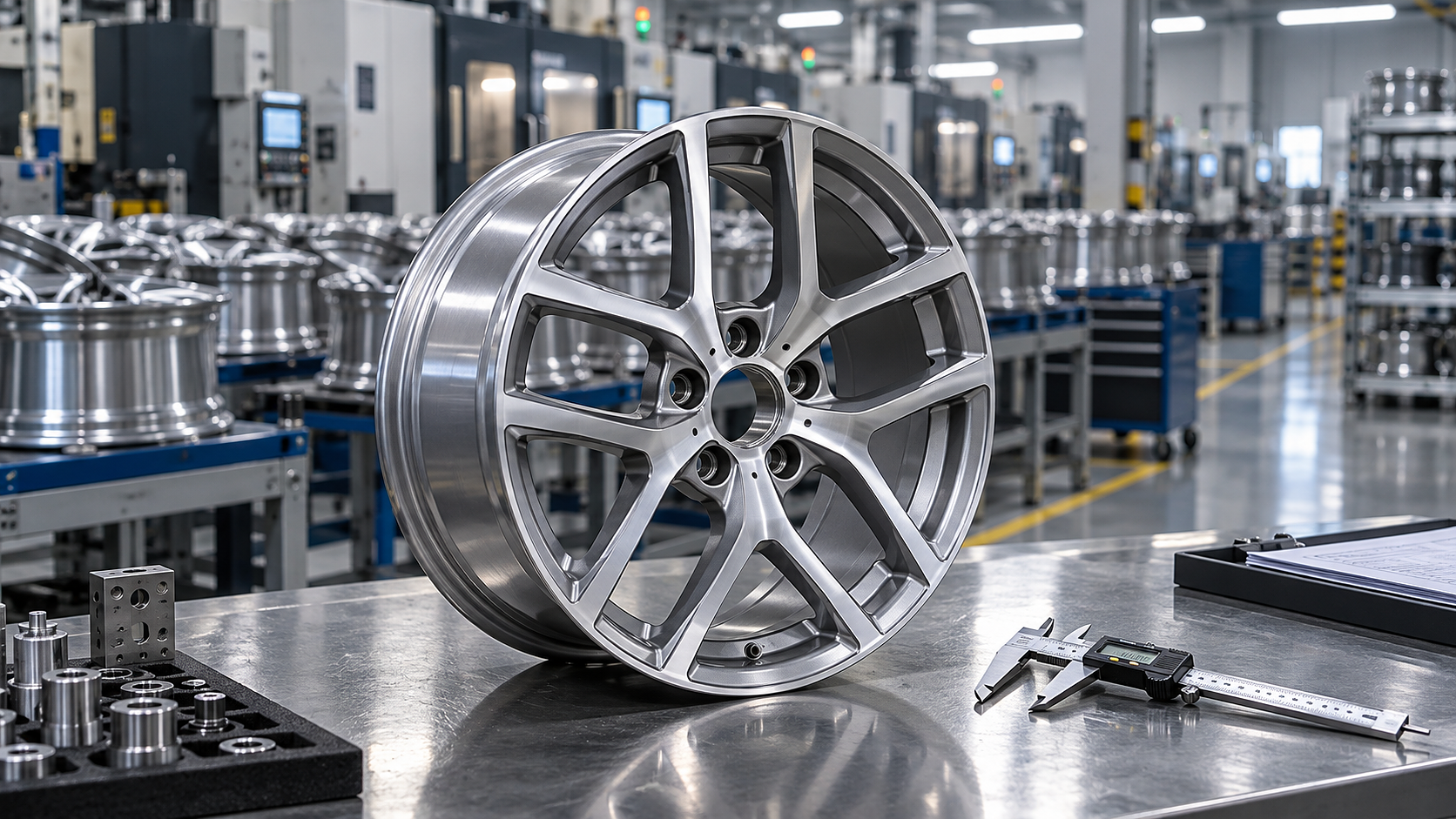
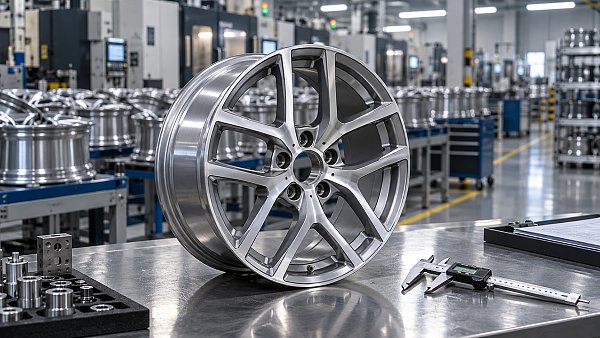
The lowest wheel price is not necessarily the lowest procurement cost. A supplier that cannot demonstrate fitment control, consistent testing and a credible production schedule can expose an order to rejected stock, delayed launches and expensive warranty claims. The most useful comparison is therefore between offers for the same technical specification, delivery commitment and level of quality assurance.
Choosing an aftermarket wheels manufacturer requires particular care because a wheel’s appearance reveals little about its fatigue resistance or manufacturing consistency. A convincing sample is valuable, but it does not establish how subsequent batches will be controlled—or whether the supplier has reserved the capacity to deliver them.
Start with a specification that suppliers can actually quote
Quotes become difficult to compare when one supplier prices a wheel design while another prices a complete, validated application. Before requesting prices, define the intended vehicle applications and destination markets, along with the wheel diameter, width, offset, bolt pattern, center bore, load rating and finish. State whether the order includes center caps, valves, mounting hardware, packaging and application documentation.
Fitment involves more than matching the bolt pattern. Offset and wheel width affect the wheel’s position relative to suspension components, bodywork and brakes. Center-bore and mounting-seat requirements affect how the wheel locates and how its fasteners clamp it. A design that fits one brake package may not clear another on the same vehicle model. Approval should therefore identify the vehicle variants and conditions covered rather than rely on a broad model-name claim.
The required load rating also needs a defined basis. Vehicle mass alone does not establish the appropriate wheel rating: axle loads, applicable rules and the supplier’s intended application all matter. This is particularly important for heavier vehicles, including some electric models. Require the supplier to state the rated load for each part number and explain how it was established.
Locking these details early reduces an important source of delay: design changes after tooling, testing or production has begun. It also makes commercial differences visible. A quote that excludes application verification or production tooling is not equivalent to one that includes them.
Judge manufacturing methods in the context of the finished wheel
Aftermarket alloy wheels can be produced by several routes, including low-pressure casting, flow forming and forging. The process influences tooling, design possibilities and cost, but the label alone is not a quality guarantee.
Low-pressure casting can support repeat production of complex designs, with quality depending on factors such as casting control, heat treatment where specified, machining and inspection. Flow forming works part of a cast wheel—typically the rim—under heat and pressure; it should not be treated as evidence that the entire wheel has the same structure as a forged wheel. Forging shapes metal under compressive force, but a forged claim still needs to be supported by the actual process, material, design and test evidence.
The commercial implication is straightforward: compare the performance and controls behind each proposed wheel, not just the manufacturing label. A lighter design is not automatically preferable if the required load capacity, impact performance or application coverage is unclear. Equally, a heavier wheel does not prove that it is stronger.
Ask which operations take place at the named factory and which are subcontracted. Casting or forging, heat treatment, machining, painting and testing may involve different sites. Subcontracting is not inherently a defect, but it introduces handoffs that should be controlled through agreed specifications, traceability and change approval.
Separate test evidence from general quality claims
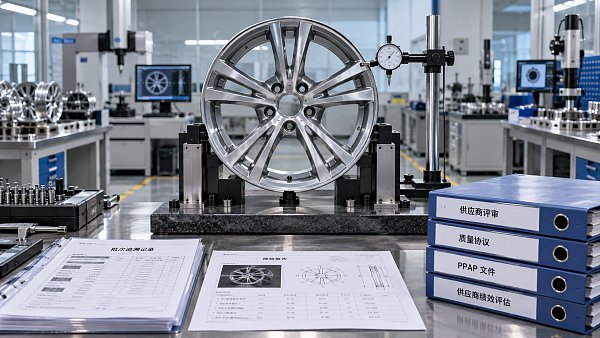
A factory certificate or a test report for a similar-looking wheel does not establish that the wheel being purchased has passed the required tests. Request evidence that connects the specific design and its relevant variants to the stated load rating, manufacturing process and intended market.
Wheel evaluation commonly includes impact and fatigue testing, as well as dimensional and finish checks. The applicable test methods and acceptance requirements depend on the market and application. For example, UNECE Regulation No. 124 concerns replacement wheels for certain vehicles in markets applying that regulation; its applicability depends on the product, vehicle and jurisdiction. JWL and VIA markings are associated with Japanese wheel requirements and testing arrangements, but their relevance and the documentation required should be checked against the particular product and sales market. A generic claim of “international certification” is not a substitute for that assessment.
When reviewing a report, check:
- The wheel identification, dimensions, offset and load rating against the item being quoted.
- The test standard and revision, test conditions, results and any limitations stated in the report.
- The identity of the testing organization and whether its scope is appropriate to the tests claimed.
- Whether the report covers the proposed design and manufacturing configuration, rather than an unrelated sample.
Some design families may be assessed using representative variants under an applicable approval scheme or agreed test plan. The basis for extending results to other sizes, offsets or load ratings should be explicit. A different finish alone may not have the same implications as a change to spoke geometry, material or heat treatment, but changes should be reviewed rather than assumed inconsequential.
For repeat orders, ask how production batches are checked against the approved design. Useful evidence includes inspection plans, dimensional records, process-control limits and a system for tracing finished wheels to production batches and material records. These controls do not replace product testing; they help maintain consistency between tested samples and delivered goods.
Inspect the quality risks that affect cost after delivery
Cosmetic defects are visible, but they are not the only reason stock may be rejected. Machining errors can affect mounting surfaces, bolt holes or tire seating. Casting defects, inappropriate heat treatment or uncontrolled process changes can affect structural performance. Coating defects can lead to corrosion or finish complaints even when a wheel is dimensionally acceptable.
Agree on measurable acceptance criteria before production. They should cover critical dimensions and tolerances, surface appearance, packaging condition, identification marks and documentation. An approved physical finish sample can help resolve disputes over color, gloss and texture, but it should be paired with written limits for defects and an agreed inspection method.
Clarify who performs pre-shipment inspection, how samples are selected and what happens when a lot fails. Sampling can identify some nonconformities; it cannot prove that every wheel is sound. The supplier should explain its own in-process controls as well as the final inspection available to the buyer.
Traceability is especially important when a problem appears after stock has been distributed. A batch identifier that links wheels to production and inspection records can narrow the affected population. Without it, containment may require a wider stock withdrawal because the affected production cannot be separated reliably.
Turn the quoted lead time into a delivery schedule
A single figure such as “production lead time” can conceal several dependencies. Ask when the clock starts: purchase order, deposit receipt, final artwork approval, tooling approval or acceptance of a pre-production sample. Then separate the milestones for tooling, sample manufacture, testing, production, finishing, inspection and shipment readiness.
For a new design, sample approval and testing can be on the critical path. If a test fails or fitment changes, tooling or design revisions may be needed before the production slot can be used. A repeat order for an approved wheel may follow a shorter route, but finish availability, raw material supply, capacity and packaging can still affect timing. Do not apply a repeat-order lead time to a new design without identifying what work has been removed.
Capacity claims also need context. A factory’s total monthly output is less useful than confirmation that the required equipment, finish line and production slot are available for the specific order. Ask whether the schedule assumes minimum batch sizes, a particular mix of wheel dimensions or consolidated shipping. A small order split across many sizes and finishes can create more changeovers and partial deliveries than the same quantity concentrated in a few part numbers.
Distinguish the date the goods are ready at the factory from the date they are expected at the destination. The latter includes transport, export and import procedures, and any inspection or release requirements. Define the agreed Incoterms® rule and named place, and identify which party arranges freight, insurance and customs clearance. This makes it easier to allocate responsibility when the factory meets its date but the goods arrive late.
Compare landed cost, not just the wheel price
A practical comparison should put each offer on the same basis: identical part numbers, quantities, finish, packaging, test obligations, delivery terms and payment conditions. The calculation can then include the costs that sit outside the quoted unit price:
- Design work, tooling ownership, tooling maintenance and any charge for design changes.
- Sample production, testing, approval documentation and independent inspection.
- Freight, insurance, duties, taxes where applicable, customs handling and inland transport.
- Inventory carrying costs, minimum order quantities and the cost of ordering by size or finish.
- Expected costs associated with defects, returns, replacement stock and warranty administration.
Warranty exposure deserves particular attention because a unit-price difference is easy to see while claims costs depend on the agreed remedy. Establish who evaluates a claim, what evidence is needed, whether the remedy is credit or replacement, and who pays for collection, testing and freight. For safety-related concerns, the contract should also address escalation, containment and cooperation with any applicable notification or recall obligations.
Payment terms affect risk as well as cash flow. A substantial tooling payment may be reasonable for a new design, but the agreement should identify who owns the tool, where it is held, how it is maintained and what happens if production moves. If the buyer funds testing, specify who can use the reports and whether the documentation remains accessible for future compliance or warranty questions.
Make supplier approval conditional on repeatable delivery
An initial order provides a basis for evaluating communication and process discipline, but approval should not rest on a sample alone. Tie production release to written approval of the final drawing, fitment scope, finish standard, test evidence and packaging. Record any deviations before shipment rather than accepting undocumented substitutions.
For ongoing supply, require advance notice and approval of changes that could affect the agreed product: manufacturing site, critical subcontractor, material specification, tooling, process or design. The agreement should define which changes trigger renewed testing or customer approval. Without change control, a report that was relevant at qualification may no longer describe the delivered wheel.
Delivery performance should be measured against the promised milestone, not an ambiguous order date. Track factory-ready dates, complete versus partial shipments, inspection failures and the causes of schedule changes by part number. This distinguishes a genuine capacity problem from delays caused by late specification approval or a missing customer decision.
The strongest offer is the one that makes both quality and timing verifiable. Where a supplier cannot connect the quoted part number to its test evidence, explain its production route or commit to a schedule with clear dependencies, a lower price transfers uncertainty rather than removing cost.
Have questions about this sector analysis, or seeking best practices specific to your niche? Drop us a line below and let the senior consultants at AEVS assist you.
Related News
 Commercial InsightsChoosing a Smart Optical Systems Manufacturer: Capabilities and Quality ChecksChoose a smart optical systems manufacturer with confidence. Compare automotive capabilities, quality checks, compliance, and total program costs.MORE+
 Commercial InsightsChoosing an Aftermarket Wheels Manufacturer: Quality and Lead TimesChoosing an aftermarket wheels manufacturer? Compare quality controls, test evidence, lead times and landed costs to source with confidence.MORE+
 Commercial InsightsLow-MOQ Private Label Tires: How to Evaluate Suppliers and CostsPrivate label tires low MOQ: discover how to compare suppliers, calculate landed costs, verify compliance, and launch your tire brand with confidence.MORE+
 Commercial InsightsEvaluating Automotive Solution Suppliers: What to Ask Customer ReferencesAutomotive solution reference buyers: discover what to ask customer references to uncover quality risks, verify delivery claims, expose hidden costs, and choose suppliers with confidence.MORE+
 Commercial InsightsBuying LED Headlight Assemblies in Europe: Approval and Fitment ChecksSourcing LED headlight assemblies Europe-wide? Discover key approval, beam pattern and vehicle fitment checks to avoid costly mistakes and buy with confidence.MORE+
 Commercial InsightsChoosing a Precision Forging Supplier: Tolerances, Traceability, and Lead TimesChoose a precision forging supplier with confidence. Learn how to verify tolerances, traceability, and lead times to reduce sourcing risks and secure reliable production.MORE+
 Commercial InsightsOver 200 Taiwan Auto Parts Suppliers Target U.S. Buyers at AAPEX 2026Explore 200+ Taiwan auto parts suppliers at AAPEX 2026 in Las Vegas, November 3–5. Discover headlights, collision parts and smart aftermarket solutions for U.S. buyers.MORE+
 Commercial InsightsChoosing a Smart Headlight Distributor: Fitment, Compliance, and Warranty SupportChoose a smart headlights distributor with confidence. Learn how to verify fitment, compliance, and warranty support to reduce costly returns and compare true installed costs.MORE+
 Commercial InsightsMichelin Defender LTX Platinum Tops 2026 Truck and SUV Tire Mileage RankingMichelin Defender LTX Platinum leads the 2026 truck and SUV tire mileage ranking with over 104,000 miles in Treadwell testing. Discover what this means for long-term tire value.MORE+
 Commercial InsightsAluminum Price Fluctuations: Fixed vs. Indexed Supply ContractsNavigate the raw material cost fluctuations aluminum buyers face. Compare fixed vs. indexed contracts, uncover hidden risks, and choose supply terms that protect your margins.MORE+
 Commercial InsightsAutomotive Product Comparison Charts: How Buyers Can Compare Specs, Cost, and FitAutomotive product comparison chart guide for buyers to evaluate specs, total cost, compliance, supplier capability, and vehicle fit for smarter sourcing decisions.MORE+
 Commercial InsightsVan Tire Comparison: Which Specifications Protect Delivery Fleet Uptime?Which commercial van tires should a delivery fleet be comparing when uptime is the governing constraint? Compare load, casing, tread, wet grip, and supply to reduce downtime.MORE+
 Commercial InsightsWhen Does a New Fleet Tire Supplier Repay the Loss of Fitment Data?Changing supplier would cost us a season of fitment data—learn which fleet tire specifications justify switching across 60 vans, from load capacity to wear, wet grip, and EV efficiency.MORE+
 Commercial InsightsQualifying Imported Tires: A Buyer Checklist for Testing, Traceability, and CustomsQualifying imported tires made practical: use this buyer checklist to verify testing, traceability, labeling, and customs documents before ordering.MORE+
 Commercial InsightsHow to Vet a Tire Compliance Supplier for Documentation, Testing, and Recall RiskTire compliance supplier vetting made practical: evaluate documentation, testing controls, traceability, and recall readiness to reduce safety and market-entry risk.MORE+
 Commercial InsightsWhat Supplier Risks Should NEV Buyers Check Before Part Approval?How can vehicle aesthetics be improved without increasing drag? Discover essential NEV supplier-risk checks for traceability, change control, compliance, capacity, and reliable part approval.MORE+
 Commercial InsightsHow Do ECE, DOT, and CCC Rules Differ for Exterior Components?How do ECE, DOT, and CCC rules differ for exterior components? Compare approval, testing, labeling, and compliance strategies to speed global market access.MORE+
 Commercial InsightsHow to Evaluate a Low-Pressure Casting Manufacturer for Automotive Quality PartsLow-pressure casting manufacturer evaluation guide for automotive quality parts—compare process control, tooling, traceability, certifications, capacity, and total cost before sourcing.MORE+
 Commercial InsightsAn automotive supplier assessment that reveals quality-system riskAutomotive supplier assessment insights that uncover quality-system risks, strengthen traceability, and protect safety, compliance, and supplier performance.MORE+
 Commercial InsightsHow to verify automotive supplier capacity before a production ramp-upAutomotive supplier capacity verification: assess bottlenecks, tooling, quality yield, sub-tier supply, and recovery plans before production ramp-up.MORE+
 Commercial InsightsNEV configuration features that matter most for long-term reliabilityWhat are the most reliable NEV configuration features? Explore durable wheels, EV tires, lighting, sensors, sunroofs, and service-ready design for lasting confidence.MORE+
 Commercial InsightsTyre Retreading Machine Inspection Before Reconditioning a Used UnitTyre retreading machine inspection guide: assess safety, structure, controls, heat, pressure and vacuum systems before reconditioning a used unit.MORE+
 Commercial InsightsAutomotive Exterior and Vision Systems: Supplier Qualification ChecklistAutomotive Exterior & Vision Systems procurement checklist: qualify suppliers for sunroofs, wheels, tires, LED lamps, and sensors with confidence.MORE+
 Commercial InsightsAutomotive Component Sourcing in China: How Buyers Verify Quality, Cost, and Supply RiskAutomotive component sourcing China: learn how to verify supplier quality, total landed cost, compliance, and supply risk for reliable wheels, tires, lighting, and EV components.MORE+
 Commercial InsightsHow to Evaluate a Replacement Tire Manufacturer for Fleet Uptime and Cost ControlReplacement tires manufacturer evaluation guide for fleets: compare uptime, cost per kilometer, durability, supply reliability, and pilot performance.MORE+
 Commercial InsightsVehicle Lightweighting for Automotive Design: Balancing Mass, Safety, and CostVehicle lightweighting for automotive design: explore practical strategies to balance mass, EV range, safety, durability, cost, and smart exterior system performance.MORE+
 Commercial InsightsPrivate Label Tire Export: Evaluating Suppliers, Compliance, and Landed CostPrivate label tires export guide: evaluate suppliers, compliance, quality control, warranty terms, and landed cost to build a profitable, reliable tire brand.MORE+
 Commercial InsightsHow to Evaluate a Vehicle Exterior Systems Manufacturer for OEM ProgramsVehicle exterior systems manufacturer selection can make or break OEM programs. Learn how to assess engineering, quality, cost, compliance, and launch readiness before sourcing.MORE+
 Commercial InsightsWhich Tire Compliance Standards Matter Most for Road Safety and Market Access?Automotive compliance standards tires teams must track most: ECE, DOT, labeling, and production controls. Learn what protects road safety, avoids recalls, and secures market access.MORE+
 Commercial InsightsWhat Determines Automotive Vision Systems Accuracy in ADAS Detection?Automotive vision systems accuracy depends on optics, calibration, latency, and environmental robustness. Learn what truly drives reliable ADAS detection in real-world conditions.MORE+
 Commercial InsightsHow to Evaluate a Precision Forging Supplier for Complex Auto PartsPrecision forging supplier evaluation for complex auto parts: learn how to assess process control, tooling, heat treatment, traceability, and total cost to reduce risk and choose a reliable source.MORE+
 Commercial InsightsHow to Evaluate OEM Sourcing References for Automotive Solution Projects?Automotive solution reference OEM sourcing starts with credible proof. Learn how to verify supplier quality, compliance, delivery, and execution records to reduce project risk and choose with confidence.MORE+
 Commercial InsightsVehicle Lightweighting for EVs: Which Materials Deliver Range Gains Without Costly Trade-Offs?Vehicle lightweighting for EVs: discover how aluminum, AHSS, polymers, and selective composites can boost range while controlling cost, safety, and manufacturing trade-offs.MORE+
 Commercial InsightsLow-Pressure Casting Process Explained: Steps, Benefits, and Ideal Alloy ApplicationsLow-pressure casting process explained for automotive and industrial buyers: learn key steps, porosity benefits, alloy fit, and how it compares with gravity casting, die casting, and forging.MORE+
 Commercial InsightsHow to Evaluate an NEV Exterior Components Exporter for Global OEM ProgramsNEV exterior components exporter selection starts with program fit, compliance, and launch control—not price alone. Learn how to assess OEM readiness, cost transparency, and global delivery risk.MORE+
 Commercial InsightsHow to Evaluate an Automotive Sensor Systems Distributor for OEM and Aftermarket SupplyAutomotive sensor systems distributor selection affects quality, compliance, and supply continuity. Learn how to assess OEM and aftermarket capabilities before you buy.MORE+
 Commercial InsightsHow to Verify Replacement Tires Are ECE Approved Before Fleet Purchase?Replacement tires ECE approved verification starts with marks, documents, and supplier traceability. Learn how fleets avoid compliance risks, wrong specs, and costly purchase mistakes.MORE+
 Commercial InsightsHow to Evaluate a NEV Exterior Components Exporter for Quality, Capacity, and ComplianceNEV exterior components exporter selection starts with quality, capacity, and compliance. Discover a practical guide to reduce sourcing risk and choose a reliable long-term partner.MORE+
 Commercial InsightsAutomotive Exterior & Vision Systems Pricing: What Drives Cost in OEM and Aftermarket Supply?Automotive Exterior & Vision Systems pricing explained: discover how materials, compliance, tooling, and supplier capability shape OEM and aftermarket costs—and how smarter sourcing protects margin.MORE+
 Commercial InsightsDOT Compliant Lighting Bulk Orders: What Fleet Buyers Should Verify Before PurchaseDOT compliant lighting bulk buyers should verify true certification, beam performance, durability, supplier consistency, and warranty terms before purchase to reduce fleet risk and total lifecycle cost.MORE+