
Industry Portal
Related News
- 00
0000-00
ECE-Compliant Lighting for Commercial Vehicles: Approval and Installation Checks - 00
0000-00
Laser Adaptive Headlights: What to Check for Range and Glare Control - 00
0000-00
Precision Forging for Aluminum Wheels: Alloy Selection and Fatigue Performance - 00
0000-00
NEV Industry Standards in China: Which Battery Safety Tests Are Required? - 00
0000-00
Automotive Exterior Lighting Systems: Lamp Types, Functions, and Placement
Tags
Tyre Retreading Machine Inspection Before Reconditioning a Used Unit
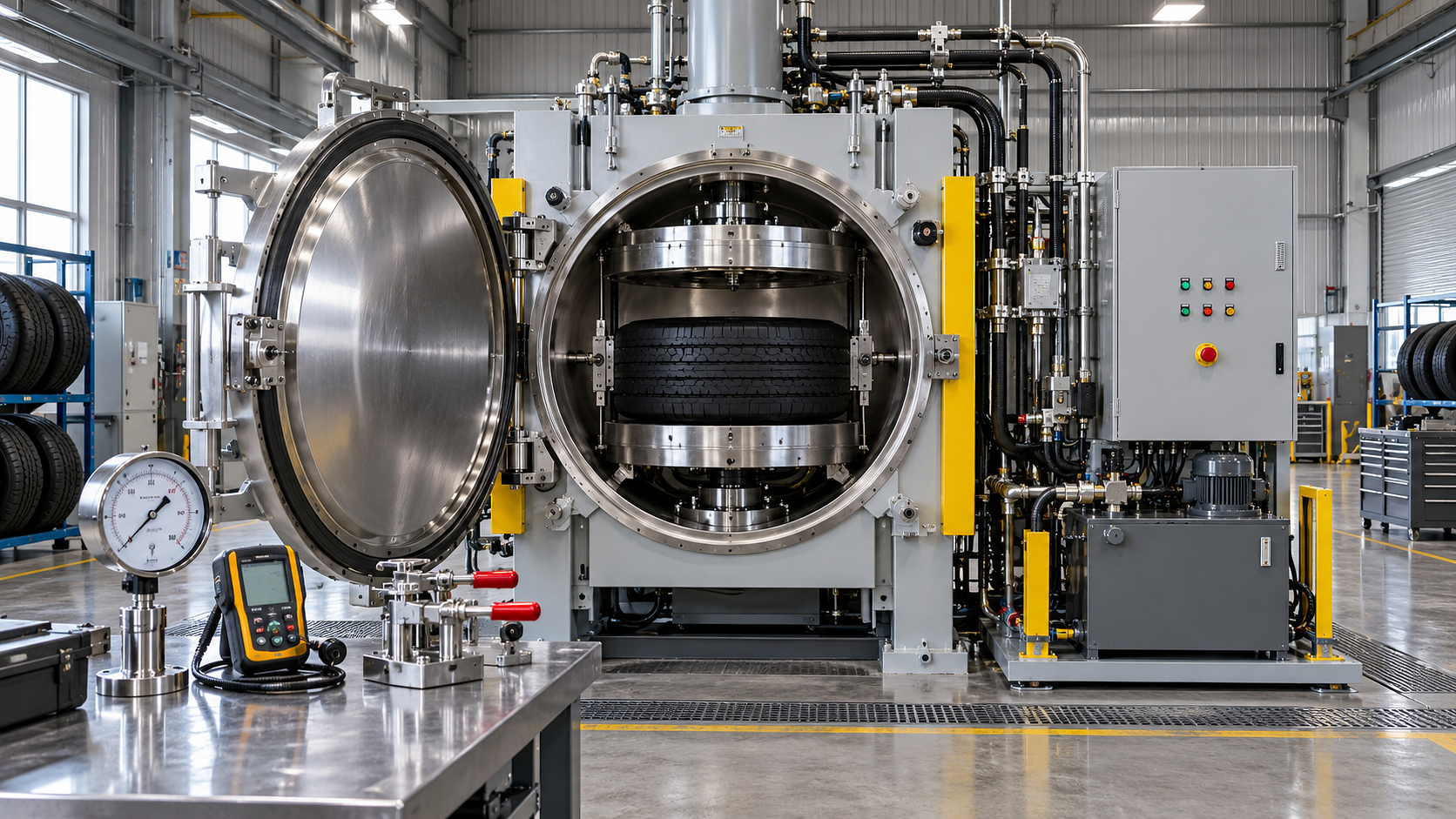
A used retreading unit can look serviceable after cleaning, repainting, and a brief powered demonstration, yet still carry faults that emerge only when heat, pressure, vacuum, or production speed are applied. For aftermarket maintenance teams, the inspection should establish more than whether the machine starts. It should determine whether the equipment can be returned to controlled, repeatable operation without creating an unsafe maintenance burden or an unstable process.
The inspection sequence matters. Replacing hoses, bearings, or electrical components before confirming the machine’s actual configuration, structural condition, and process suitability can consume budget without resolving the main risk. A used unit may have been modified for a different retreading method, operated with unsuitable utilities, or left idle long enough for seals, insulation, and control components to deteriorate.
Start by identifying the process the unit was built to perform
“Retreading machine” is often used as a broad description, but the condition checks depend on the actual operation. A buffing machine, building station, envelope spreader, curing chamber, autoclave, tread extruder, repair station, and rubber mixer have different failure modes. Before dismantling anything, maintenance personnel should collect the serial plate data, electrical drawings, pneumatic and hydraulic schematics, operating manuals, and any available service records.
Compare those records with the machine in front of you. The following differences should be treated as engineering questions rather than minor discrepancies:
- Motor ratings that do not match the available site voltage or frequency.
- Replacement cylinders, valves, sensors, or drives from unrelated equipment.
- Disconnected safety interlocks, bypassed limit switches, or missing guard sections.
- Changes to pressure vessels, heated tooling, steam lines, or vacuum piping.
- Controller programs that are unavailable, password-protected, or no longer supported.
- Tooling and moulding fixtures that do not fit the tyre sizes the plant intends to process.
This review prevents a common reconditioning mistake: restoring the mechanical condition of a machine that cannot be integrated into the intended production route. A chamber designed for one envelope arrangement, for example, may require new fixtures and revised operating procedures before it can run a different casing range. Likewise, a building machine with worn but repairable mechanical parts may still be impractical if its obsolete control system cannot communicate with the plant’s safety circuit or spare-parts inventory.
Make the first inspection safe before testing functions
Do not rely on an emergency-stop button as the only means of making a used machine safe. Before guards are removed or access panels opened, isolate electrical, pneumatic, hydraulic, thermal, and stored mechanical energy. This is especially important on curing equipment, tyre presses, bead clamps, and systems using large cylinders or spring-loaded mechanisms. Components may move when trapped pressure is released, even if the machine has not operated for months.
For facilities under United States jurisdiction, OSHA’s control-of-hazardous-energy rule requires procedures for isolating and locking out energy sources during servicing and maintenance; see 29 CFR 1910.147. OSHA also addresses machine guarding requirements under 29 CFR 1910.212. These references do not replace local legal obligations or a site-specific risk assessment, but they provide a practical baseline for deciding whether an older machine’s safeguarding needs redesign rather than simple repair.
A controlled inspection normally begins with photographs, condition notes, and non-powered checks. Record missing guards, cable routes, fluid leaks, corrosion, cracked welds, loose anchors, and signs of heat damage before cleaning obscures the evidence. If the machine was transported recently, inspect for fresh impact damage around motor feet, gearbox housings, cylinders, control cabinets, and alignment points.
Assess the frame, drives, and moving assemblies before ordering parts
Retreading equipment is exposed to abrasive rubber dust, repeated loading, vibration, and, in curing areas, elevated temperatures. Surface rust on an outer cover is not automatically serious. Corrosion around load-bearing members, pressure boundaries, pivot points, anchor holes, and electrical enclosures is more consequential. Look for stretched bolt holes, cracked gussets, distorted frames, improvised weld repairs, and shims used to compensate for lost alignment.
On rotating equipment such as buffers, grinders, conveyors, and stitcher assemblies, inspect shaft runout, bearing play, pulley condition, belt tracking, coupling wear, and guard clearances. Rubber dust can conceal wear around bearings and fan covers. A motor that turns freely by hand may still have degraded insulation, contaminated cooling passages, or a seized brake. Before committing to a motor rewind or replacement, verify the driven assembly is not overloaded by misalignment or a failing gearbox.
Hydraulic and pneumatic circuits deserve the same scrutiny. Check cylinder rods for pitting, scoring, and corrosion in the seal travel area. Examine hose manufacture dates where visible, routing near heated surfaces, abrasion points, fittings, pressure gauges, and filter housings. A leaking cylinder is not always a simple seal-kit job: rod damage, bore scoring, or bent mountings may cause the new seals to fail quickly. Hydraulic oil should be sampled or at least visually examined for water, burnt odour, suspended debris, and unusual discoloration. Contaminated oil can damage rebuilt pumps and proportional valves shortly after recommissioning.
Inspect heat, pressure, and vacuum systems as process-critical equipment
Curing performance depends on more than reaching a displayed temperature. The control system must measure temperature accurately, distribute heat adequately for the process, maintain the required pressure or vacuum, and repeat the programmed cycle. Used chambers and autoclaves may have concealed issues in door seals, insulation, circulation fans, condensate drainage, steam traps, vacuum lines, or temperature probes.
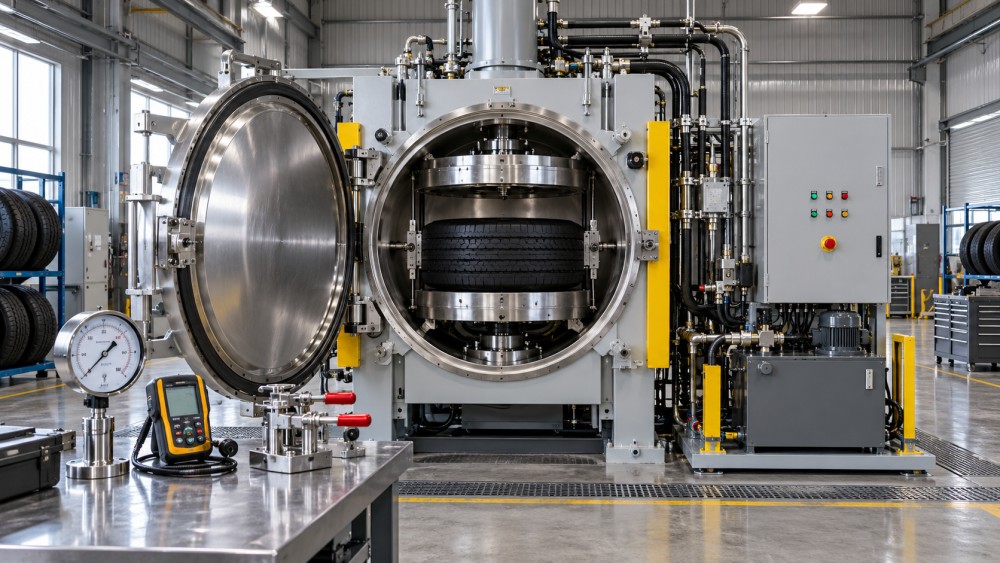
Begin with a cold inspection. Check door hinges, locking geometry, seal contact surfaces, gasket compression, corrosion at the lower edge of the chamber, and condition of internal racks or loading carts. A door that requires excessive force to close may be misaligned rather than merely fitted with an old gasket. For steam-heated units, inspect visible piping for unsupported sections, corrosion, leaking joints, and evidence of previous overheating. Pressure-retaining components should not be modified casually; their inspection and repair requirements depend on the applicable jurisdiction, design documentation, and operating conditions.
During later controlled testing, compare displayed process values with independently verified instruments. A temperature controller can report a plausible number while its sensor is drifting or mounted in a location that does not represent the product zone. Pressure decay and vacuum-hold tests can reveal leaking valves, door seals, and pipe connections, but acceptance limits should come from the equipment documentation, validated process requirements, or a qualified engineering review rather than an arbitrary target.
Electrical condition is often the hidden reconditioning cost
Electrical cabinets may appear clean while containing obsolete relays, undocumented wiring changes, brittle insulation, corroded terminals, or failed cooling fans. Open the panel only after proper isolation and discharge procedures. Look for overheated contactors, discoloration near terminals, loose earth connections, blocked filters, missing gland plates, and cables that have been routed through sharp openings without protection.
Older relay logic can be maintainable if drawings are accurate and replacement parts remain available. The greater concern is undocumented modification. Labels that no longer match field devices make fault finding slower and can compromise safe operation. A modern controller retrofit may be justified when the existing system cannot support reliable interlocks, alarm history, temperature control, or replacement components. It should not, however, be treated as a cosmetic upgrade. The new design must account for motor protection, emergency stops, guard circuits, sequence logic, and the behaviour of the machine after power loss or air-pressure failure.
Insulation-resistance testing, continuity checks, and motor evaluation should be performed by competent personnel using procedures appropriate to the equipment and local electrical rules. A test result alone does not prove that the complete machine is safe to run. It is one input alongside enclosure condition, protective bonding, circuit protection, control logic, and physical guarding.
Check the rubber-processing scope rather than trusting the asset label
Some used-equipment listings group mixers, mills, extruders, repair-gum preparation systems, and curing equipment under the same broad tyre-manufacturing category. That can be useful for locating related assets, but it can also blur the difference between tread application equipment and upstream compound preparation. Where the intended reconditioning scope includes internal rubber preparation, maintenance teams may need to examine equipment described as a tyre retreading machine in relation to its actual mixing, milling, extrusion, or curing function.
For example, an internal mixer requires inspection of rotor condition, chamber wear, ram movement, cooling passages, gearbox condition, dust extraction interfaces, and discharge-door sealing. Those concerns are materially different from the checks required for a buffing machine or curing chamber. The practical question is whether the equipment can produce or handle the required material consistently and safely, not whether its resale category sounds relevant to retreading.
Use a staged recommissioning plan instead of a single start-up attempt
A successful no-load start does not establish production readiness. Recommissioning is more reliable when each stage has a purpose and a documented result:
- Static condition review: confirm identity, guards, structure, utilities, lubrication points, tooling, and visible defects.
- Component repair and replacement: address clearly defective hoses, seals, bearings, wiring, sensors, filters, and guarding before motion testing.
- No-load functional test: verify directions of rotation, movement limits, emergency stopping behaviour, alarms, interlocks, and abnormal noise or vibration.
- Utility and process test: evaluate air supply, hydraulic pressure, heating, vacuum, cooling, and control stability under supervised conditions.
- Controlled production trial: run representative materials and tyre sizes while monitoring cycle repeatability, joint quality, surface finish, temperature behaviour, and operator access.
Each stage should have stop conditions. A recurring overcurrent fault, unexplained pressure loss, unstable temperature, failed guard interlock, or abnormal mechanical noise should pause the process until the cause is understood. Repeatedly resetting alarms may damage a recoverable component or conceal a condition that puts personnel at risk.
Decide whether reconditioning is commercially sensible
Reconditioning is usually justified when the core structure, major assemblies, and process configuration remain suitable, while the faults are concentrated in serviceable wear parts, controls, hoses, seals, and peripheral systems. It becomes less attractive when the machine needs extensive frame repair, undocumented pressure-system work, unavailable proprietary components, or major safeguarding changes with uncertain integration effort.
Maintenance teams should separate the visible purchase or recovery cost from the full return-to-service cost. Include transport, foundations, lifting, electrical supply upgrades, compressed-air capacity, extraction, guarding, controls work, documentation recovery, spare parts, commissioning labour, and trial material. The real decision is not whether a used unit can be made to move; it is whether it can be restored to a repeatable process with maintainable components, defined safeguards, and evidence that its operating condition is understood.
Sources and technical references
U.S. Occupational Safety and Health Administration, 29 CFR 1910.147, The Control of Hazardous Energy (Lockout/Tagout).
U.S. Occupational Safety and Health Administration, 29 CFR 1910.212, General Requirements for All Machines.
ISO 12100:2010, Safety of Machinery — General Principles for Design — Risk Assessment and Risk Reduction.