Industry Portal
Related News
- 00
0000-00
Michelin Defender LTX Platinum Tops 2026 Truck and SUV Tire Mileage Ranking - 00
0000-00
ECE-Compliant Fog Lamps: Which Approval Marks and Test Reports Should You Check? - 00
0000-00
Vehicle Perception System Accuracy: Which Metrics Matter in Rain and Fog? - 00
0000-00
Aluminum Price Fluctuations: Fixed vs. Indexed Supply Contracts - 00
0000-00
ECE-Compliant Lighting for Commercial Vehicles: Approval and Installation Checks
What Supplier Risks Should NEV Buyers Check Before Part Approval?
Part Approval Is a Supplier Decision, Not a Prototype Decision
For NEV buyers, a component can meet drawing requirements, look convincing on a prototype vehicle, and still be the wrong choice for series approval. The supplier may be unable to hold surface quality after a tooling change, trace a material batch after a field issue, support a homologation update, or produce the same optical, aerodynamic, and dimensional result at volume.
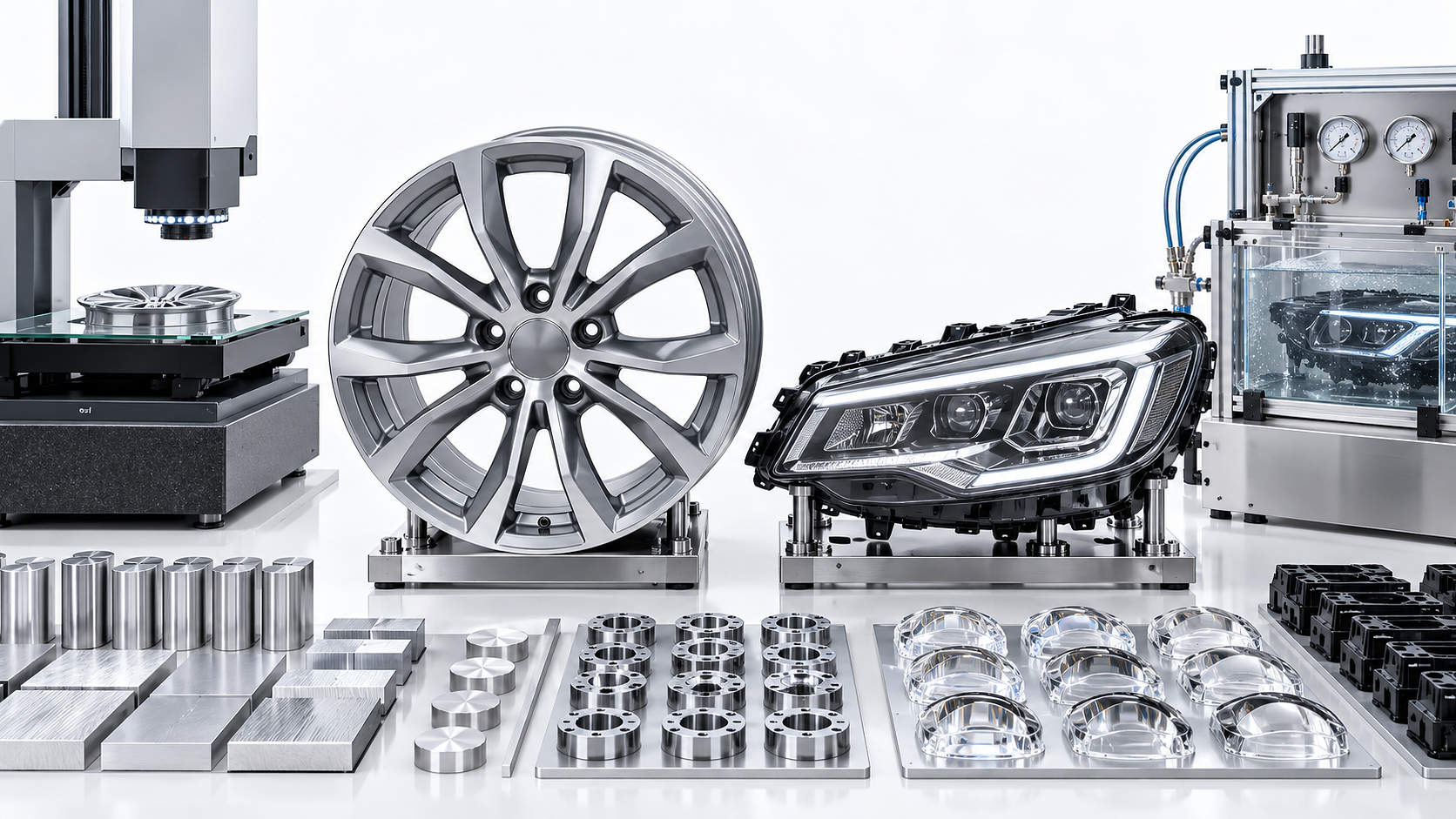
That risk is especially high for exterior and vision-related parts. A wheel design affects mass, brake cooling, curb-impact durability, and aero performance. A headlamp assembly combines optics, thermal behavior, electronics, sealing, and regulatory requirements. A panoramic roof may involve glass, coatings, adhesives, drainage, noise performance, and body integration. Even a sensor switch that appears minor can become a launch problem if it behaves inconsistently across temperature, contamination, vehicle software versions, or regional specifications.
Before part approval, buyers should therefore evaluate the supplier in two dimensions: whether it can make the approved sample, and whether it can repeatedly deliver the approved part under production pressure. The gap between those two questions is where many NEV programs lose time, cost, and brand confidence.
Start With the Risk That Cannot Be Seen in a Sample
Prototype parts often benefit from controlled conditions: selected materials, extra manual inspection, low production speed, and direct engineering attention. Those conditions are useful for proving a design concept, but they do not demonstrate process stability. A buyer approving a supplier only on prototype performance may be approving a one-time result rather than a manufacturing system.
The first review should focus on the supplier's ability to control the characteristics that matter after launch. This is more specific than asking whether the supplier has a quality certificate. A quality-system certificate may indicate that formal processes exist, but it does not confirm that a particular factory, tool set, sub-supplier network, and inspection method can protect the characteristics of the proposed NEV part.
For an exterior trim component, those characteristics may include color consistency, gloss, grain, gap and flush, clip retention, coating adhesion, UV durability, and dimensional behavior after thermal cycling. For forged or cast aluminum wheels, the questions may center on alloy control, porosity management, machining consistency, coating coverage, runout, fatigue performance, and traceability from raw material to finished wheel. For LED headlamps, the supplier must control beam pattern, sealing, condensation behavior, thermal paths, electronic component sourcing, software calibration, and optical alignment at the same time.
Buyers should ask for evidence that the supplier understands the critical-to-quality features rather than merely listing inspection equipment. Useful evidence includes process flow, control plans, measurement-system capability, reaction plans for out-of-control conditions, and records showing how changes are contained. The documents matter less as paperwork than as a way to reveal whether the supplier knows where a defect originates and how it prevents recurrence.
A practical warning sign is a supplier that can describe final inspection in detail but cannot explain in-process control. Final inspection catches defects after cost has been added. Stable production depends on preventing them earlier, at material receipt, molding or casting, machining, coating, assembly, calibration, and packaging.
Material Traceability Must Match the Consequence of Failure
NEV components are frequently exposed to harsher combinations of load, temperature, electrical demand, and customer expectation than buyers initially assume. Vehicle mass can raise tire, wheel, suspension, and body-load demands. Fast torque delivery can reveal weaknesses in tires and wheels. Dense electronics and high-output lighting create thermal management challenges. A vehicle's aerodynamic surfaces may become visually prominent because they are designed as functional elements rather than hidden underbody details.
In that environment, material traceability is not an administrative exercise. It determines whether the buyer can isolate an affected production lot, identify the source of a nonconforming resin, aluminum melt, coating chemical, LED bin, adhesive, seal, or electronic component, and take targeted action when a defect appears.
The depth of traceability should be proportionate to the risk. A decorative non-safety trim part may need lot-level tracking tied to production date and tooling cavity. A wheel, optical assembly, roof system, or sensor-related device generally demands a stronger chain of evidence, including incoming-material identification, process records, inspection results, and serial or batch linkage to the finished part.
Buyers should examine traceability in a failure scenario, not in a presentation. Ask the supplier to explain how it would answer several practical questions:
- Can it identify every vehicle or shipment affected by a suspect material batch?
- Can it distinguish parts made before and after a tooling, process, software, or sub-supplier change?
- Can it retrieve retained samples and relevant inspection records without reconstructing the history manually?
- Can it prove that rework, regrind, mixed inventory, or alternate material was controlled within the approved limits?
- Can it keep traceability intact through outsourced coating, assembly, calibration, or packaging operations?
Weak traceability expands the cost of every quality event. Instead of containing a defined population, the buyer may have to quarantine broad inventories, delay vehicle production, or conduct expensive sorting because the supplier cannot establish what is affected. That commercial exposure should be considered before approval, even when the initial piece price is attractive.
Assess Change Control as Closely as Initial Validation
Many supplier failures do not begin with an obviously poor launch process. They begin when a validated process is changed without a disciplined reassessment. A resin grade becomes difficult to source. A wheel coating supplier is replaced. An LED source changes binning behavior. A mold cavity is repaired. A sensor module receives a component substitution. A plant moves production to another line or region. Each change may appear manageable in isolation, yet the accumulated effect can alter fit, appearance, durability, optical output, or vehicle-system behavior.
Part approval should establish what changes require buyer notification and what changes require formal revalidation. The answer should cover more than the direct manufacturing plant. It should include raw materials, electronic components, sub-tier suppliers, tooling, manufacturing location, test methods, software or calibration parameters, packaging, and logistics conditions where these can affect part performance.
A useful comparison is between suppliers that treat change control as a communication duty and suppliers that treat it as an engineering discipline. The first may notify the buyer after an internal decision has already been made. The second identifies the affected characteristics, evaluates risk, defines validation work, preserves comparison samples where appropriate, and waits for agreed approval before releasing the change.
For exterior and vision systems, seemingly cosmetic modifications can carry functional consequences. A revised wheel face may alter airflow around brakes or increase drag. A new decorative cover can interfere with radar or camera fields. A headlamp lens material change may affect transmission, haze, UV aging, or thermal stress. An added roof garnish can change wind noise or water management. Buyers should avoid classifying a change as “appearance only” until the relevant design, aero, optical, sensor, and vehicle-integration functions have been considered.
Validate the Supplier's Ability to Protect Design Intent
NEV design teams often face a difficult brief: create a vehicle that is distinctive and premium while preserving range, noise performance, thermal function, and sensing capability. The question, “How can vehicle aesthetics be improved without increasing drag?” is therefore not purely a styling question. It is also a supplier-approval question.
A supplier may deliver a visually striking grille treatment, wheel, lamp signature, roof profile, or body add-on, but buyers should check whether it has the engineering capability to protect the aerodynamic target through the full development cycle. This does not mean every supplier needs an in-house wind tunnel. It does mean the supplier must work effectively within the OEM's aerodynamic development process, understand the interfaces that influence drag, and manufacture parts without introducing unintended variation.
For example, low-drag wheel concepts often depend on tight control of spoke geometry, inserts, surface transitions, and wheel-to-tire integration. A design that looks clean in a digital render may create local turbulence, restrict brake airflow, or become difficult to balance after production tolerances are applied. The buyer should seek evidence that the supplier can produce the intended geometry repeatedly, not simply machine a convincing development sample.
The same principle applies to lighting and sensor surfaces. Flush lamp lenses, concealed sensor zones, and tightly integrated bumper forms can improve perceived quality and reduce visual clutter. They may also create thermal, optical, radar-transmission, cleaning, repairability, or sealing risks. A supplier should be able to identify these tradeoffs early and show how its design validation plan addresses them.
Approval discussions are stronger when buyers ask the supplier to compare alternatives against the vehicle-level requirement:
- A more sculpted surface versus its effect on drag, wind noise, water run-off, and manufacturing tolerance.
- A larger wheel visual package versus mass, tire rolling resistance, ride, curb-impact exposure, and aerodynamic treatment.
- A thinner or more hidden lamp architecture versus heat dissipation, serviceability, sealing margin, and optical stability.
- An integrated sensor cover versus sensing performance, material aging, paint compatibility, and replacement cost.
No supplier needs to eliminate every compromise. The risk lies in approving one that cannot make the compromise visible, quantify the affected interfaces, or support the vehicle team when a styling change reaches a late program stage.
Regulatory Readiness Should Be Tested by Region and Configuration
A part can comply in one vehicle configuration and create problems in another. This is common when programs share architecture across markets, wheel sizes, lighting packages, sensor suites, and body variants. Buyers should verify that the supplier understands the applicable regulatory path for the intended sales regions and can maintain the evidence needed as the part evolves.
For lighting, this can involve performance and marking requirements, beam behavior, electromagnetic compatibility, and the implications of adaptive or matrix functions. For wheels and tires, the relevant questions may include marking, load and speed suitability, durability expectations, and fitment consistency. Exterior components can raise pedestrian-protection, projection, lighting, visibility, sensor, or material-compliance considerations depending on their location and function.
Buyers do not need a supplier to replace the OEM's compliance organization. They do need it to recognize when a modification could affect approval status and to provide controlled technical evidence quickly. A supplier that discovers regional differences only after a design freeze can turn a manageable engineering issue into a program delay.
Documentation should also be configuration-specific. One test report does not automatically validate every finish, lens color, wheel dimension, software version, material grade, or assembly location. The buyer should understand what the evidence covers, where its boundaries lie, and what triggers additional assessment.
Capacity Risk Is More Than Installed Equipment
Capacity presentations commonly emphasize machine count, annual output, factory floor area, and planned expansion. Those figures are relevant, but they do not answer whether the supplier can meet the vehicle program's actual demand pattern. NEV launches may involve volatile mix, rapid option take-rate changes, regional shifts, service-part demand, and late engineering updates. A supplier with nominal capacity may still fail if its bottleneck is coating, curing, optical calibration, end-of-line testing, skilled labor, a single tool, or one imported electronic component.
Buyers should examine the capacity model at the process constraint, not only at the final assembly line. For a wheel supplier, melting, casting or forging, heat treatment, machining, coating, inspection, and logistics may each have different constraints. For a headlamp supplier, optical aiming, leak testing, electronic programming, burn-in, and critical LED availability may define output more than housing assembly does.
Questions that expose resilience include whether tooling has backup capacity, whether production can be rebalanced between qualified lines, how long critical raw materials are held, how quickly quality containment can be implemented without stopping all shipments, and whether service parts use the same validated process as production parts. A low-cost quote that assumes permanently high utilization, single sourcing, or no disruption reserve should be evaluated as a risk position, not simply a commercial advantage.
Part Approval Should End With a Clear Escalation Model
The final supplier-risk check is organizational. When an issue crosses design, manufacturing, quality, purchasing, logistics, and compliance boundaries, who has authority to act, and how quickly can the supplier provide a technically credible response?
Buyers should establish named technical and quality contacts, reporting expectations for escapes and process deviations, response timing for containment actions, and the route for approving corrective actions. These arrangements matter most for components that influence safety, visibility, driving perception, range, or a vehicle's visible quality. A supplier that communicates early about a developing risk is often more manageable than one that reports only after stock is affected.
The best approval decision is rarely based on a single audit score or a single successful validation build. It comes from a coherent view of process control, traceability, change discipline, engineering depth, regulatory awareness, and operational resilience. When those elements are present, buyers have a stronger basis for approving parts that will remain attractive, efficient, compliant, and manufacturable long after the first vehicle leaves the line.