
Industry Portal
Related News
- 00
0000-00
NEV Industry Standards in China: Which Battery Safety Tests Are Required? - 00
0000-00
Automotive Exterior Lighting Systems: Lamp Types, Functions, and Placement - 00
0000-00
Choosing an Electric SUV Sunroof: Key Fit, Safety, and Weather-Sealing Factors - 00
0000-00
Pop-Up Automotive Sunroof Systems: Key Design Factors for Vehicle Integration - 00
0000-00
Automotive Product Comparison Charts: How Buyers Can Compare Specs, Cost, and Fit
How to Evaluate a Replacement Tire Manufacturer for Fleet Uptime and Cost Control
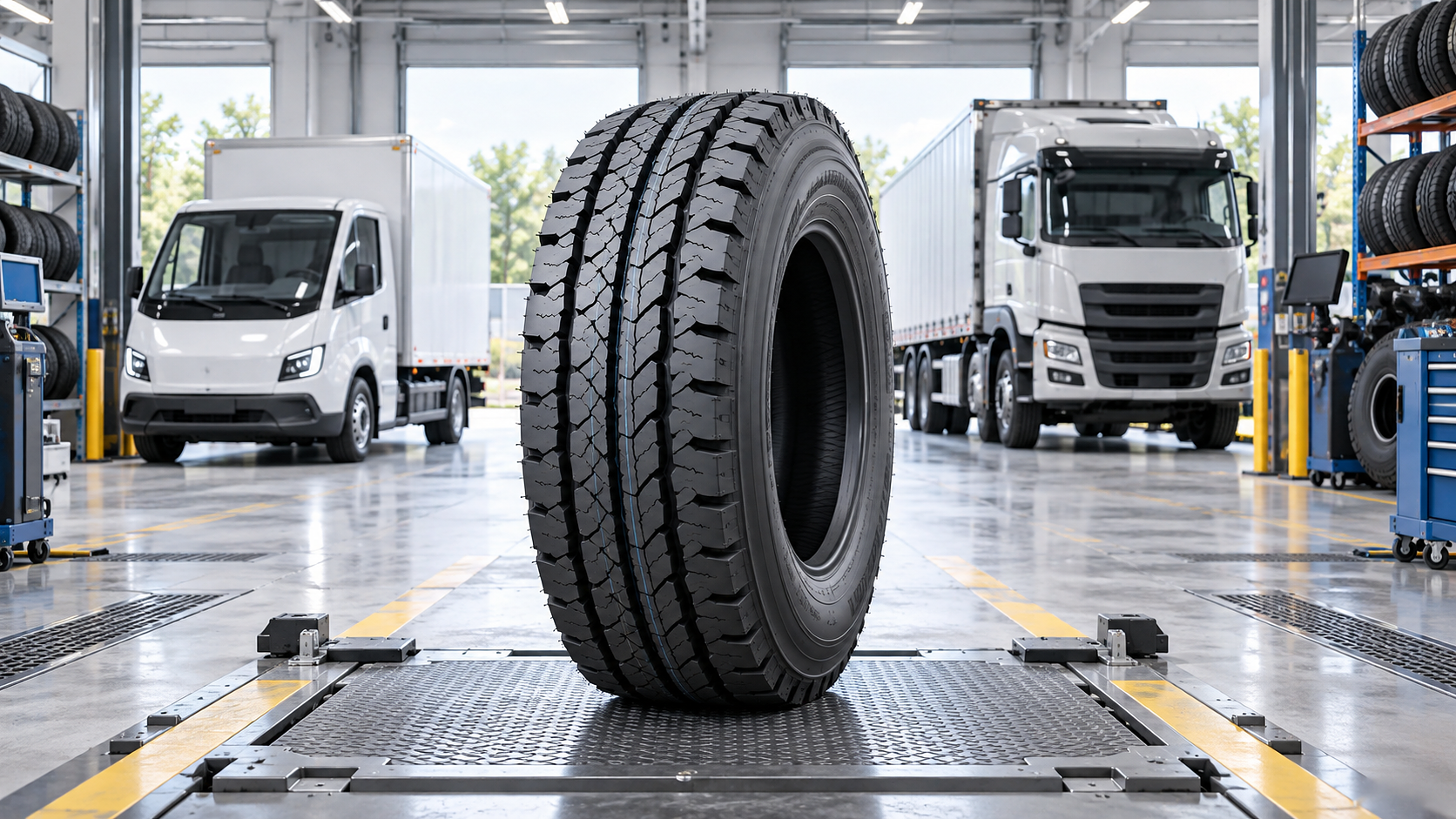
Selecting a replacement tire manufacturer is a fleet operating decision, not a routine parts purchase. A lower invoice price can be erased quickly by shorter tread life, higher fuel or energy use, casing failures, missed delivery windows, or a tire specification that does not match the fleet’s real duty cycle. For procurement teams, the useful comparison is not “Which tire costs less per unit?” but “Which manufacturer gives this fleet the lowest controllable cost per kilometer while keeping vehicles available for work?”
That question becomes more demanding when a fleet includes electric vans, heavier delivery vehicles, regional trucks, mixed routes, or vehicles that operate in high-stop, high-torque conditions. In those cases, tire wear, heat generation, load capacity, noise, and rolling resistance can move in different directions. A manufacturer that performs well in one application may be a poor fit in another.
The right replacement tire manufacturer is usually the one that can demonstrate a repeatable fit between its product range, production consistency, supply model, and the fleet’s operating data. Procurement should begin with the fleet’s use case, then test manufacturer claims against measurable commercial and operational requirements.
Start with the fleet duty cycle, not the catalog
Many tire sourcing exercises fail at the first step because the fleet is described too broadly. “Commercial vehicles,” “delivery fleet,” or “EV fleet” are purchasing categories, not tire operating conditions. A tire manufacturer needs a more specific picture before its recommendation can be evaluated properly.
A useful duty-cycle profile should include vehicle type, axle position, typical load, annual distance, route mix, average trip length, road surface, ambient temperature range, driver behavior, and maintenance practice. The objective is to identify what is consuming the tire first: abrasive road surfaces, repeated acceleration, curb contact, sustained highway heat, overloading, poor inflation control, or irregular alignment wear.
For example, a last-mile electric delivery fleet may experience rapid drive-axle wear due to vehicle mass and immediate electric-motor torque. A regional freight fleet may place greater value on heat management, retreadability, and predictable long-distance wear. A municipal fleet may need sidewall resilience and availability across varied service vehicles. These are different replacement tire decisions even when the nominal wheel size is the same.
Before inviting bids, procurement should establish a small set of operating categories rather than demand a single tire solution for every vehicle. Segmenting the fleet can reduce unnecessary specification compromises and makes supplier comparisons more meaningful.
- Urban stop-start routes with frequent braking, turning, and curb exposure
- Mixed regional routes where tread life and rolling resistance must be balanced
- High-load or high-temperature routes where casing durability and heat resistance are central
- Electric vehicle applications where load index, torque wear, noise, and energy consumption interact
- Seasonal or severe-weather operations where wet grip and winter performance may take priority over maximum mileage
A manufacturer that responds with only a general product brochure has not yet answered the procurement question. A stronger response maps its recommended pattern, construction, load rating, and operating limits to each segment, while stating the assumptions behind that recommendation.
Evaluate total tire cost as an operating model
Unit price remains important, especially for large replacement programs, but it is only one input. The financial comparison should bring together acquisition cost, usable tread life, energy consumption, maintenance burden, downtime exposure, and the value retained in the casing where retreading is part of the fleet strategy.
Cost per kilometer is a practical starting point:
Cost per kilometer = total tire-related cost over the tire’s usable life / kilometers delivered in the intended application
The formula is simple; the inputs are not. “Usable life” should account for removal before legal minimum tread depth if the tire develops irregular wear, sidewall damage, unacceptable noise, vibration, or operational risk. It should also distinguish between expected mileage in a controlled test environment and achievable mileage under the fleet’s actual maintenance discipline.
Rolling resistance deserves attention because it affects fuel use in conventional fleets and energy consumption in electric fleets. Yet procurement should avoid treating low rolling resistance as an automatic win. A tire designed to minimize energy loss may involve trade-offs in grip, tread wear, cut resistance, or application flexibility. The right question for a manufacturer is how its rolling-resistance position was achieved and what performance compromises apply to the proposed tire size and duty cycle.
The same caution applies to long-mileage claims. A tread compound that delivers extended wear on highway routes may not tolerate tight urban turns, repeated acceleration, rough loading yards, or heavily loaded operation as well as another design. It is more useful to ask for expected performance ranges under defined operating conditions than to request a single mileage promise.
Procurement should also separate predictable costs from disruptive costs. A tire that costs slightly more but reduces unscheduled removals, emergency roadside service, or stock shortages can improve fleet availability even if its cost-per-kilometer advantage is modest. For fleets where missed routes or idle assets carry material penalties, uptime has a direct financial value.
Test durability claims at the casing and operating-limit level
Tread depth alone does not define durability. The casing, belt package, sidewall construction, compound formulation, bead area, and heat-management design all influence how a tire behaves under load and over time. This is particularly important for replacement programs because the fleet may operate vehicles longer, under more varied conditions, than the original equipment fitment was designed to address.
A capable replacement tire manufacturer should be able to explain the application limits of its products in practical terms. That includes load index and speed rating, recommended inflation pressure ranges, axle suitability, tire rotation guidance, and conditions that can invalidate expected service life. Vague assurances of “heavy-duty” or “EV-ready” performance are not enough for a procurement decision.
For electric vehicles, manufacturers should address the combined effect of higher curb weight, concentrated battery mass, regenerative braking, and instant torque. EV tire discussions often focus on low rolling resistance and cabin noise, but fleets should also examine load capacity, shoulder wear, wet braking behavior, and resistance to accelerated wear on driven wheels. A tire designed for a passenger EV may not be suitable for an electric commercial vehicle simply because it carries an EV label.
Casing quality matters even more where retreading is economically viable. A low-priced tire that cannot produce a sound casing after its first life may cost more over the full asset cycle than a higher-priced alternative with consistent retread potential. Manufacturers should be asked whether the proposed casing is intended for retread use, which inspection criteria apply, and how the company manages construction consistency across production batches.
There is no need to demand confidential material formulas. Procurement does need sufficient technical transparency to understand whether the product is engineered for the stated service. A manufacturer that can connect its design choices to the fleet’s failure modes is easier to assess than one relying on broad performance language.
Supply reliability is part of tire performance
A tire that cannot be delivered in the required size, pattern, or quantity does not protect fleet uptime. Supply reliability should therefore carry weight comparable to tread life and purchase price, especially when the fleet depends on specialized sizes, EV-specific load ratings, seasonal products, or tires that must remain consistent across multiple service locations.
Procurement teams should examine more than the manufacturer’s nominal production capacity. The operational questions are more specific: Which plants produce the proposed SKU? Is supply dependent on one region? What lead-time assumptions apply? How are allocations handled when demand increases? Can the supplier maintain the same specification over a contract period? Is there an approved alternative if a particular pattern becomes unavailable?
Consistency matters because replacing one tire with a near-equivalent product can create operating complications. Mixed tread patterns, changing rolling-resistance characteristics, and inconsistent wet-grip behavior may affect driver confidence, rotation planning, and maintenance routines. On drive axles or paired positions, an unplanned substitution may have broader implications than a simple stock replacement.
Inventory design should be discussed before award. A fleet does not necessarily need large local stock, but it should know which critical sizes are held at service points, distributor warehouses, or manufacturer-managed locations. The appropriate model depends on vehicle utilization, geographic coverage, and the cost of a vehicle being unavailable. A supplier’s ability to provide a realistic replenishment plan is often more valuable than an aggressive initial price concession.
Use compliance as a gate, then assess documentation quality
Regulatory compliance is a minimum condition, not a differentiator. The manufacturer must provide tires that meet the applicable legal requirements in the markets where the fleet operates, including required markings and approval documentation. For cross-border fleets, procurement should verify that the supplied product configuration, not merely the manufacturer’s broader portfolio, is compliant in each operating jurisdiction.
Compliance documentation also reveals something about supplier discipline. Clear product data sheets, traceable batch information, warranty terms, labeling information where applicable, and documented recall or complaint procedures make it easier to manage risk after delivery. Ambiguous paperwork can become costly when a fleet needs to investigate a field issue, submit a claim, or demonstrate that its maintenance program used approved equipment.
This review should include the commercial details that are often left until late in negotiations: warranty coverage, claim submission process, exclusions related to inflation or alignment, response expectations for suspected defects, and responsibility for inspection costs. A broad warranty statement has limited value if the evidence burden is unclear or if the process requires the fleet to remove a vehicle from service for an extended period.
Ask for evidence that can survive a pilot
Manufacturer presentations tend to emphasize favorable product characteristics. A procurement team needs evidence that can be checked in its own operating environment. The most credible manufacturers support a structured pilot with a defined baseline, matched vehicle groups where practical, installation records, pressure checks, rotation rules, removal reasons, and scheduled tread-depth measurements.
The pilot should not be designed solely to prove that one brand lasts longer. It should capture the operational factors that determine whether the program can scale: tire availability, fitment accuracy, installation quality, driver reports, maintenance workload, casing condition, and the supplier’s response when an issue appears.
Set the decision rules before the pilot begins. For example, compare usable mileage, irregular wear rate, unscheduled removals, energy or fuel trend where the measurement is reliable, and service response time. Avoid judging the result on a few early removals or a single highly unusual route. Tires are sensitive to vehicle condition and operating behavior, so the test needs enough control to distinguish product performance from maintenance variation.
Manufacturers should also be evaluated on how they handle unfavorable results. A supplier that helps diagnose pressure loss, alignment issues, axle overload, or route-specific damage may be more valuable than one that simply replaces a tire under dispute. Technical support is not an optional add-on when the fleet depends on tire performance to preserve vehicle availability.
Build the award decision around controllable risk
The best replacement tire program rarely comes from selecting the cheapest supplier or the brand with the strongest name recognition. It comes from matching tire construction and service support to a documented duty cycle, then contracting for the supply and performance conditions that the fleet can actually manage.
Procurement should score manufacturers across a limited set of factors: application fit, projected total cost per kilometer, casing and durability quality, supply resilience, technical support, documentation, and pilot performance. The weighting should reflect the fleet’s operational exposure. A delivery fleet with tight route commitments may weight availability and emergency support more heavily; a long-haul operator may place more emphasis on casing life, retread economics, and rolling resistance.
A replacement tires manufacturer should leave the buying team with fewer assumptions, not more. When its product recommendation is tied to specific loads, routes, maintenance controls, and replenishment commitments, the fleet can make a defensible decision. When the proposal rests mainly on unit price and broad performance claims, the cost risk has simply been moved downstream into operations.