
Industry Portal
Related News
- 00
0000-00
ISO 9001 Requirements for Automotive Exterior Component Suppliers - 00
0000-00
Supplier Capability Evaluation Matrix: Criteria and Weighting for Reliable Sourcing - 00
0000-00
How to Choose SUV Performance Tires for Grip, Load Capacity, and Daily Comfort - 00
0000-00
How EV Exterior Design Balances Aerodynamics, Range, and Brand Identity - 00
0000-00
Silent Tire Prices: What Fleet Buyers Should Compare Beyond the Upfront Cost
Private Label Tire Export: Evaluating Suppliers, Compliance, and Landed Cost
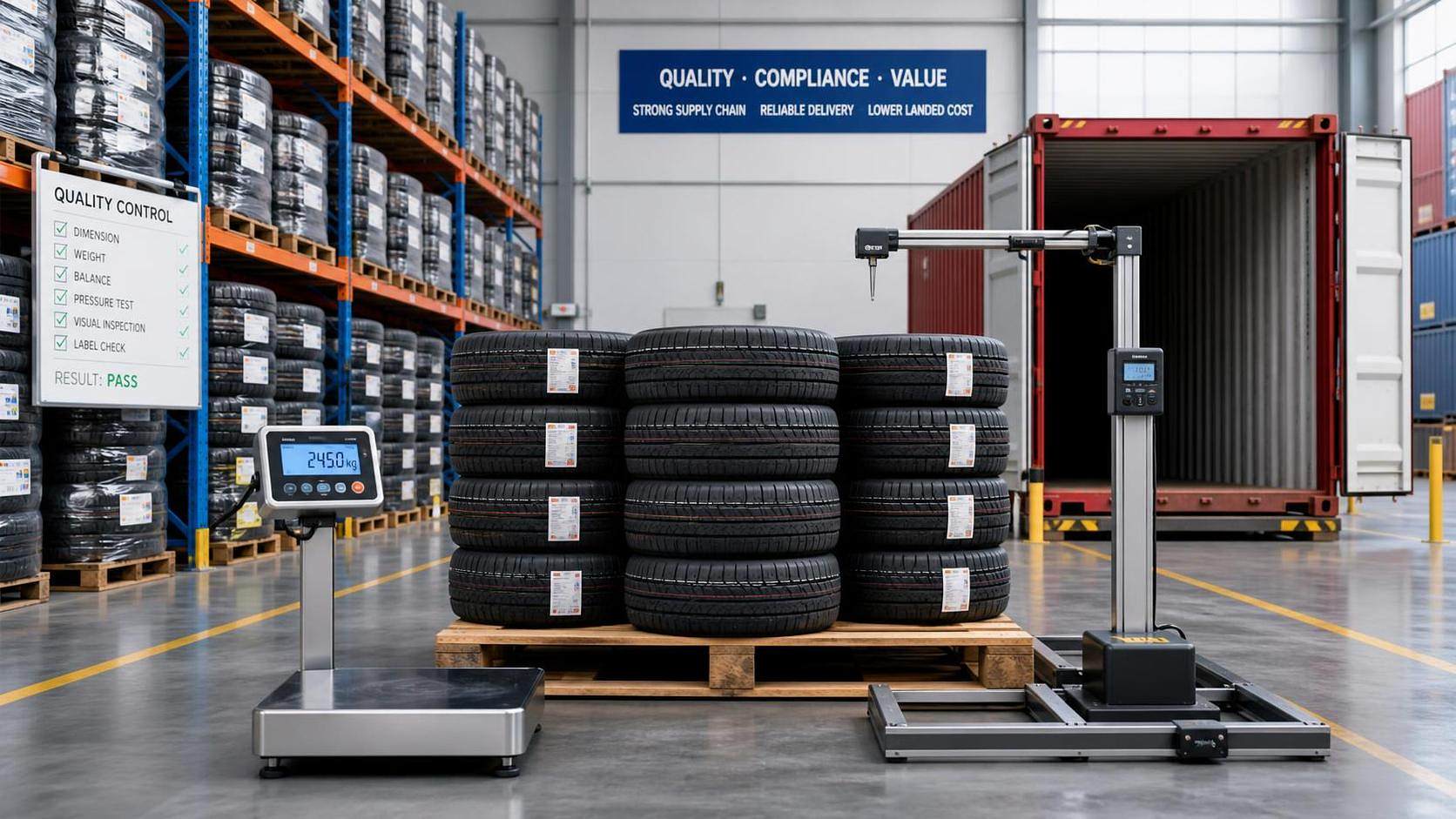
A low factory quote is rarely the best starting point for a private label tire export program. The commercial result depends on whether the supplier can reproduce the agreed tire consistently, support the documentation required in the destination market, load containers efficiently, and handle claims without turning a modest defect rate into a brand problem.
Private label tires export gives distributors control over branding, range architecture, packaging, and positioning. It can also create room to serve market segments that are poorly covered by global tire brands. But a tire is not a generic commodity. Two products with the same size, tread category, and headline specification can differ materially in casing construction, compound stability, rolling resistance, noise, wet behavior, uniformity, and expected service life. The purchasing decision should therefore be built around a defined market need and a full landed-cost model, not a comparison of FOB prices alone.
Start with the market position, not the factory catalogue
Before requesting quotations, decide what the private label is intended to be. A budget replacement line, a mid-market touring range, a performance-oriented product, and an EV-focused tire require different product choices and different supplier capabilities. A supplier that produces acceptable entry-level passenger tires may not be the right partner for a quiet, high-load tire aimed at heavier electric vehicles or for a UHP range sold into demanding replacement channels.
The brief should be specific enough to prevent suppliers from quoting different constructions under the same commercial description. At minimum, define the target vehicle class, tire sizes, seasonal use, speed and load requirements, intended retail position, target market, preferred tread pattern approach, labeling needs, packaging requirements, and expected annual volume by SKU.
For example, an EV-oriented tire program should not be specified only as “low rolling resistance.” The tire must also be evaluated against the higher vehicle mass, immediate torque delivery, road-noise expectations, and wear pattern associated with the intended vehicles. A low-resistance compound that compromises wet grip or shortens wear life may create a poor ownership experience. Similarly, a touring tire sold in a rough-road market needs a construction appropriate to local road conditions, not simply a visually similar tread design.
Keeping the opening range focused is usually more useful than launching too many sizes. A smaller group of fast-moving fitments allows meaningful production volume per SKU, cleaner inventory management, and more reliable replenishment. Long-tail sizes can be added after the first range has demonstrated stable sell-through and claim performance.
Evaluate the supplier behind the sample
A good sample proves that a factory can make one acceptable tire at one point in time. It does not prove that the factory can deliver the same result through repeated production runs. Supplier evaluation should examine the production system, product engineering, quality controls, and export discipline together.
Manufacturing capability and product ownership
Ask whether the proposed tire is an established factory design, a modified existing design, or a new development. An established pattern can reduce development risk and shorten time to market, provided its performance fits the intended position. A modified pattern may be appropriate when branding, sidewall treatment, or a construction adjustment is needed. A new design offers more differentiation but brings higher cost, longer validation work, and a greater risk of mismatch between the approved prototype and later production.
It is also important to establish who owns the tread design, mold, sidewall artwork, packaging artwork, and brand assets. Mold charges and tooling arrangements should be written clearly. A private label should not discover after launch that the supplier may use its branded sidewall design, custom packaging, or paid-for tooling for another buyer.
Quality systems that affect field performance
Quality review should go beyond a certificate list. The useful questions concern process control: how raw materials are received and traced, how compound batches are managed, how curing conditions are controlled, how uniformity and balance are checked, how non-conforming products are quarantined, and how the factory investigates recurring defects.
Request production records or quality-control examples for comparable export products. A supplier should be able to explain its inspection points and its response when a batch does not meet specification. Procurement teams also benefit from understanding the factory’s treatment of cosmetic grades, repaired tires, and rejected inventory. These categories must be separated from exportable first-quality production. Ambiguity here can undermine a brand quickly, particularly where distributors sell through installers who see the product before the vehicle owner does.
For a high-performance or EV-related range, review the supplier’s experience with relevant load, speed, noise, and efficiency targets. This does not mean selecting a factory solely because it uses EV terminology in a brochure. It means checking whether the engineering team can explain the trade-offs between compound formulation, carcass stiffness, tread geometry, heat buildup, durability, and acoustic behavior.
Commercial reliability matters as much as technical capability
Private label programs often fail through inconsistent communication rather than an obvious manufacturing issue. Review lead-time assumptions, minimum order quantities by size, tolerance for mixed-size container loading, raw-material exposure, payment terms, and how the supplier handles changes after an order is confirmed.
A supplier with a slightly higher unit price can be commercially stronger if it provides stable production slots, accurate documents, disciplined packing lists, and early warning when a material or shipping issue affects delivery. The cheapest quoted supplier becomes expensive when containers miss seasonal demand, labels need reprinting, or buyers have to reorder urgently from another source.
Compliance is a product decision, not a shipping document
Destination-market compliance must be considered while choosing the product, before artwork approval and production scheduling. Tire markings, performance labels, testing requirements, registration arrangements, customs documentation, and local product-liability expectations vary by market. A tire accepted in one destination may not be ready for sale in another simply because the same physical product can be exported there.
The procurement file should connect each SKU to its target market and required evidence. That file normally includes the approved technical specification, sidewall marking artwork, applicable test or approval documentation, labeling artwork where relevant, shipment documents, and lot traceability information. It should also identify which party is responsible for each item: manufacturer, exporter, brand owner, importer, or local distributor.
One common mistake is treating a compliance mark as a broad proof of suitability. A marking can be necessary while still leaving unresolved questions about the exact tire size, load index, speed rating, labeling format, documentation holder, or local importer obligations. Another mistake is approving sidewall artwork late in the process. Sidewall text is part of the product identity and should be controlled through the same approval process as the construction and packaging.
Testing and approval costs should be allocated early. When a range includes many sizes, the cost structure may not scale evenly. A small-volume size can absorb a disproportionate amount of validation, tooling, artwork, and inventory cost. That does not make it impossible to source, but it changes the commercial case.
For distributors working across several regions, it is often better to separate the range into compliance groups rather than assume one specification will serve every destination. This may require more SKUs and more planning, but it reduces the risk of relabeling, blocked inventory, or a product that cannot be sold through its intended channel.
Build landed cost from the point of sale backwards
Landed cost is the cost of making a tire available for sale in usable condition, at the intended warehouse or distribution point. It is not the price on the supplier’s quotation. A sound model starts with the expected selling price and target gross margin, then works backward to the maximum acceptable landed cost for each size.
Container utilization deserves special attention. Tire freight is strongly influenced by volume, so an apparently cheap small-size tire may carry a less favorable logistics burden than a larger product that packs efficiently. Packaging should protect the tire and present the brand properly, but oversized cartons, excessive inserts, or inefficient pallets can consume space that could otherwise hold saleable inventory.
Use a scenario model rather than a single landed-cost figure. At a minimum, test normal freight conditions, a higher freight condition, a slower sales cycle, and a claim rate above the initial assumption. This exposes ranges whose margin depends on every variable behaving perfectly. It also helps distinguish a product that is genuinely competitive from one that only works in a favorable spreadsheet.
Samples, pilot orders, and approval discipline
Do not approve a range from photographs, catalogue data, or a single showroom sample. The approval sequence should reflect the risks of the program. Start with document review and supplier assessment, then evaluate physical samples against the agreed specification. Confirm sidewall markings, dimensions, finish, labeling, packaging, and basic fitment expectations before moving into a pilot order.
A pilot order is especially valuable when the program includes a new factory relationship, a new construction, or a premium market position. It allows the buyer to inspect production consistency, loading quality, document accuracy, and reception condition before committing to a larger launch. The pilot should have acceptance criteria that can be applied consistently, including what will trigger rejection, rework, credit, or a corrective-action request.
The approved “golden sample” should be identified and retained by both parties. However, it should be supported by a written technical specification. A sample alone cannot adequately define acceptable tolerances, labeling details, packaging configuration, or batch-traceability requirements.
Set warranty terms before the first container ships
Warranty exposure is easy to underestimate because it may not appear in the supplier’s initial quotation. The brand owner needs a practical claims procedure covering photos, tire identification, purchase evidence, inspection standards, response timing, and settlement rules. Define whether the supplier provides replacement tires, credit, shared freight support, or another agreed remedy when a confirmed manufacturing issue occurs.
Claims data should be tracked by tire size, production lot, vehicle application, failure type, and region. A small number of isolated claims may be normal commercial noise; repeated patterns tied to a specific batch, fitment, or condition require a technical response. The objective is not merely recovering cost from the factory. It is identifying whether the issue originates in manufacture, specification, installation, inflation practice, vehicle alignment, road conditions, or customer expectation.
Clear warranty terms also protect the supplier from unfair claims. Damage caused by underinflation, impact, overload, or poor maintenance should not be confused with a manufacturing defect. A credible private label program needs a process that distinguishes these causes fairly.
Choosing the right export partner for the range you intend to sell
Supplier selection becomes clearer when procurement teams score factories against the intended business model instead of asking which supplier is “best.” A value-focused range may prioritize dependable basic construction, competitive container economics, and broad size availability. A premium replacement range may justify higher cost for stronger quality control, refined product performance, and more disciplined warranty support. A specialized EV or performance program should place greater weight on engineering depth, validation evidence, and the ability to maintain product consistency as volumes grow.
AEVS tracks high-performance ground-contact systems alongside wheels, exterior components, and intelligent vehicle technologies. For tire sourcing, the useful perspective is that the tire cannot be evaluated in isolation. Wheel fitment, vehicle mass, aerodynamic efficiency, cabin-noise expectations, and the demands of electrified powertrains all influence what a commercially viable tire specification should deliver.
The first supplier meeting should end with a clear action list: the target SKU range, required documentation, sample plan, pricing basis, tooling ownership, compliance responsibilities, lead-time assumptions, and claim process. When those points remain vague, a low unit price is not a commercial advantage. It is simply an incomplete number.