Industry Portal
Related News
- 00
0000-00
ISO 9001 Requirements for Automotive Exterior Component Suppliers - 00
0000-00
Supplier Capability Evaluation Matrix: Criteria and Weighting for Reliable Sourcing - 00
0000-00
How to Choose SUV Performance Tires for Grip, Load Capacity, and Daily Comfort - 00
0000-00
How EV Exterior Design Balances Aerodynamics, Range, and Brand Identity - 00
0000-00
Silent Tire Prices: What Fleet Buyers Should Compare Beyond the Upfront Cost
Low-Pressure Casting Process Explained: Steps, Benefits, and Ideal Alloy Applications
Why low-pressure casting still matters in automotive lightweighting
For anyone evaluating manufacturing routes for aluminum wheels or safety-relevant structural parts, the low-pressure casting process sits in a very practical middle ground. It is not the cheapest route in absolute terms, and it is not the highest-performance route either. But that is exactly why it keeps showing up in serious automotive programs. It offers better internal quality and dimensional consistency than conventional gravity casting, while avoiding much of the cost burden and throughput trade-off that can come with forged components.
That balance is especially relevant in today’s NEV market, where wheel weight, brake cooling airflow, impact resistance, and production stability all need to be considered together rather than one by one. In the exterior systems space followed closely by AEVS, aluminum alloy wheels are not just styling parts. They influence unsprung mass, aerodynamic drag management, NVH behavior, and even the thermal environment around brakes and sensors. Process choice therefore becomes a vehicle-level decision, not just a foundry decision.
If you are screening suppliers or comparing casting routes, the real question is not “Is low-pressure casting good?” It is more specific: where does it reduce risk, where does it add cost, and which alloys actually benefit from it?
What happens during the low-pressure casting process
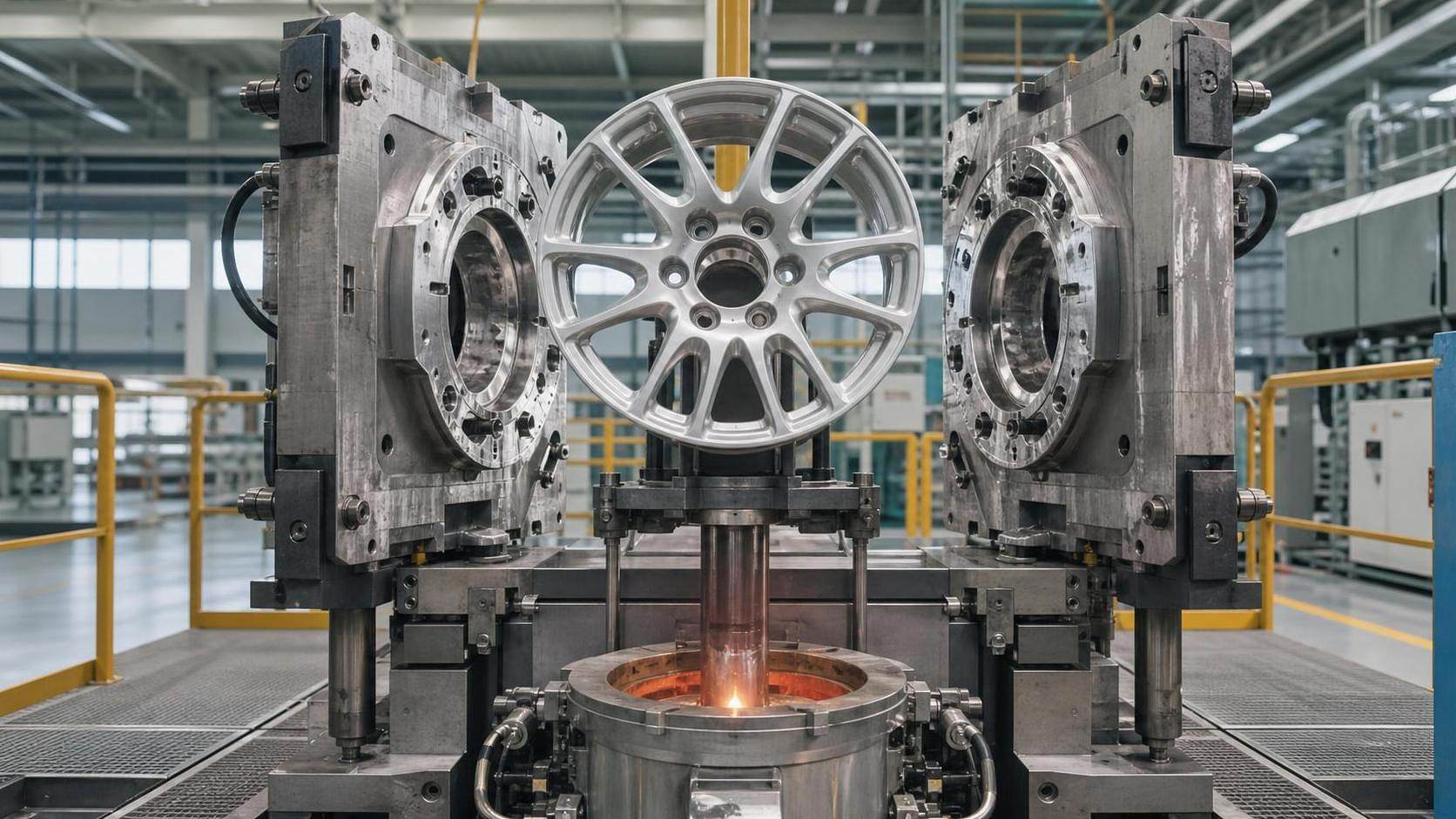
In low-pressure casting, molten aluminum is held in a sealed furnace beneath the die. Dry, controlled air pressure is applied to the furnace, pushing the melt upward through a riser tube into the mold cavity. The fill starts from the bottom and progresses smoothly upward. Once the cavity is full, pressure is maintained during solidification so the casting can feed shrinkage more effectively than in a free-pouring process.
That sounds simple, but the engineering value is in the flow behavior. Bottom filling reduces the violent splashing and oxide folding often associated with uncontrolled pouring. Less turbulence usually means fewer entrapped gas defects and fewer bifilm-related problems. For a technical evaluator, this is one of the first reasons low-pressure casting deserves attention: many downstream durability issues begin with what happened in the first seconds of mold filling.
A typical process chain includes melt preparation, degassing and filtration, die preheating, pressurized filling, pressure holding, controlled solidification, casting removal, heat treatment where required, machining, and then inspection. None of those steps is unique on its own. What matters is that low-pressure casting makes the whole chain more controllable if the foundry has disciplined melt handling and die thermal management.
The steps that actually decide part quality
A lot of evaluations stop at the process diagram. In practice, quality usually swings on a few operational details.
Melt cleanliness comes first. Low-pressure filling cannot compensate for poor melt treatment. If hydrogen content is high or oxide contamination is already present, the process may still produce parts that look acceptable externally but fail X-ray, leak testing, fatigue testing, or machining yield targets. This is why strong suppliers put as much attention on furnace discipline, transfer practice, filtration, and degassing as they do on the pressurization profile.
Die temperature control is another one. Automotive wheels, suspension nodes, and similar geometries do not solidify uniformly. Thick hubs and thin spokes behave differently. Without stable thermal control, the same die may produce acceptable dimensions in one zone and shrinkage-related inconsistency in another. Technical reviews should therefore ask how the supplier manages local cooling, cycle-to-cycle repeatability, and die coating condition.
Then there is pressure curve design. Too slow, and cycle time stretches and fill quality may become uneven in thin sections. Too aggressive, and the process starts giving back the turbulence advantage it was supposed to protect. Good foundries tune the pressure ramp to the geometry rather than relying on a generic recipe.
Why it reduces porosity and where that benefit has limits
The main quality argument for the low-pressure casting process is reduced porosity, but it helps to be precise about why. The process supports laminar-style filling compared with top-poured methods, and the maintained pressure during solidification improves feeding into areas that would otherwise shrink. That generally lowers the probability of shrinkage voids and gas-related defects in critical sections.
For wheels, this matters because fatigue cracks do not care whether a defect came from turbulence, gas pickup, or feeding failure. A pore in the wrong spoke transition or bead seat area can become a durability problem later. For structural castings, porosity can also affect leak tightness, local elongation, machining stability, and heat treatment response.
Still, it is worth resisting the common shortcut that “low-pressure casting means low porosity.” It often means lower porosity potential. The actual outcome still depends on alloy chemistry, melt practice, die design, section thickness, and inspection threshold. If a supplier cannot show consistent control of these inputs, the process label by itself does not tell you much.
Where low-pressure casting fits versus gravity casting, die casting, and forging
For technical comparison, it helps to place low-pressure casting in context rather than treating it as a stand-alone answer.
This is why many OE and Tier 1 wheel programs continue to rely on low-pressure cast wheels in mainstream and upper-mid segments. They can meet demanding durability and weight targets when the design and process are developed together, even if forged wheels still lead at the extreme end.
Ideal alloy applications: what usually works well
The alloys most commonly associated with low-pressure casting in automotive applications are heat-treatable aluminum-silicon systems, especially where castability, fluidity, and a practical strength-to-weight ratio are needed. A356 and related variants are frequently chosen for wheels and chassis-related castings because they offer a useful combination of casting behavior and post-heat-treatment mechanical performance. In many plants, the conversation is less about whether these alloys can be cast by low pressure, and more about how tightly chemistry and thermal treatment are controlled to achieve stable results.
For wheels, the appeal is clear. You need an alloy that fills complex spoke geometries, supports machining, responds predictably to T6-type heat treatment where specified, and can deliver repeatable fatigue behavior after finishing. Low-pressure casting helps because it gives these alloys a cleaner path into the mold and better feeding during solidification.
Other aluminum-silicon-magnesium families may also be considered depending on the part function, required elongation, corrosion environment, and local validation standards. But this is the point where evaluators should avoid broad assumptions. Alloy selection is not just a material question; it is tied to section thickness, heat treatment window, machining strategy, surface finish requirements, and test method.
What technical evaluators should check beyond the brochure
In supplier reviews, the most useful questions are often not about the machine size or furnace count. They are about process discipline and evidence.
- How is melt cleanliness monitored and documented before casting?
- What non-destructive inspection methods are used for critical zones: X-ray, CT in development, dye penetrant, leak test, or a combination?
- How are pressure curves and die temperatures controlled and recorded over long production runs?
- What heat treatment controls are in place, especially if wheel fatigue and impact targets are tight?
- How does the supplier correlate casting quality with downstream machining scrap and field durability feedback?
These questions are particularly relevant in the AEVS domain, where exterior and vision-related engineering increasingly intersects with wheel aerodynamics, brake cooling flow, and package constraints around sensors and lighting systems. A wheel is no longer evaluated only for static strength and appearance. Its manufacturing route can affect mass distribution, spoke geometry freedom, and the airflow environment around adjacent systems.
Common misunderstandings
One mistake is assuming low-pressure casting is automatically suitable for every lightweight part. It is excellent for many wheels and selected structural castings, but not every geometry or production volume will justify it. Some thin-wall, very high-volume parts may point toward die casting. Some top-end strength targets may still favor forging or hybrid routes.
Another mistake is treating the process as detached from design. In reality, fillet transitions, wall thickness distribution, hub mass, spoke architecture, and feeding path design all influence whether the process delivers its promised quality. A mediocre design run through a good low-pressure line is still a mediocre casting.
There is also a cost misconception. Low-pressure casting can reduce scrap and improve consistency, but that does not automatically mean lower total cost in every sourcing scenario. Tooling strategy, cycle time, yield, heat treatment, machining allowance, and logistics all need to be included in the comparison.
A practical decision frame
If the part is an aluminum wheel, a suspension-related casting, or another component where internal integrity and dimensional repeatability carry real safety and warranty consequences, the low-pressure casting process is often worth serious consideration. It is particularly attractive when the target is a credible mix of lightweighting, fatigue performance, surface quality, and scalable production.
If you are comparing routes for an actual program, do not stop at nominal mechanical properties or generic process claims. Ask to see how the supplier controls melt quality, solidification, and post-cast validation. For parts that sit close to the vehicle’s exterior performance envelope, especially wheels in EV and premium segments, that is usually where the real difference shows up.
And if alloy choice is still open, start with the application loads and validation plan, then work backward into process and chemistry. In this field, the best manufacturing decision is rarely the one with the strongest marketing label. It is the one that holds up under inspection, machining, impact, and fatigue when production becomes routine rather than ideal.