
Industry Portal
Related News
- 00
0000-00
NEV Industry Standards in China: Which Battery Safety Tests Are Required? - 00
0000-00
Automotive Exterior Lighting Systems: Lamp Types, Functions, and Placement - 00
0000-00
Choosing an Electric SUV Sunroof: Key Fit, Safety, and Weather-Sealing Factors - 00
0000-00
Pop-Up Automotive Sunroof Systems: Key Design Factors for Vehicle Integration - 00
0000-00
Automotive Product Comparison Charts: How Buyers Can Compare Specs, Cost, and Fit
How to Select NVH Control Materials for Automotive Panels and Powertrain Systems
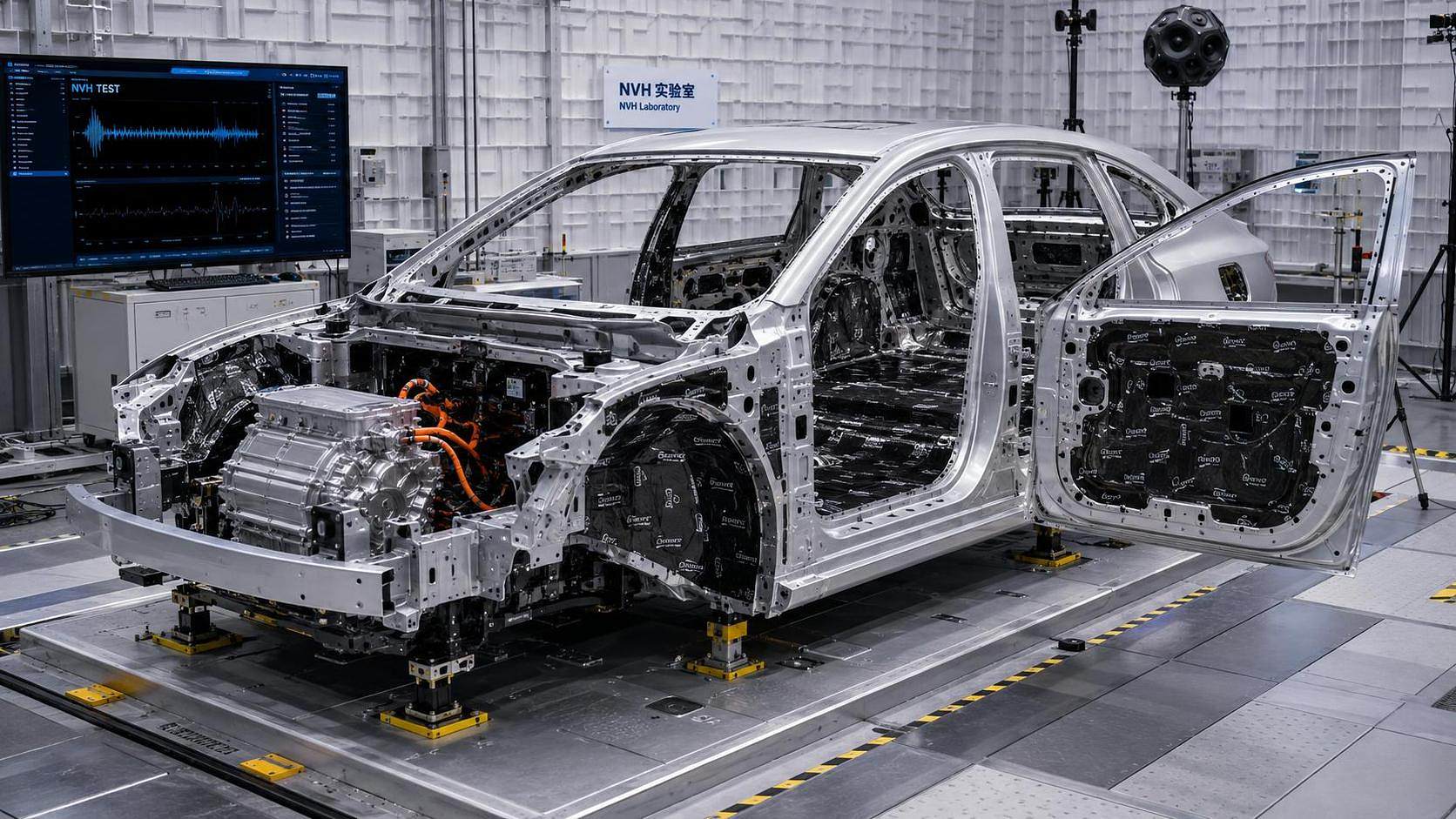
Selecting NVH control materials for automotive panels and powertrain systems is rarely a matter of choosing the material with the highest acoustic rating on a data sheet. A vehicle may pass a laboratory sound test and still feel noisy on coarse asphalt, resonate at a particular motor speed, or transmit an irritating high-frequency whine into the cabin. For technical evaluators, the real task is to match a material system to the noise path, structural behavior, operating environment, manufacturing route, and vehicle character.
This matters even more in battery-electric vehicles. Without the masking effect of an internal-combustion engine, occupants notice tire roar, wind leakage, gear mesh tones, inverter switching noise, trim buzz, and the subtle drumming of large lightweight panels. A quiet vehicle is not created by adding mass everywhere. It is created by controlling where vibration begins, how it travels, and where airborne sound enters or reflects.
Start with the noise path, not the material catalog
The most common selection error is to define the problem as “noise reduction” before identifying whether the dominant issue is airborne noise, structure-borne vibration, panel radiation, cavity resonance, or leakage. These mechanisms demand different interventions. A porous absorber may be excellent inside a trim cavity but ineffective against a vibrating floor panel. A dense barrier can block sound transmission yet add unacceptable mass or create assembly difficulties. A damping layer may calm a roof skin while doing little for tire noise entering through the wheelhouse.
A practical evaluation begins with three questions:
- Where is the excitation generated? Examples include tire-road contact, electric drive gears, cooling fans, combustion pulses, wind turbulence, or body-panel impacts.
- How does it reach the occupant? Through air, sheet metal, mounts, seals, glass, trim cavities, wiring pass-throughs, or suspension attachment points.
- At which frequency and operating condition is it objectionable? Idle, launch, highway cruise, regenerative braking, rough-road input, cold start, and high ambient temperature can each produce different NVH signatures.
This diagnostic discipline prevents a familiar and expensive outcome: adding insulation after prototype testing, only to discover that the perceived problem was a resonant bracket, a weak body sealing interface, or a wheel-and-tire tuning issue.
What each class of NVH control material is designed to do
Automotive NVH control materials are usually applied in layered systems rather than as isolated parts. Their value depends on location, thickness, coverage, attachment method, and interaction with the surrounding structure.
The distinction between absorption, insulation, and damping deserves particular attention. Absorption reduces acoustic energy in air. Insulation or barrier performance reduces sound passing through a partition. Damping lowers the amplitude of structural vibration. A multilayer dash insulator may need all three: a barrier to resist powertrain noise, an absorber to control cavity reflections, and a decoupling layer to prevent the barrier from mechanically coupling to the body.
Panel applications: control resonance without overbuilding the body
Automotive panels behave like radiating surfaces. When a roof, door outer, floor, hood, or liftgate is excited near a natural frequency, it can amplify sound into the cabin or exterior environment. Thin-gauge steel, aluminum, mixed-material structures, and large panoramic roof openings can make this balancing act more demanding.
For body panels, constrained-layer damping treatments are often evaluated by their ability to reduce vibration over the relevant temperature range. The material must remain effective after paint bake, during winter operation, and under elevated roof or underbody temperatures. A material that performs well at room temperature but stiffens excessively in cold conditions may not control the same resonance on a winter road.
Coverage strategy is usually more important than indiscriminate area coverage. Technical teams should use modal analysis, laser vibrometry, operational deflection shape testing, or validated CAE models to identify high-strain regions. Applying damping material near the most active zones can deliver more useful control than covering low-energy areas simply because they are accessible on the production line.
Door systems require a broader view. Door outer-panel damping can reduce drumming, but the full acoustic result also depends on vapor barriers, speaker sealing, window guide interfaces, trim attachment stiffness, latch and cable rattle control, and door aperture seals. In premium electric vehicles, a small leak at the glass run or mirror triangle may be more noticeable at highway speed than a measurable improvement in panel damping.
Roof, floor, and wheelhouse priorities differ
A roof panel is often sensitive to rain impact, wind-induced excitation, and low-frequency booming. Its material package must coexist with headliner attachment and, increasingly, sunroof modules or electrochromic glass systems. Here, added thickness may be limited, while thermal exposure and adhesive durability remain important.
Floor panels face structure-borne input from suspension, tires, and powertrain mounts. The solution may combine damping patches, under-carpet barriers, absorptive layers, and local decouplers. In wheelhouse areas, water, salt, stone impact, and thermal cycling make durability as important as acoustic performance. A wheelhouse liner that absorbs noise but retains moisture or degrades under debris exposure is not an acceptable long-term choice.
Powertrain systems: frequency mapping should lead material selection
Powertrain NVH is changing rapidly. Internal-combustion vehicles still require management of firing orders, intake and exhaust noise, gearbox whine, and mount-transmitted vibration. Electric vehicles introduce quieter baseline operation but expose different tonal issues: e-motor electromagnetic excitation, reducer gear mesh, inverter harmonics, coolant pump noise, and battery enclosure radiation.
The materials around the powertrain should therefore be selected from a frequency map, not from a generic “EV acoustic package” specification. Low-frequency vibration may require mount tuning, structural reinforcement, or damping treatment. Mid-frequency airborne noise can call for multilayer dash insulation or encapsulation components. Higher-frequency tonal content may need absorptive treatment, enclosure optimization, or careful management of reflective surfaces and leakage paths.
For electric drive units, heat resistance and fire-performance requirements can narrow the material field. Encapsulation and dash-area materials may sit near components with significant thermal loads, while battery-adjacent treatments must be assessed for thermal aging, flammability behavior, emissions, and compatibility with service access. The lightest material is not automatically the best option if it loses shape, emits odor, or changes acoustic behavior after prolonged exposure to heat and humidity.
Engine and e-axle encapsulation also present a useful caution. Encapsulation can reduce radiated noise, but it may alter thermal management, water drainage, maintenance accessibility, and the airborne-versus-structure-borne balance. Evaluators should request a system-level assessment rather than approve a material based solely on insertion-loss measurements from a simplified test fixture.
The properties that should appear on an evaluation sheet
A robust material comparison sheet should include more than density and thickness. Those values are useful, but they do not explain how a part will behave once laminated, compressed, cured, perforated, wet, or attached to a complex body geometry.
- Dynamic mechanical behavior: Loss factor, stiffness, and temperature sensitivity for damping materials; these indicate whether vibration control remains effective across the vehicle’s use conditions.
- Acoustic behavior by frequency: Sound absorption coefficient, transmission loss, airflow resistivity, and impedance should be reviewed in the frequency bands relevant to the vehicle program.
- Mass efficiency: Compare performance per unit area and per unit mass, not only absolute reduction. This is essential for EV range and lightweighting targets.
- Thermal and environmental resistance: Consider heat aging, humidity, water absorption, freeze-thaw exposure, salt spray, oil contact, and UV exposure where applicable.
- Mechanical durability: Compression set, tear strength, abrasion resistance, stone-chip resistance, adhesion, and resistance to buzz, squeak, and rattle development.
- Manufacturing fit: Formability, tack, robot handling, curing window, dimensional stability, recyclability pathway, and compatibility with e-coat, paint, and adhesive processes.
- Vehicle interior requirements: Odor, fogging, VOC emissions, fiber release, and visual quality where a material is close to the occupied cabin.
Material suppliers may provide excellent bench data, yet the test methods, sample thicknesses, mounting conditions, and temperatures must be comparable. An absorption value measured on an unconstrained sample cannot be treated as a direct prediction of vehicle cabin performance. Likewise, a damping loss factor obtained at one temperature and frequency may hide a sharp decline elsewhere in the operating envelope.
A practical selection sequence for technical evaluators
When program timing is tight, NVH decisions can become dominated by available package space and supplier lead time. A structured sequence protects the project from late-stage mass additions and repeated prototype loops.
- Define the target in perceptual and engineering terms. State whether the concern is boom, road roar, wind hiss, tonal whine, rain impact, or rattle. Connect subjective feedback to measurable operating conditions.
- Map the transmission path. Use test data and CAE to distinguish radiation from a panel, leakage through an interface, and vibration transmitted through a mounting route.
- Set package and environmental boundaries. Establish allowable mass, thickness, temperature exposure, water exposure, repairability, and regulatory constraints before evaluating alternatives.
- Screen candidate material systems. Compare damping, barrier, absorber, and decoupler combinations rather than asking one material to solve every problem.
- Validate on representative assemblies. Test materials in the real stack-up with production-intent fasteners, seals, trim, adhesives, and body geometry.
- Confirm durability after aging. Repeat critical acoustic and vibration measurements after thermal cycling, humidity exposure, vibration loading, and contamination tests appropriate to the installation location.
Do not separate NVH from exterior and driving-quality decisions
NVH performance is closely linked to systems often managed by different engineering teams. Tire selection influences road noise, impact harshness, and the excitation reaching the wheelhouse. Wheel stiffness, mass, aerodynamic geometry, and brake airflow can affect vibration paths and cabin perception. Exterior mirror design, glass sealing, roof systems, and body gaps shape wind noise. Even smart headlamp cooling modules and sensor housings can introduce local fan noise or aerodynamic disturbances if packaging is not considered early.
For organizations working across lightweight exterior components, tires, wheels, roof systems, and optical perception hardware, the most valuable NVH strategy is cross-functional. A quiet cabin should not rely on heavy compensating materials because an upstream wheel, seal, or exterior geometry decision created avoidable excitation.
Final decision: choose a validated system, not a promising sample
The right NVH control materials for automotive panels and powertrain systems are those that solve a defined noise path while respecting mass, thermal, durability, manufacturing, and sustainability constraints. Technical evaluators should be cautious of single-number comparisons and broad claims of “high acoustic performance.” Vehicle NVH is inherently contextual: a material’s effectiveness changes with frequency, temperature, assembly pressure, structural stiffness, and the adjacent layers around it.
A disciplined selection process turns NVH from a late corrective exercise into a design-quality advantage. By combining source control, transmission-path management, targeted damping, effective sealing, and realistic validation, engineering teams can create vehicles that feel calmer on the road—not merely quieter in a test chamber.