
Industry Portal
Related News
- 00
0000-00
Precision Forging for Aluminum Wheels: Alloy Selection and Fatigue Performance - 00
0000-00
NEV Industry Standards in China: Which Battery Safety Tests Are Required? - 00
0000-00
Automotive Exterior Lighting Systems: Lamp Types, Functions, and Placement - 00
0000-00
Choosing an Electric SUV Sunroof: Key Fit, Safety, and Weather-Sealing Factors - 00
0000-00
Pop-Up Automotive Sunroof Systems: Key Design Factors for Vehicle Integration
How EV Exterior Design Balances Aerodynamics, Range, and Brand Identity
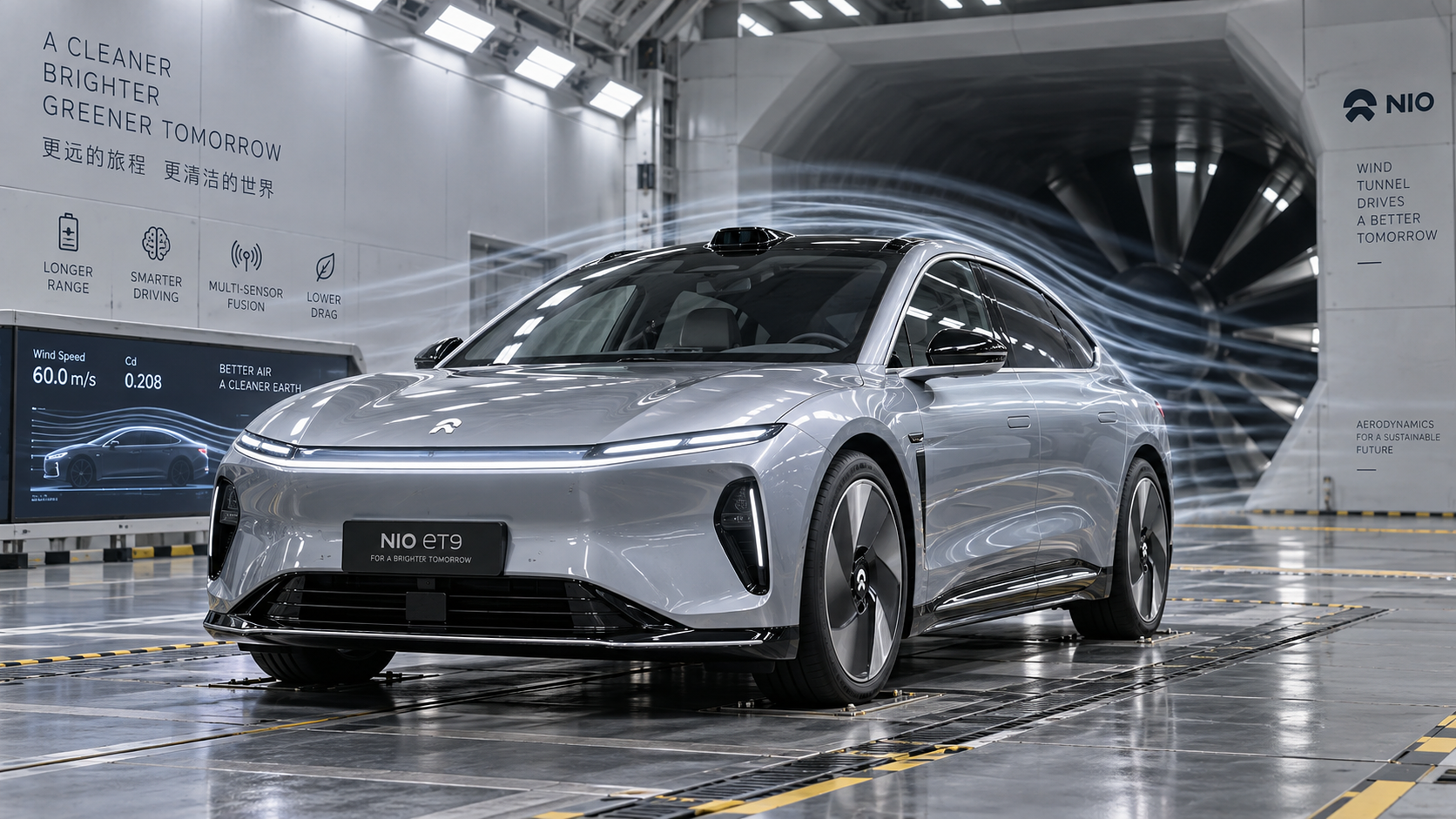
A strong vehicle exterior design EV program does not begin with styling sketches alone. It begins by defining which exterior surfaces, openings, wheels, lamps, sensors, and materials can change without compromising the vehicle’s energy target, safety performance, production feasibility, or recognizable character.
The central trade-off is real: a shape that lowers aerodynamic drag can look anonymous; a dramatic lighting signature can introduce heat, packaging, and repair complexity; a larger wheel can strengthen visual presence while increasing mass, tire losses, and airflow disturbance. The best EV exteriors do not maximize one attribute. They manage the interactions between them early enough that efficiency is not treated as a late-stage correction.
Range is shaped by the whole exterior, not one low-drag silhouette
At highway speed, aerodynamic resistance becomes a major consumer of propulsion energy. Designers often focus first on the roofline, windshield angle, rear taper, and underbody because these areas influence how smoothly air stays attached to the vehicle. That is necessary, but it is not sufficient.
Drag is also affected by smaller details that are easy to classify as styling: mirror housings, wheel openings, brake cooling paths, door-handle geometry, lamp lenses, panel gaps, roof-mounted hardware, and the transition between the rear glass and tailgate. A vehicle can have a visually streamlined body yet lose part of its expected benefit through uncontrolled local turbulence.
This changes the design question. Instead of asking whether a feature is aerodynamic, teams should ask how it changes the air path around adjacent components. For example, a flush door handle may reduce local disturbance when closed, but its mechanism must remain reliable through contamination, ice, repeated use, and body tolerances. A sealed front surface may improve airflow, yet the vehicle still needs managed openings for battery conditioning, drive-unit cooling, cabin climate systems, and brake thermal needs. The objective is controlled airflow, not simply fewer visible apertures.
Evaluation should also distinguish between steady cruising efficiency and real operating conditions. Crosswinds, rain, road spray, cooling demand, wheel rotation, passenger load, and ride-height changes can alter the flow field. A solution that appears clean in an idealized simulation may create issues when the suspension compresses, louvers open, or the wheels turn. Correlation between computational fluid dynamics, wind-tunnel work, physical prototypes, and road testing is therefore more useful than treating any one result as final.
Wheel and tire decisions have disproportionate exterior consequences
Wheels are among the most visible brand elements on an EV, but they are also moving aerodynamic devices. Open-spoke designs can communicate performance and expose brake hardware, while more covered wheel faces often reduce airflow disruption around the rotating assembly. Neither choice is automatically correct. The appropriate design depends on brake cooling demand, wheel diameter, tire specification, vehicle mass, expected duty cycle, and the intended identity of the model.
A low-drag wheel should not be judged only by its front-face appearance. Air moves through, around, and behind the wheel, then interacts with the wheelhouse, underbody, rocker area, and rear wake. A cover or aero insert that improves the wheel face may be less effective if it creates an unfavorable flow condition in the arch. It must also withstand curb contact, cleaning chemicals, vibration, thermal cycling, and service removal without creating objectionable noise.
Tires belong in the same engineering review. Low rolling resistance supports range, but the selection must remain compatible with wet grip, load capacity, noise targets, ride comfort, and the high instantaneous torque common to EV propulsion. A tire optimized narrowly for efficiency can change steering feel, braking behavior, or wear characteristics in ways that are unacceptable for the vehicle’s positioning. Larger wheels may sharpen the visual stance, but their added mass and altered tire geometry can make range, comfort, and impact durability harder to manage.
The common mistake is approving wheels, tires, and wheel-arch treatments as separate supplier-led decisions. They should be reviewed as one exterior-energy-durability system. This is especially important when a vehicle carries a high battery mass, uses performance-oriented torque calibration, or targets long-distance highway use.
Brand identity works best when it is built into functional surfaces
EV manufacturers face a recognizable design problem. Without a large conventional front grille, familiar exhaust outlets, or extensive cooling openings, many legacy visual cues disappear. Some brands respond by adding decorative vents, sharply sculpted surfaces, or oversized light graphics. These can make a vehicle identifiable, but they can also add complexity without supporting performance.
A more durable strategy is to make brand identity emerge from functional decisions. The front graphic can be defined by the relationship between lighting, sensors, cooling zones, and body color rather than by an imitation grille. Side identity can come from a consistent shoulder line, greenhouse proportion, wheel treatment, or charging-port integration. At the rear, lamp geometry, tailgate cut lines, aerodynamic separation points, and reflector placement can establish a signature without creating unnecessary visual clutter.
Lighting is particularly valuable because it can create recognition in daylight and darkness. Yet the lamp assembly is not an unlimited canvas. Its optical output, heat dissipation, lens durability, sealing, repairability, and mounting accuracy all influence the final design. Advanced LED or matrix-capable systems also need careful integration with sensing and control logic. A visually thin lamp may require a deeper package behind the visible lens; a seamless full-width appearance may still need structural breaks, drainage paths, and tolerance management.
For this reason, a lighting signature should be assessed as an illuminated system, not as a graphic line on a render. The review should include glare control, visible uniformity, thermal behavior, condensation management, fault indication, and the ability to maintain required lighting functions after minor damage. In markets with differing lighting and signaling rules, the same visual intent may require different technical executions.
Sensors make clean surfaces harder, not easier
Smart exterior design must accommodate cameras, radar units, ultrasonic devices where used, rain-light sensors, and other perception hardware. These components are often placed where they have the best field of view, but that location can conflict with styling, pedestrian protection, repair cost, dirt accumulation, or aerodynamic flow.
Concealing a sensor behind a painted panel or lamp surface can preserve visual cleanliness, but the material stack must not degrade sensing performance. Curvature, coatings, metallic pigments, heating elements, adhesive choices, and local thickness variation can all matter. Camera placement needs a clear optical path and should account for water, dust, glare, and washer coverage. A camera hidden too aggressively can become difficult to clean or calibrate after a bumper repair.
The practical standard is not “invisible technology.” It is predictable sensing performance with a controlled service path. Sensor covers should have documented material requirements, installation references, calibration procedures, and replacement constraints. Bumper and fascia design should also account for low-speed impacts. A minor cosmetic event should not become an unnecessarily complex multi-component repair because sensor alignment, trim retention, and access were considered too late.
Lightweighting must preserve stiffness, impact behavior, and perceived quality
Reducing exterior mass can support vehicle efficiency, but lightweighting is not interchangeable with using the lowest-mass material. Aluminum, engineered plastics, composites, mixed-material closures, and thin-gauge solutions each introduce their own joining, corrosion, thermal expansion, surface-finish, repair, and recycling considerations.
An aluminum hood or tailgate may reduce mass in a useful location, but the surrounding hinges, latches, reinforcements, bonding methods, and repair procedures must be compatible with the full structure. Polymer exterior panels can offer design freedom and corrosion resistance, yet they need controlled expansion behavior, stable appearance, robust fastening, and repair methods suited to real workshop conditions. Material choice affects more than a mass calculation; it affects panel gaps over time, crash behavior, paint quality, and ownership experience.
Electric sunroof systems illustrate this interaction clearly. A large glazed opening can improve cabin openness and contribute to the intended brand experience. It can also raise questions about roof stiffness, overhead thermal comfort, wind noise, water management, actuator durability, and the added mass above the vehicle’s center of gravity. Electrochromic glazing can reduce the need for a conventional shade in some configurations, but it does not eliminate the need to assess thermal load, control behavior, and failure modes as a complete roof system.
Use gates that force cross-functional decisions
Exterior programs become inefficient when aerodynamics, design, lighting, sensor engineering, body structures, thermal systems, purchasing, and service teams evaluate the same feature at different stages. By the time an issue appears in late validation, the remaining options are usually expensive: alter the feature, accept a compromise, or carry a manufacturing and repair burden into production.
A useful review process asks the same questions at each major design maturity gate:
- What is the intended airflow path, including wheelhouses, cooling openings, and underbody transitions?
- Which exterior details are essential to brand recognition, and which are decorative substitutes for a resolved design?
- Can lamps and sensors meet their functional requirements without creating difficult-to-manufacture surface geometry?
- What happens to the feature after rain, contamination, thermal expansion, a minor impact, or a routine repair?
- Does the material and joining strategy preserve panel quality and function across the expected life of the vehicle?
- Are regional lighting, visibility, pedestrian-protection, and exterior projection requirements included before surface release?
This approach prevents another common error: optimizing a visible part in isolation. The most successful exterior solutions are often not visually dramatic in engineering reviews because their benefits come from coordinated interfaces. A wheel design works with its arch; a lamp works with its thermal and optical package; a radar cover works with the fascia material and repair process; a roof system works with body stiffness and noise control.
What technical evaluation should prioritize before a design freeze
Before approving an EV exterior direction, establish a ranked requirement set rather than a list of equal wishes. Highway range, urban efficiency, cooling duty, premium appearance, performance handling, sensor capability, repair cost, and regional compliance do not carry the same importance for every vehicle. A compact urban EV and a high-speed electric grand tourer may both pursue low drag, but their wheel, tire, cooling, lighting, and stance decisions should not be identical.
Then review the exterior through four connected lenses: energy, perception, durability, and identity. Energy covers aerodynamic resistance, rolling losses, mass, and thermal openings. Perception covers lighting performance, sensor field of view, contamination behavior, and driver-assistance reliability. Durability includes impact exposure, weather sealing, finish stability, noise, and service access. Identity asks whether the vehicle remains recognizable after functional constraints are applied.
AEVS coverage of lightweight exterior components, high-performance tires and wheels, smart lighting, and body sensing reflects why these decisions should be evaluated together. The useful output is not a collection of attractive parts. It is a technically coherent exterior in which every visible element has a defined aerodynamic, structural, optical, sensing, or user-experience role.
That is the practical balance point: protect the range target through disciplined airflow and mass control, preserve safe and reliable perception through honest sensor and lighting integration, and let brand identity come from the quality of those solutions rather than from features that merely look efficient.