
Industry Portal
Related News
- 00
0000-00
ECE-Compliant Lighting for Commercial Vehicles: Approval and Installation Checks - 00
0000-00
Laser Adaptive Headlights: What to Check for Range and Glare Control - 00
0000-00
Precision Forging for Aluminum Wheels: Alloy Selection and Fatigue Performance - 00
0000-00
NEV Industry Standards in China: Which Battery Safety Tests Are Required? - 00
0000-00
Automotive Exterior Lighting Systems: Lamp Types, Functions, and Placement
Tags
Computex Taipei 2026: AI-Enhanced ADB Control Modules Debut
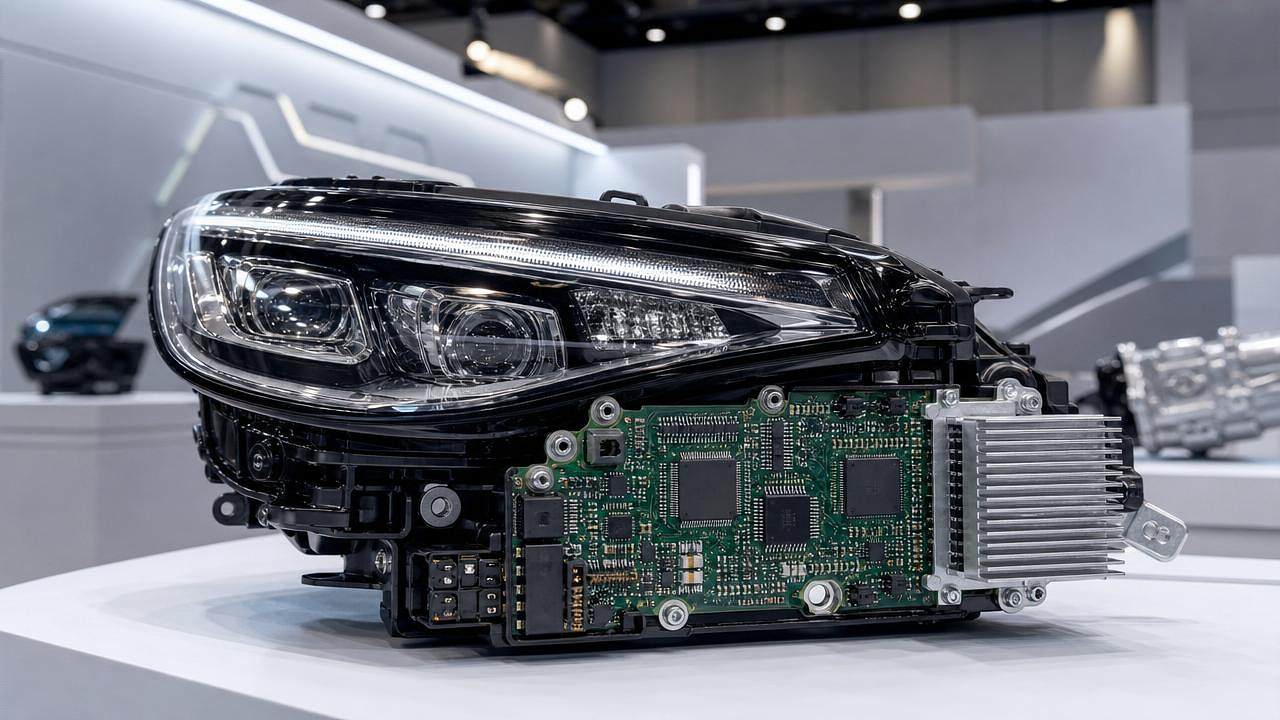
At Computex Taipei 2026, which opened on June 2, 2026, several Chinese IC design firms jointly unveiled adaptive driving beam (ADB) control modules integrated with multi-frame fusion AI vision algorithms—marking a notable shift in automotive lighting system development. This advancement is particularly relevant for Tier 1 automotive lighting system integrators, semiconductor suppliers serving ADAS applications, and OEMs accelerating intelligent headlamp deployment.
Event Overview
On June 2, 2026, during the opening of Computex Taipei, multiple China-based IC design companies announced ADB control modules featuring newly integrated AI vision algorithms capable of real-time identification of 128 road object classes and dynamic matrix beam segmentation. The modules have passed the pre-assessment for UN ECE R153 certification and are scheduled for mass production in Q3 2026.
Impact on Specific Industry Segments
Tier 1 Automotive Lighting System Integrators: These firms face compressed development timelines for ADB systems; the new modules reduce typical development cycles by 6–9 months. Impact manifests primarily in faster time-to-integration, reduced need for custom edge AI hardware, and lower bill-of-materials (BOM) costs for edge computing units.
Automotive Semiconductor Suppliers (IC Design Firms & Fabless Companies): As adopters of advanced vision processing IP, they may see increased demand for AI-accelerated SoCs compatible with multi-frame fusion workloads. Impact centers on shifting design priorities toward low-latency, high-accuracy vision inference at the controller level—not just at the camera module.
OEMs and Tier 2 Lighting Component Manufacturers: These players benefit indirectly through accelerated ADB adoption across vehicle platforms. The impact lies in earlier feasibility for regulatory-compliant, cost-sensitive ADB deployment—especially in mid-tier models where BOM sensitivity is high.
What Relevant Enterprises or Practitioners Should Monitor and Act On
Track official certification progress beyond pre-assessment
UN ECE R153 certification status remains pending final approval. Enterprises involved in system validation should monitor official updates from certification bodies—not just vendor announcements—to assess timing for compliance-aligned integration.
Assess compatibility with existing lighting control architectures
Early technical documentation (e.g., interface specs, latency benchmarks, thermal envelope) will determine whether these modules can integrate into current ADB ECUs without redesign. Engineering teams should prioritize reviewing datasheets and reference designs as they become publicly available post-Computex.
Evaluate supply chain readiness for Q3 2026 ramp-up
Given the stated Q3 2026 mass production timeline, procurement and logistics teams should confirm lead times, minimum order quantities, and regional distribution channels—particularly for dual-sourcing strategies in light of geopolitical supply chain considerations.
Distinguish between algorithm capability claims and real-world performance
The claim of ‘128-class object recognition’ reflects lab or controlled-environment testing. Field validation under diverse lighting, weather, and occlusion conditions remains essential. Testing teams should treat this as a functional baseline—not a guaranteed operational specification—until third-party verification is published.
Editorial Perspective / Industry Observation
Observably, this launch signals growing maturity in embedding domain-specific AI vision capabilities directly into automotive lighting controllers—not just cameras or central ADAS domains. Analysis shows it reflects a broader industry trend: offloading perception tasks closer to actuators to meet strict latency and functional safety requirements. However, this remains an early-stage integration signal—not yet a proven volume-deployment outcome. From an industry perspective, the significance lies less in immediate adoption and more in the narrowing gap between AI algorithm capability and automotive-grade controller implementation. Continued attention is warranted not only for technical execution but also for how certification pathways evolve alongside AI-driven functional safety arguments.
Computex Taipei 2026’s ADB module announcement underscores a tangible step toward scalable, cost-efficient intelligent lighting systems—but its near-term industry impact hinges on certification finalization, ecosystem support, and real-world validation. It is best understood not as a market-ready solution, but as a concrete indicator of accelerating convergence between automotive electronics, AI vision, and regulatory readiness.
Source: Official announcements from participating Chinese IC design firms at Computex Taipei 2026 (June 2, 2026). Note: UN ECE R153 certification status remains at pre-assessment stage; final approval is pending and requires ongoing observation.