
Industry Portal
Related News
- 00
0000-00
ECE-Compliant Lighting for Commercial Vehicles: Approval and Installation Checks - 00
0000-00
Laser Adaptive Headlights: What to Check for Range and Glare Control - 00
0000-00
Precision Forging for Aluminum Wheels: Alloy Selection and Fatigue Performance - 00
0000-00
NEV Industry Standards in China: Which Battery Safety Tests Are Required? - 00
0000-00
Automotive Exterior Lighting Systems: Lamp Types, Functions, and Placement
Tags
EU REACH Bans 3 Surface Treatment Agents for Lightweight Wheels
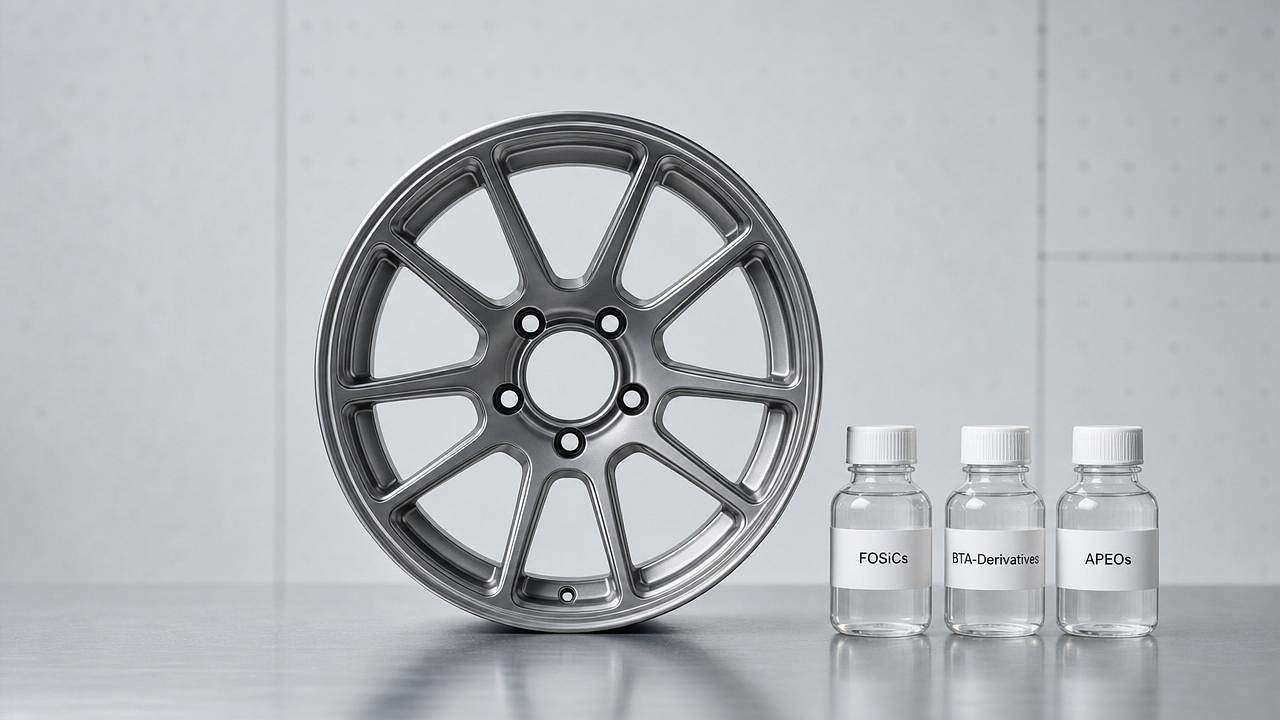
On 23 May 2026, the European Chemicals Agency (ECHA) updated Annex XVII of the REACH Regulation, introducing new restrictions on three classes of substances used in metal surface treatment agents—fluorinated organosilicon coupling agents (FOSiCs), benzotriazole derivatives (BTA-Derivatives), and certain alkylphenol ethoxylates (APEOs). The restrictions apply immediately to forged lightweight wheels and aero/low-drag wheels exported to the EU market.
Regulatory Update Confirmed
The European Chemicals Agency (ECHA) formally amended Annex XVII of the REACH Regulation on 23 May 2026. The amendment prohibits the use of FOSiCs, BTA-Derivatives, and specific APEOs in metal surface treatment formulations intended for anodizing and finishing processes applied to forged lightweight wheels and aero/low-drag wheels. This restriction applies to all such products placed on the EU market as of the effective date. Chinese manufacturers exporting these wheel types must resubmit SVHC screening reports and update their Declarations of Conformity (DoC) accordingly.
Impact Across Supply Chain Roles
Export-oriented trading companies
These firms face immediate compliance verification requirements before customs clearance. Non-compliant shipments risk detention or rejection at EU ports. They must now verify updated DoC documents and SVHC screening outcomes from suppliers prior to export booking.
Raw material procurement entities
Purchasers of surface treatment chemicals must reassess existing supplier portfolios. Substances previously accepted under older REACH provisions may no longer qualify. Procurement specifications must be revised to exclude FOSiCs, BTA-Derivatives, and restricted APEOs—and validated through certified lab testing.
Wheel manufacturing enterprises
Manufacturers relying on conventional anodizing lines must evaluate process compatibility with REACH-compliant alternatives. Equipment recalibration, bath formulation reformulation, and operator retraining may be necessary—particularly for high-precision forged wheel finishes requiring corrosion resistance and aesthetic consistency.
Supply chain compliance service providers
Third-party labs, certification bodies, and regulatory consultants will see increased demand for SVHC re-screening, DoC validation, and technical documentation audits. Their service scope must now explicitly cover substance-level traceability across multi-tiered chemical supply chains.
Key Compliance Actions for Exporters
Update SVHC screening and DoC documentation
Chinese suppliers must conduct new SVHC screenings covering the three newly restricted substance groups and issue updated Declarations of Conformity reflecting full alignment with the revised Annex XVII entries.
Review anodizing chemistry and process parameters
Surface treatment formulations used in post-forging anodization must be reformulated to eliminate FOSiCs, BTA-Derivatives, and non-exempt APEOs. Compatibility testing with existing wheel substrates and coating adhesion performance must be verified.
Verify conformity of upstream chemical suppliers
Manufacturers must obtain updated safety data sheets (SDS), substance declarations, and REACH-compliance statements from all chemical vendors—including intermediate formulators supplying pre-mixed anodizing additives.
Align export documentation with EU enforcement expectations
Commercial invoices, packing lists, and transport documents should reflect the updated regulatory status. Customs brokers must be briefed on classification implications and potential documentary red flags during EU border inspections.
Industry Perspective: Beyond Immediate Compliance
Analysis shows this amendment reflects a broader tightening of EU chemical governance—not just toward hazard reduction, but toward lifecycle accountability in high-value engineered components. From an industry perspective, the inclusion of FOSiCs and BTA-Derivatives signals growing scrutiny of functional additives that enhance performance but lack robust environmental degradation data. What deserves closer attention is the compressed timeline: unlike many REACH amendments granting phase-in periods, this restriction took effect immediately, underscoring ECHA’s prioritization of rapid risk mitigation over transitional flexibility. Observably, manufacturers with established REACH technical dossiers and integrated chemical management systems are better positioned to adapt than those relying solely on supplier attestations.
Strategic Implications for Wheel Suppliers
This regulatory shift marks a structural inflection point—not merely a compliance checkpoint. It elevates chemical transparency from a supporting requirement to a core design criterion in lightweight wheel development. For Chinese exporters, sustained market access hinges less on volume capacity and more on demonstrable, auditable control over surface chemistry inputs. The long-term implication is a de facto consolidation toward suppliers capable of end-to-end substance stewardship, including analytical verification, process validation, and real-time regulatory monitoring.
Source Information and Verification Notes
This article was generated exclusively from the provided title, event date (23 May 2026), and event summary. Specific official source links were not provided in the input and should be verified continuously. Stakeholders are advised to monitor ECHA’s official website for detailed guidance documents, enforcement FAQs, and updates on interpretation of the new Annex XVII entries—particularly regarding exemptions, concentration thresholds, and acceptable alternative substances. Ongoing observation is recommended for national enforcement practices across EU member states, technical tender revisions in automotive OEM procurement, and emerging industry-led substitution roadmaps.