
Industry Portal
Tags
ECE R117-03 Mandatory for EV Tyres in EU from 8 May 2026
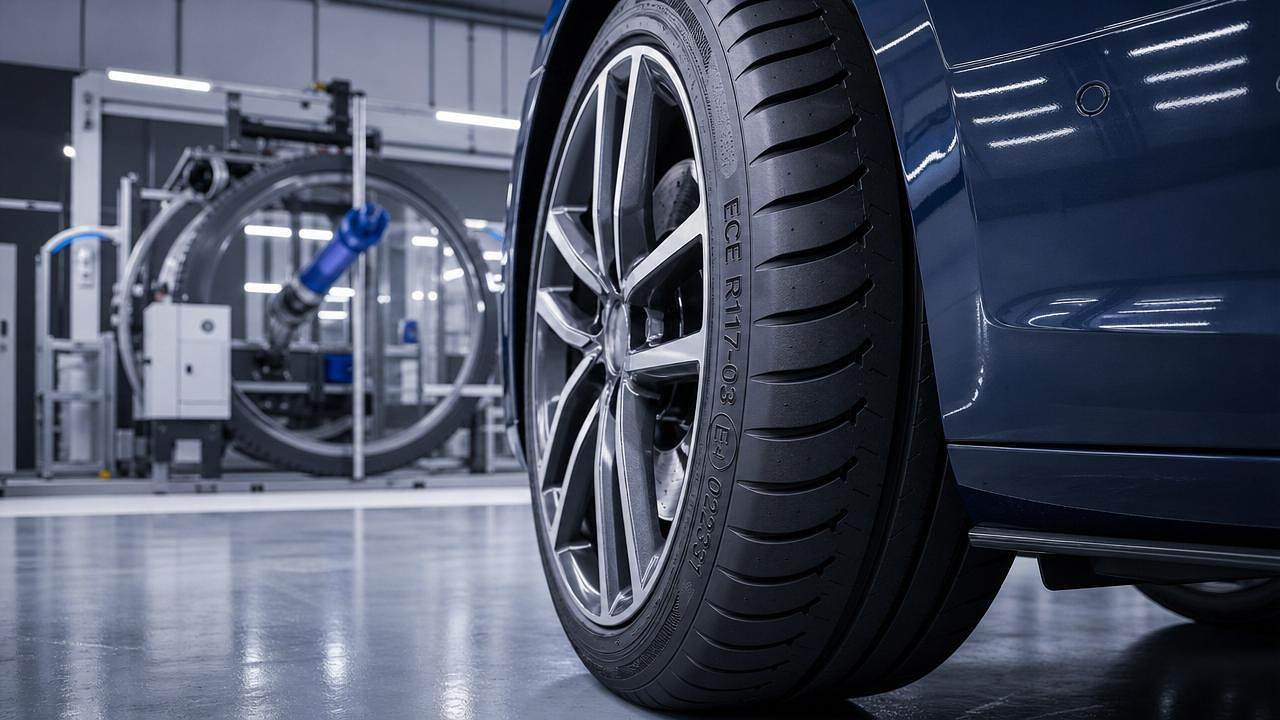
As of 8 May 2026, the United Nations Economic Commission for Europe (UNECE) has confirmed the full enforcement of Regulation ECE R117-03 for electric vehicle (EV) tyres entering the EU market. This regulation imposes binding requirements on rolling noise (≤69 dB), wet grip (≥1.02), and rolling resistance (≤6.5 kg/t). Export-oriented tyre manufacturers—particularly those based in China—must complete type approval for all applicable models within six months; otherwise, existing ECE certificates will lapse automatically. With only 32% of domestically produced EV tyres currently meeting all three criteria (per TÜV SÜD data), the regulation directly affects exporters, certification service providers, and downstream supply chain stakeholders.
Event Overview
On 8 May 2026, UNECE formally confirmed the mandatory implementation of ECE R117-03 for new EV tyre type approvals. The regulation requires compliance with three performance thresholds: maximum rolling noise of 69 dB, minimum wet grip index of 1.02, and maximum rolling resistance of 6.5 kg/t. All newly certified EV tyres placed on the EU market must meet these requirements. Chinese tyre exporters are required to complete full-type certification for all affected models within six months of this date; failure to do so results in automatic invalidation of prior ECE certificates. According to publicly cited data from TÜV SÜD, 32% of currently available Chinese-made EV tyres pass all three tests.
Impact on Specific Industry Segments
Export-focused tyre manufacturers: These companies face direct regulatory pressure to re-certify existing EV tyre SKUs. Non-compliance means loss of market access for affected models after the 6-month window closes. Certification delays or test failures may trigger production recalibration, material substitution, or design revision—each carrying cost and timeline implications.
Tyre testing and certification service providers: Demand for R117-03-specific testing capacity is expected to rise sharply over the next six months. Providers must verify their accreditation scope covers all three parameters under R117-03 (not just earlier versions), and confirm alignment with updated UNECE interpretation documents issued post-2026.
Raw material and compound suppliers: Achieving the rolling resistance and wet grip targets often requires reformulation of tread compounds—particularly adjustments to silica content, coupling agents, and polymer selection. Suppliers serving export-oriented tyre makers may see accelerated technical consultations and revised specification requests beginning Q2 2026.
Distribution and brand owners managing EU-bound inventory: Stockpiled tyres certified under earlier R117 versions (e.g., R117-02) remain compliant only if already placed on the market before the deadline—but ‘placed on the market’ is defined per EU national transposition rules. Distributors must track national implementation timelines and clarify whether unsold inventory qualifies for grandfathering.
What Relevant Enterprises or Practitioners Should Focus On and How to Respond
Monitor official UNECE and EU national authority updates closely
The formal entry into force date (8 May 2026) is confirmed, but national enforcement procedures—including grace periods for stock clearance or transitional labelling rules—may vary across EU member states. Enterprises should subscribe to notifications from designated type approval authorities (e.g., KBA in Germany, RDW in the Netherlands) and review national transposition acts as they are published.
Prioritise certification for high-volume and high-revenue EV tyre SKUs
Given finite testing capacity and potential backlog, enterprises should triage models by export volume, OEM fitment status, and contractual commitments. Models already in active OE fitment or covered by signed distribution agreements should be prioritised for immediate submission to avoid commercial disruption.
Distinguish between regulatory signal and operational readiness
While the mandate is effective as of 8 May 2026, actual certification turnaround time depends on laboratory availability, sample preparation, and documentation completeness. Enterprises should treat the six-month window not as a passive countdown, but as an active project timeline requiring internal coordination across R&D, quality, regulatory affairs, and logistics teams.
Review and update technical documentation and test reports now
Existing test reports issued under R117-02 or earlier may not satisfy R117-03’s updated test protocols—especially for rolling noise measurement methodology and wet grip reference tyre definitions. Manufacturers should audit current files against the latest UNECE Consolidated Resolution on the Construction of Vehicles (R.E.3), Annex 6, and initiate retesting where gaps exist.
Editorial Perspective / Industry Observation
This development is best understood not as an isolated regulatory change, but as a structural tightening of the EU’s sustainability-linked product policy framework—where tyre performance metrics increasingly serve as proxies for energy efficiency and road safety outcomes. Analysis shows that R117-03’s thresholds represent a measurable step up from prior versions, particularly in rolling resistance and noise control. Observably, the 32% pass rate among Chinese EV tyres suggests many current designs were optimised for cost or durability rather than the full R117-03 triad. From an industry perspective, this regulation functions less as a one-time compliance hurdle and more as a signal of converging global standards: similar tightening is anticipated in UK, South Korea, and ASEAN markets over the next 2–3 years. Current attention should therefore focus less on whether the rule applies—and more on how quickly enterprises can align product development cycles with evolving regulatory baselines.
The enforcement of ECE R117-03 marks a concrete shift in market access conditions for EV tyres—not merely adding another test requirement, but raising the performance floor across three interdependent parameters. Its significance lies not in novelty, but in enforceability: unlike previous versions, non-compliance now carries automatic certificate withdrawal, with no discretionary grace period for individual models. For industry participants, this is better interpreted as a calibrated calibration point—a moment where product specifications, testing infrastructure, and regulatory engagement practices must be synchronised to maintain continuity in EU trade.
Source: United Nations Economic Commission for Europe (UNECE); TÜV SÜD public dataset citation (2026). Note: National transposition timelines and enforcement interpretations across EU Member States remain subject to ongoing official publication and require continuous monitoring.