Industry Portal
Related News
- 00
0000-00
How Tire Dynamics Shape Braking Distance, Stability, and ABS Performance - 00
0000-00
How to Specify Automotive Trim Parts for Durable Interior and Exterior Finishes - 00
0000-00
Choosing Joining Technologies for Lightweight Multi-Material Vehicle Structures - 00
0000-00
Vehicle Lightweighting for Automotive Design: Balancing Mass, Safety, and Cost - 00
0000-00
ISO 9001 Requirements for Automotive Exterior Component Suppliers
How accurate are CFD simulations before physical testing?
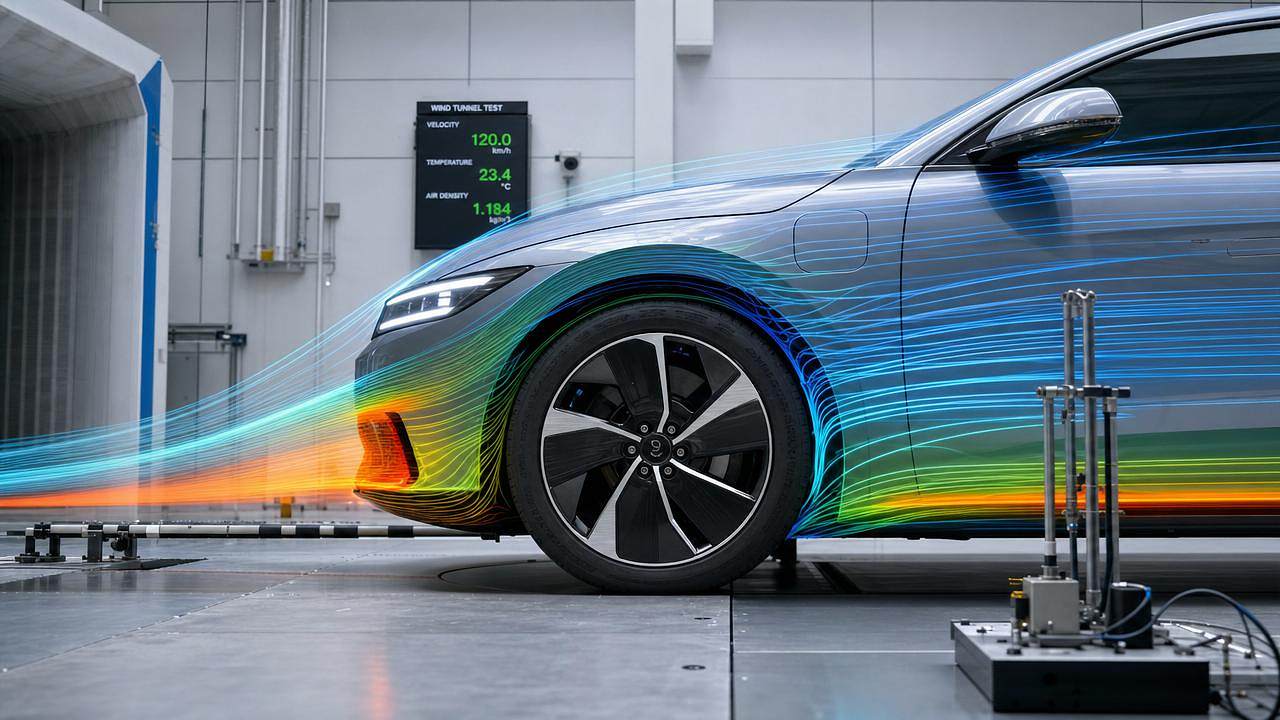
Before prototypes consume budget and timelines, project leaders need to know how far CFD simulations can be trusted. In automotive exterior, wheel airflow, lighting thermal paths, and tire-related aerodynamics, simulation accuracy can sharply reduce testing cycles—but only when models, assumptions, and validation methods are robust. This article explains where CFD simulations deliver reliable guidance before physical testing, and where engineering judgment and real-world verification still matter most.
For engineering managers and program owners in the NEV supply chain, the core question is rarely whether to use CFD simulations. The real issue is how accurate they are before tooling, prototype builds, chamber tests, coastdown work, or road validation begin.
That question matters across the AEVS focus areas: brake cooling inside low-drag alloy wheels, airflow around high-performance tires, thermal behavior in LED headlight assemblies, rain and wind behavior around sensor zones, and pressure management near sunroof interfaces. In all of these cases, simulation can compress 2–4 development loops into 1–2, but only if the model reflects reality closely enough.
A practical answer is this: CFD simulations are highly useful before physical testing for ranking concepts, detecting major flow issues, and estimating trends. They are less reliable when teams expect them to predict final certification-level numbers without disciplined setup, correlation, and boundary-condition control.
Where CFD simulations are most accurate before physical testing
In early and mid-stage development, CFD simulations perform best when the engineering target is comparative rather than absolute. If a project team wants to know whether Design A reduces drag more than Design B by 3%–8%, or whether one wheel spoke geometry improves brake ventilation over another, simulation can be very dependable.
This is especially true when geometry is stable, material behavior is not strongly nonlinear, and the operating window is well defined. For example, external aerodynamics at 80–120 km/h, steady thermal loading in a headlamp enclosure, or rotating wheel airflow under repeatable conditions are all suitable use cases.
High-value automotive exterior use cases
For project managers, the most bankable use of CFD simulations is directional decision support. A validated model can identify flow separation zones, hot spots, recirculation regions, water paths, and pressure imbalances before expensive prototype iterations start.
- Wheel and brake airflow studies for forged or cast alloy wheels
- Tire wake analysis affecting drag, lift, and aeroacoustic behavior
- LED headlight thermal paths, including heat sink and vent behavior
- Sensor-area airflow for camera, radar, and photoelectric switch reliability
- Sunroof edge sealing, wind noise, and pressure equalization studies
In these scenarios, teams often achieve useful correlation in the range of ±5% to ±15% for trend-based performance indicators before full physical testing, assuming mesh quality, turbulence modeling, and rotating domain treatment are appropriate. The exact range varies by subsystem and test objective.
Why comparative accuracy matters more than perfect prediction
Many delays occur because stakeholders expect simulation to replace all validation. In reality, one of the strongest advantages of CFD simulations is prioritization. If the tool helps a team eliminate 6 out of 10 weak concepts before cutting hardware, it already creates measurable value in cost, lead time, and engineering focus.
For a wheel, for example, knowing which vent window shape improves cooling flow by 10% under a standard rotation case can be more valuable at Gate 2 than trying to predict the exact final disc temperature after a full proving-ground event.
The table below shows where CFD simulations are generally strongest in pre-test automotive development and where confidence is usually lower.
The key takeaway is that CFD simulations are usually most accurate for relative ranking, design screening, and flow-field visualization. Confidence decreases when the physics become transient, multiphase, highly coupled, or highly sensitive to manufacturing variation.
What limits simulation accuracy in real automotive programs
When CFD simulations disappoint, the problem is often not the software itself. The gap usually comes from inputs, scope, or timing. Program teams may start with incomplete CAD, estimated boundary conditions, simplified rotating parts, or unrealistic thermal loads. Each shortcut can shift the result by several percentage points.
In automotive exterior development, five sources of error appear repeatedly: geometry simplification, mesh strategy, turbulence-model choice, boundary-condition uncertainty, and weak correlation planning. If even 2 of these 5 are off, pre-test confidence falls quickly.
Common technical causes of mismatch
A wheel airflow model may ignore underbody details or brake package heat release. A headlamp study may miss true LED power cycling or sealing leakage. A tire-related aerodynamic model may simplify tread, deformation, or road motion. These choices save time, but they also reduce realism.
- Geometry is not release-level and misses small but flow-sensitive edges.
- Mesh density is too coarse in boundary layers, vents, or wake zones.
- Rotating regions are simplified without checking wheel-road interaction.
- Thermal loads, ambient conditions, or vehicle speed profiles are estimated.
- No correlation plan exists for wind tunnel, thermal chamber, or road data.
For project leaders, this means simulation accuracy should be reviewed as a process capability, not just a solver output. A result with 8 million cells and attractive streamlines is not automatically trustworthy if the test setup it represents is still vague.
The cost of false confidence
An over-trusted simulation can trigger wrong sourcing, delayed tooling changes, or late-stage design churn. In practical terms, one incorrect decision at the prototype freeze point can add 3–6 weeks to a program, especially when wheel surfaces, vent parts, lamp housings, or sensor covers require redesign and revalidation.
That is why experienced organizations treat CFD simulations as a decision accelerator with defined confidence bands. They do not treat them as an unconditional substitute for hardware evidence.
How project managers should judge whether a CFD result is reliable
Engineering managers do not need to rebuild the mesh themselves, but they do need a simple governance framework. A reliable CFD simulations workflow should answer four questions clearly: what was modeled, what was simplified, what was assumed, and how will the result be validated.
If those four answers are weak, the result should be treated as exploratory. If they are documented and tied to test plans, the simulation can support sourcing, budgeting, and milestone decisions with much higher confidence.
A practical review checklist for program decisions
The following table can be used during design reviews, supplier meetings, or gateway approvals. It helps non-specialist decision makers test whether CFD simulations are mature enough to influence prototype investment.
For managers, the most important part of this checklist is not technical depth for its own sake. It is the ability to classify a result into one of three buckets: concept guidance, design optimization, or release decision support. Each bucket deserves a different level of trust.
Recommended confidence bands
A useful internal rule is to assign confidence bands before using CFD simulations in major decisions. For example, concept studies may only need medium confidence. Tooling-release decisions should require high confidence plus a defined physical correlation plan within 1–3 validation events.
- Low confidence: early geometry, generic inputs, no correlation history
- Medium confidence: stable CAD, known operating case, limited benchmark data
- High confidence: validated setup, mature inputs, prior physical correlation
Subsystem-specific guidance for wheels, tires, headlights, and sensors
Not all automotive exterior systems should be judged by the same standard. The physics differ, so the role of CFD simulations also differs. A strong project plan recognizes which subsystem can lean more heavily on virtual work and which still needs earlier hardware confirmation.
Aluminum alloy wheels and brake airflow
In wheel programs, CFD simulations are valuable for comparing spoke openness, barrel vent behavior, and cooling flow direction. They can often narrow 4–6 styling-feasible options down to 2 engineering-feasible choices before sample machining starts.
Accuracy improves when brake geometry, wheel rotation, ride height, and underbody influence are included. It drops when the model isolates the wheel too aggressively or ignores real road interaction. For low-drag EV wheels, even small surface changes can alter both drag and cooling enough to affect the tradeoff.
High-performance tires and wake control
For tires, CFD simulations help quantify wake size, local turbulence, and airflow interaction with wheelhouses. They are especially useful when teams want to cut drag without harming cooling or cabin noise targets. However, exact prediction becomes harder when tire deformation, tread detail, and road texture are simplified.
In project terms, use simulation to compare airflow trends and packaging options first. Use physical testing to confirm final performance at the edge cases, such as crosswind sensitivity, wet road spray, or combined aeroacoustic behavior.
LED headlight assemblies and thermal paths
Among AEVS-relevant systems, headlight thermal studies are often one of the stronger pre-test applications for CFD simulations. Heat sink effectiveness, vent path design, and enclosure temperature distribution can be screened early, often reducing the number of physical thermal iterations from 3 rounds to 1 or 2.
Yet transient duty cycles, local material tolerances, and dust or moisture effects still require validation. If the lamp includes matrix LED functionality or compact packaging near painted surfaces and sensors, the thermal margin should not rely on simulation alone.
Sensor switches, optical zones, and contamination risk
For radar, photoelectric, and automatic sensor activation areas, CFD simulations can reveal air stagnation, splash exposure, and contamination-prone surfaces. This supports better placement and protection strategy before expensive integration changes hit the vehicle front-end or mirror architecture.
Because these zones often involve multiphase flow, droplets, debris, and thermal interaction, simulation confidence should be treated as medium unless backed by controlled chamber or road evidence.
A realistic workflow: use CFD early, validate smartly, decide faster
The most effective organizations do not ask whether CFD simulations are accurate in the abstract. They build a staged workflow where each simulation phase has a defined business purpose. This turns virtual engineering into a program control tool rather than a reporting exercise.
A 5-step workflow for project teams
- Use simplified CFD simulations for concept screening and architecture tradeoffs.
- Refine geometry and operating conditions at the design-freeze approach stage.
- Run sensitivity checks on mesh, loads, and key assumptions.
- Link 1–3 physical tests directly to the highest program risks.
- Update the model using test correlation before release-level decisions.
This workflow usually creates the best return when prototype budgets are tight, launch timing is aggressive, or multiple suppliers are contributing wheel, tire, lamp, and sensor components into one exterior performance target.
What this means for sourcing and supplier reviews
When suppliers present CFD simulations, buyers and project owners should look beyond attractive contour plots. Ask whether the virtual result reduced a specific risk, shortened a decision by 1–2 weeks, or prevented a likely hardware rework loop. If not, the analysis may be technically impressive but commercially weak.
For Tier 1 suppliers, aftermarket performance brands, and global exterior system partners, the strongest technical credibility comes from combining simulation discipline with transparent validation logic. That is exactly where strategic industry intelligence becomes useful: understanding not only the model, but also the standards, materials, cost pressures, and design trends surrounding it.
CFD simulations are accurate enough before physical testing to guide concept selection, reveal hidden airflow or thermal risks, and reduce unnecessary prototype loops across wheels, tires, lighting, sensor zones, and related exterior systems. Their value is highest when program teams define assumptions clearly, classify confidence honestly, and connect virtual results to a focused validation plan.
For project managers, the winning approach is not simulation-only or test-only. It is a controlled combination of both, used at the right stage and for the right decision. If you want deeper insight into automotive exterior aerodynamics, wheel airflow, smart lighting thermal behavior, or supplier-facing technical intelligence, contact AEVS to get a tailored solution, discuss your project details, or explore more decision-ready industry analysis.