
Industry Portal
Related News
- 00
0000-00
IAA Mobility 2026 Puts Panoramic Roofs on the Procurement Agenda - 00
0000-00
Aluminum Spike Extends Forged Wheel Lead Times - 00
0000-00
Japan Enforces Dual Durability Tests for Smart Dimming Glass - 00
0000-00
U.S. DOT Moves to Require OTA Audit Capability in ADB Modules - 00
0000-00
EU Laser Headlight Rule Under ECE R149 Takes Effect July 1
How to Evaluate Thermal Management Models for EV Motors and Battery Systems
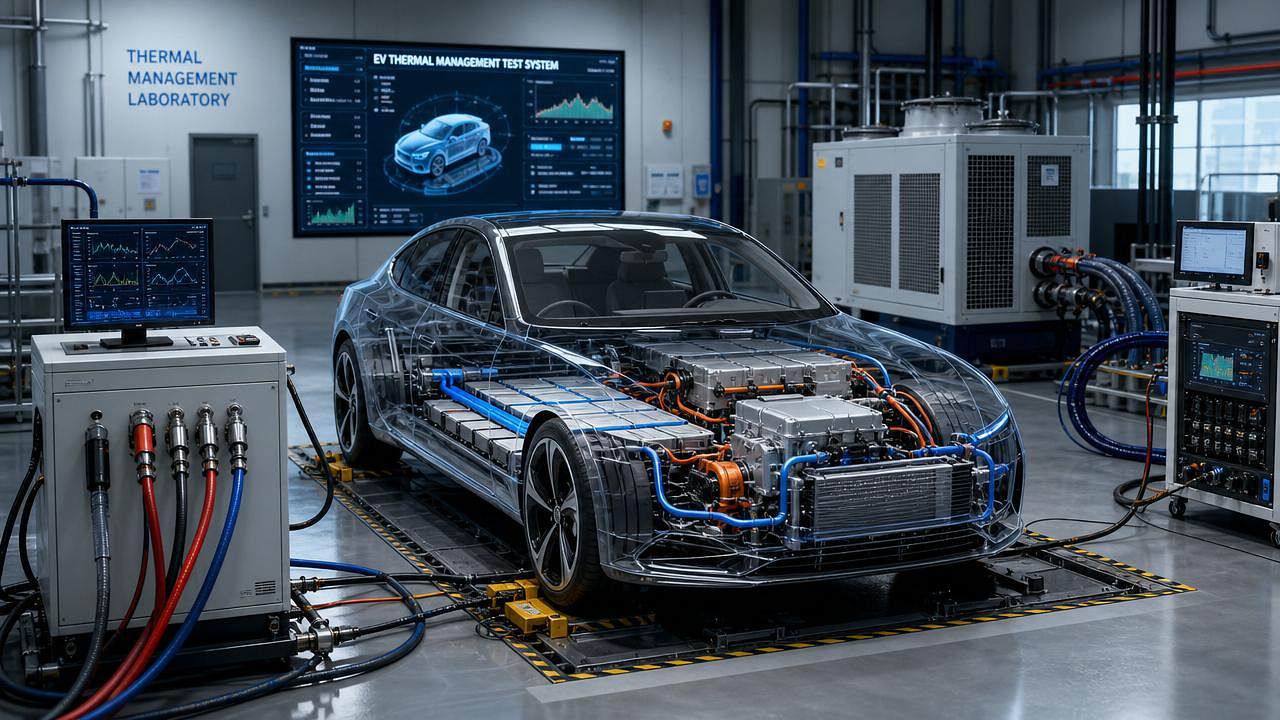
How to Evaluate Thermal Management Models for EV Motors and Battery Systems
As EV performance, safety, and efficiency become board-level priorities, choosing the right thermal management models is no longer just an engineering task.
It is a strategic decision that shapes reliability, range, warranty risk, and speed to market.
For buyers comparing software, suppliers, and validation partners, thermal management models should be judged by business value as much as technical elegance.
That matters even more in the broader AEVS ecosystem, where battery heat, motor efficiency, wheel airflow, tire rolling resistance, and lighting electronics increasingly interact.
Why thermal management models now matter beyond engineering
A weak model can produce expensive confidence.
It may look accurate in a lab case, yet fail under fast charging, high-load driving, cold starts, or hot urban cycles.
For EV motors, poor thermal assumptions distort torque derating, magnet protection, insulation life, and inverter coordination.
For battery systems, inaccurate thermal management models can misjudge cell aging, thermal propagation risk, charging limits, and usable energy windows.
From a procurement angle, the real question is simple.
Can these thermal management models reduce uncertainty across product design, sourcing, compliance, and lifecycle cost?
Start with the business use case
Before comparing vendors, define where the model will influence decisions.
Different use cases require different thermal management models.
- Concept design needs fast trade-off models for architecture screening.
- Detailed development needs coupled electro-thermal and CFD accuracy.
- Validation needs correlation with test benches and road data.
- Operations may need digital twins for predictive control and service insights.
This step avoids a common buying mistake.
Many teams buy the most advanced model, when the real need is a scalable model that fits daily decision speed.
What to check in EV motor thermal management models
Motor-side thermal behavior is rarely isolated.
A useful evaluation should cover the motor, inverter, housing, coolant path, drive cycle, and control logic.
Model fidelity
Check whether the model represents stator windings, rotor losses, magnets, shaft conduction, and cooling jacket performance.
If these are simplified too aggressively, hotspot prediction becomes unreliable.
Transient response
Steady-state results are not enough.
Strong thermal management models must capture launch torque spikes, repeated acceleration, hill climbs, and regenerative braking heat patterns.
Control integration
Ask whether the model links to derating logic and supervisory control strategies.
A model that predicts heat but cannot support control decisions offers limited commercial value.
What to check in battery system thermal management models
Battery packs demand wider evaluation criteria because risk exposure is higher.
The best thermal management models should connect cell behavior with module layout, cooling design, and pack-level safety strategy.
Cell-level realism
Review how the model handles heat generation, internal resistance, SOC, SOH, and chemistry-specific behavior.
This becomes critical when comparing LFP, NMC, or next-generation cell formats.
Pack non-uniformity
Average temperature is not the key metric.
Temperature spread often drives aging imbalance, charging inconsistency, and warranty loss.
Abuse and propagation capability
Ask whether the thermal management models can simulate fast charging stress, coolant failure, external heat, and thermal runaway pathways.
In procurement terms, this separates a design aid from a safety decision tool.
The five evaluation criteria that matter most
- Accuracy against measured data. Demand validation versus dyno, chamber, and vehicle results.
- Scalability across programs. Thermal management models should work from prototype to production variants.
- Speed of simulation. Slow models often fail to support design iteration and sourcing timelines.
- Integration with existing tools. Compatibility with BMS, CFD, CAE, and controls matters.
- Decision relevance. Outputs should support cost, risk, and performance trade-offs clearly.
If one of these criteria is weak, ownership cost usually rises later through delays, redesigns, or overengineering.
Questions to ask suppliers before buying
A polished demo should never replace structured questioning.
- What validation data supports the thermal management models?
- How often are material properties and cell parameters updated?
- Can the model handle mixed duty cycles and regional climates?
- How are uncertainty and sensitivity reported?
- What training, support, and customization are included?
- Can the solution scale across motor, battery, and related thermal subsystems?
The last question is increasingly important as EV thermal decisions intersect with wheel aerodynamics, brake cooling, sensor reliability, and smart lighting durability.
Common procurement risks to avoid
Several risks appear repeatedly in sourcing reviews.
- Buying thermal management models with strong visuals but weak correlation.
- Choosing models built only for one chemistry or one cooling architecture.
- Ignoring solver speed and workflow burden on internal teams.
- Treating validation as a one-time milestone, not a continuous discipline.
- Underestimating integration cost with legacy engineering systems.
More clearly now, the market rewards buyers who evaluate operating fit, not just model sophistication.
A practical scoring framework
To compare vendors fairly, use a weighted scorecard.
This approach keeps thermal management models tied to measurable business priorities, not internal preference alone.
Why cross-system thinking creates better decisions
In real vehicles, thermal performance is connected.
Low-drag wheels change airflow behavior.
Tire design influences rolling losses and heat generation.
LED headlight modules and sensors also introduce packaging and local heat constraints.
That is why advanced evaluation should not isolate motor and battery models from the vehicle exterior context.
The strongest sourcing teams increasingly prefer thermal management models that support this broader systems view.
Final decision guidance
The right thermal management models do more than predict temperature.
They improve design confidence, shorten iteration cycles, support compliance, and reduce avoidable cost.
When evaluating options, focus on validated accuracy, operational fit, integration depth, and long-term scalability.
In practice, the best purchase is rarely the flashiest platform.
It is the one that turns thermal insight into faster, safer, and more profitable EV decisions.
If the next sourcing cycle includes motor platforms, battery packs, or connected exterior systems, now is the right time to benchmark thermal management models with a cross-functional scorecard.