
Industry Portal
Related News
- 00
0000-00
How Tire Dynamics Shape Braking Distance, Stability, and ABS Performance - 00
0000-00
How to Specify Automotive Trim Parts for Durable Interior and Exterior Finishes - 00
0000-00
Choosing Joining Technologies for Lightweight Multi-Material Vehicle Structures - 00
0000-00
Vehicle Lightweighting for Automotive Design: Balancing Mass, Safety, and Cost - 00
0000-00
ISO 9001 Requirements for Automotive Exterior Component Suppliers
Why raw material cost fluctuations keep changing EV pricing
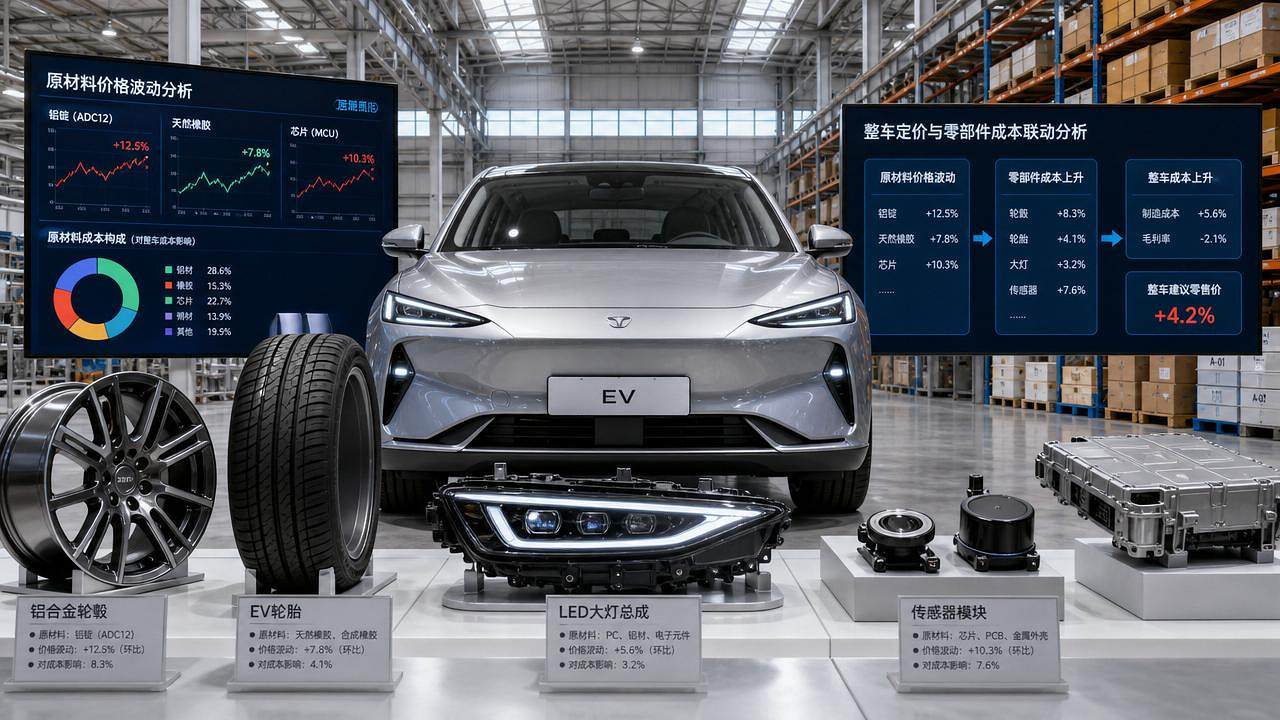
For financial planning across the EV value chain, raw material cost fluctuations have become a daily pricing variable, not a distant market signal.
They affect battery packs, aluminum wheels, tires, LED headlight assemblies, sensor modules, logistics contracts, and even warranty assumptions.
That is why EV pricing keeps moving even when consumer demand, vehicle design, and factory capacity appear relatively stable.
For AEVS, this issue matters because exterior lightweighting and smart vision systems depend heavily on aluminum, polymers, specialty rubbers, copper, and electronics inputs.
Understanding raw material cost fluctuations helps connect sourcing reality with product strategy, price discipline, and long-term competitiveness in new energy mobility.
When do raw material cost fluctuations become a direct EV pricing trigger?
Not every cost move changes the sticker price immediately. The impact depends on timing, contract structure, and component sensitivity.
In some quarters, automakers absorb higher input costs. In others, suppliers renegotiate, model mixes shift, or optional features get repriced.
Raw material cost fluctuations usually become a direct pricing trigger in five conditions:
- Commodity increases last longer than one purchasing cycle.
- A material affects multiple high-value systems at once.
- Supply contracts include index-based adjustment clauses.
- Model margins are already thin.
- Trade, energy, or logistics shocks amplify base material inflation.
This matters in the comprehensive automotive ecosystem, where one material movement can ripple from wheel design to sensor packaging and final retail strategy.
Scenario one: aluminum-intensive exterior systems face fast margin pressure
Aluminum is central to EV lightweighting. It supports range goals, wheel performance, structural efficiency, and visual appeal.
When aluminum prices rise, forged wheels, cast wheels, brackets, housings, and selected body-adjacent exterior parts all become more expensive.
This scenario is especially important for premium EVs. Lightweight exterior components are not cosmetic extras; they are part of efficiency engineering.
In that setting, raw material cost fluctuations do more than raise part prices. They also pressure aerodynamic optimization programs and trim-level profitability.
Core judgment points in aluminum-heavy programs
- How much of the bill of materials is indexed to aluminum benchmarks?
- Are low-pressure casting and forging capacities regionally balanced?
- Can design teams substitute geometry optimization for material volume?
- Will higher wheel costs alter OEM option pricing?
If the answer points to limited substitution and strong performance dependence, EV pricing usually becomes more exposed.
Scenario two: tire and rubber cost swings reshape operating economics
High-performance EV tires rely on natural rubber, synthetic rubber, carbon black, silica, steel cord, and specialty chemicals.
Raw material cost fluctuations in these inputs affect both original equipment tires and replacement channels.
EVs create a special challenge. Their higher curb weight and instant torque demand stronger compounds, quieter construction, and lower rolling resistance.
That means tire makers cannot always downgrade materials without hurting noise, grip, or durability targets.
What to watch in this scenario
When rubber costs rise sharply, the first visible effect may not be vehicle list price. It may appear in replacement tire inflation or reduced promotional support.
Over time, however, OEM tire package costs can force EV pricing revisions, especially in high-volume models with tight margin architecture.
This is where raw material cost fluctuations become a lifecycle issue, not just a launch-cost issue.
Scenario three: smart lighting and sensor systems absorb hidden commodity risk
LED headlight assemblies and auto sensor switches look like electronics stories, but they also depend on raw materials with volatile pricing.
Copper, rare earth materials, engineering plastics, semiconductor substrates, optical resins, and aluminum heat sinks all matter.
In advanced matrix lighting, thermal management and optical precision leave less room for cost-down substitution.
If input inflation hits several subcomponents at once, suppliers may spread increases across modules rather than one visible line item.
Core judgment points for vision-system exposure
- How complex is the module architecture?
- Are imported optical materials involved?
- Do compliance standards limit redesign flexibility?
- Is the system standard or optional across trims?
These factors determine whether raw material cost fluctuations affect premium packages first or broad vehicle pricing later.
How different EV pricing scenarios respond to raw material cost fluctuations
What scenario-based planning works best when costs keep moving?
A practical response starts by linking each EV program to its highest-volatility materials, then testing how those materials affect total delivered cost.
The goal is not perfect prediction. The goal is faster decision quality under uncertainty.
Recommended adaptation actions
- Build material exposure maps for wheels, tires, lighting, and sensors.
- Separate temporary spikes from structural cost resets.
- Review supplier contracts for pass-through timing and benchmark formulas.
- Use scenario budgets for energy, freight, and commodity bundles.
- Align trim strategy with parts most exposed to raw material cost fluctuations.
- Track compliance-linked components that cannot be easily respecified.
This approach supports stronger pricing strategy across both OEM and aftermarket channels.
Common misreads that distort EV pricing decisions
One common mistake is focusing only on battery minerals. Exterior and vision systems often carry meaningful cost sensitivity too.
Another mistake is assuming all raw material cost fluctuations can be delayed through supplier negotiation.
That may work briefly, but suppliers facing energy inflation, metal volatility, and compliance costs eventually reset pricing.
A third error is ignoring interaction effects. Aluminum, rubber, freight, and energy can rise together and compound total cost pressure.
The final misread is treating every platform the same. Premium, mass-market, export, and compliance-sensitive models respond very differently.
A more actionable next step for cost-resilient EV pricing
The most effective next move is to convert commodity volatility into component-level intelligence.
That means tracing raw material cost fluctuations from benchmarks into wheels, tires, LED headlights, sensor switches, and final vehicle positioning.
AEVS supports this view by connecting exterior lightweighting, optical systems, compliance trends, and material-market shifts in one decision framework.
When that framework is in place, EV pricing becomes less reactive and far more strategic.
In a market where raw material cost fluctuations keep rewriting assumptions, better visibility is no longer optional. It is a pricing capability.