
Industry Portal
Related News
- 00
0000-00
How to Evaluate Auto Sensor Switches for Passenger Cars: Accuracy, Response, Reliability - 00
0000-00
Automotive Exterior and Vision Systems: Supplier Qualification Checklist - 00
0000-00
How to Evaluate an Automotive Exterior Systems Manufacturer for OEM Program Supply - 00
0000-00
Automotive Component Sourcing in China: How Buyers Verify Quality, Cost, and Supply Risk - 00
0000-00
Headlight Thermal Management Standards: Testing LED Heat Dissipation and Reliability
What Affects Automotive Lightweight Components Price? Materials, Volume, and Tooling
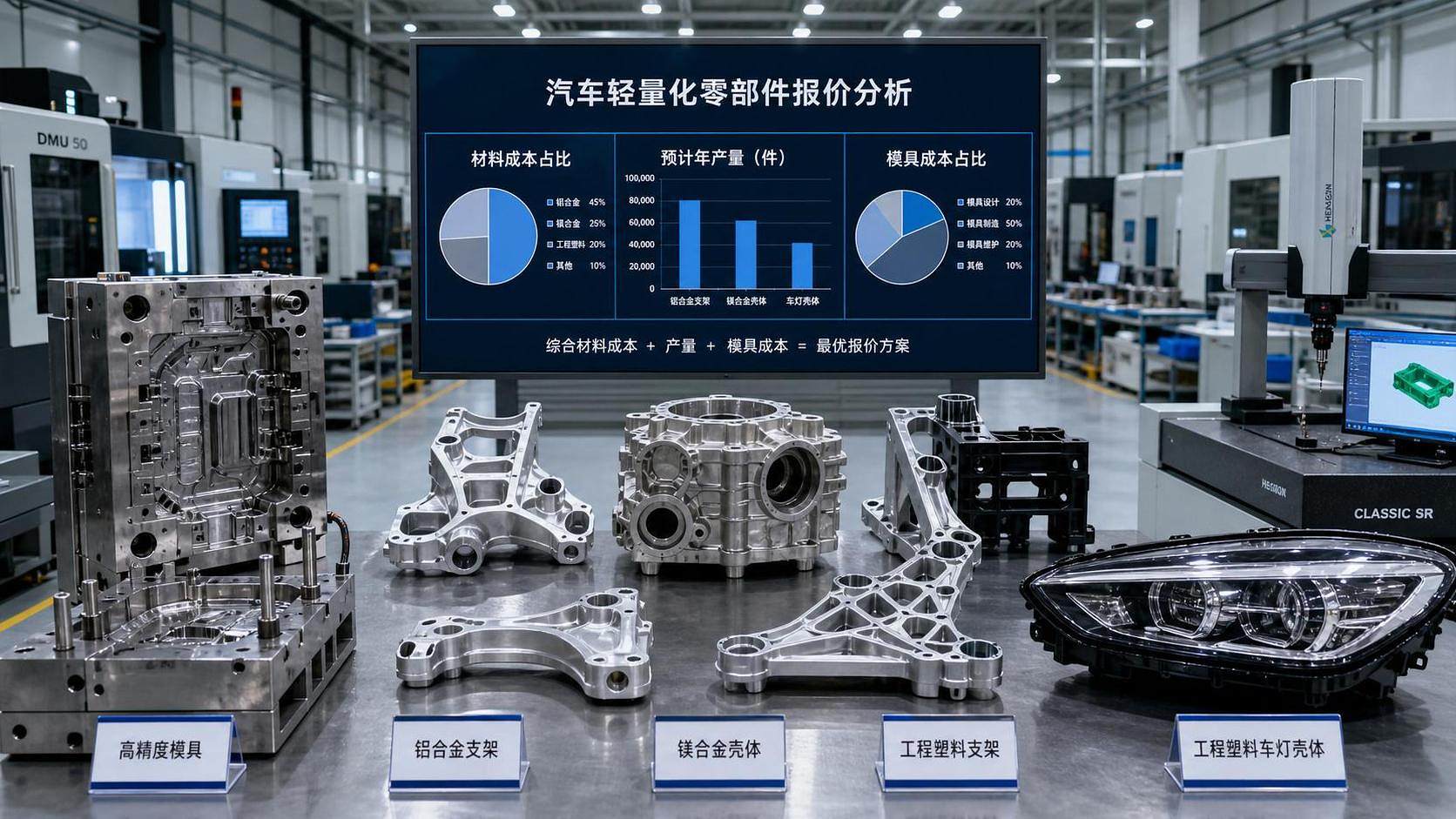
What Affects Automotive Lightweight Components Price? Materials, Volume, and Tooling
For procurement teams, understanding automotive lightweight components price starts with three core variables: materials, production volume, and tooling investment.
Whether sourcing aluminum exterior parts, optical housings, or other weight-saving components, buyers need clear cost logic to balance performance, compliance, and margin.
This article breaks down the main pricing drivers and shows how smarter sourcing decisions can reduce total cost without compromising quality.
Why automotive lightweight components price varies so much
The biggest mistake in sourcing is comparing quotes without comparing assumptions.
Two suppliers may both quote an exterior bracket, lamp housing, or wheel-related part, yet their cost structures can be completely different.
That is why automotive lightweight components price is rarely just a material number.
It reflects engineering choices, process capability, annual demand, quality controls, and the commercial model behind the tool.
In practice, three cost levers matter most: material selection, production volume, and tooling strategy.
Once these are understood, quote gaps become easier to explain and negotiate.
Material choice is the first cost driver
Material usually defines the baseline of automotive lightweight components price.
For lightweight exterior and vision parts, common options include aluminum alloys, magnesium alloys, engineering plastics, composites, and hybrid structures.
Each option changes not only raw material cost, but also scrap rate, processing time, and downstream quality risk.
Aluminum and magnesium
Aluminum is widely used because it balances weight reduction, corrosion resistance, and manufacturability.
But aluminum prices move with energy markets, regional supply, and alloy grade availability.
Magnesium can cut more mass, but it often raises automotive lightweight components price through stricter handling, lower yield, and added safety controls.
Engineering plastics and composites
For sensor covers, headlamp structures, and aerodynamic trim, plastics can look cheaper at first.
However, flame resistance, UV stability, optical clarity, and temperature resistance can quickly push resin costs upward.
Composites reduce weight well, yet cycle times, post-processing, and repair difficulty may increase the final automotive lightweight components price.
Material grade matters more than many RFQs show
A quote based on generic alloy language is risky.
Strength targets, surface class, dimensional tolerance, coating compatibility, and ECE or DOT requirements all affect usable material choices.
This also means a lower unit quote may hide substitution risk.
Production volume changes unit economics fast
Volume is the second major driver of automotive lightweight components price.
A component built for 5,000 units per year is priced very differently from one built for 200,000 units.
The reason is simple: fixed costs need to be spread across more parts.
Low-volume programs
Prototype EV platforms, premium trims, and regional variants usually carry higher piece prices.
Setup costs, sampling, validation, and inventory buffering are distributed over fewer shipments.
In these cases, automotive lightweight components price often depends on process flexibility more than raw material savings.
High-volume programs
When annual volume rises, suppliers can justify automation, multi-cavity tooling, and tighter cycle optimization.
That typically reduces unit cost, but only after launch instability is under control.
Early overestimation of volume can backfire if the supplier builds capacity that never gets absorbed.
Volume forecasts influence quote credibility
Suppliers price risk into uncertain forecasts.
If release schedules are unstable, they may increase automotive lightweight components price to cover idle labor, safety stock, and expedited logistics.
Clear demand visibility usually produces more competitive quotes.
Tooling investment is often the hidden pricing factor
Tooling is where many sourcing discussions become misleading.
One quote may show a low unit price but a high tool charge.
Another may bury part of the tool cost inside the piece price.
Without separating these items, it is hard to compare total landed economics.
What drives tooling cost
- Part geometry complexity and undercuts
- Surface finish and appearance standards
- Tolerance requirements for optical or sensor interfaces
- Tool steel grade and expected lifetime
- Number of cavities and cycle-time targets
- Secondary operations such as trimming, coating, or insert assembly
In automotive exterior and vision systems, tight optical alignment can make tooling more expensive than buyers first expect.
That cost still matters because it directly affects defect rates and launch timing.
Amortized versus upfront tooling
Amortized tooling lowers the visible entry cost, which can help with budget approval.
But it can raise automotive lightweight components price over the life of the program.
Upfront tooling creates cleaner unit economics, though it increases early cash pressure.
The better model depends on program duration, forecast confidence, and ownership terms.
Other factors that shape automotive lightweight components price
Materials, volume, and tooling explain most cost movement, but not all of it.
Several secondary factors can shift automotive lightweight components price enough to change a sourcing decision.
How to evaluate quotes more accurately
A good cost review looks beyond the headline unit price.
This is especially true when automotive lightweight components price is tied to performance-critical applications.
- Request a clean cost breakdown for material, conversion, tooling, finishing, and logistics.
- Confirm the exact alloy, resin, or composite specification behind the quote.
- Check whether annual volume assumptions match the latest SOP plan.
- Clarify who owns the tool, who maintains it, and how modifications are charged.
- Review validation scope, PPAP timing, and the cost of engineering changes.
- Compare landed cost, not only EXW or FOB pricing.
When this discipline is missing, teams often select the cheapest quote and discover later that total cost was never actually lower.
How to reduce automotive lightweight components price without losing quality
Cost reduction is possible, but it usually comes from smarter design and sourcing alignment.
- Simplify geometry early to lower tool complexity and improve yield.
- Standardize materials across related platforms where performance allows.
- Bundle volume across regional programs to improve supplier commitment.
- Use value engineering to remove unnecessary cosmetic or tolerance demands.
- Track metal and resin indices, then time negotiations around market movement.
- Engage capable suppliers early on DFM before RFQ release.
From recent market shifts, the stronger signal is that volatility now matters almost as much as nominal price.
That means stable process control and technical transparency are becoming strategic cost advantages.
Final takeaway for cost-focused sourcing
Automotive lightweight components price is shaped first by material choice, then by volume assumptions, and finally by tooling structure.
Everything else, from compliance to scrap, builds on those three foundations.
In real sourcing work, the best result rarely comes from chasing the lowest visible quote.
It comes from understanding the cost logic, testing assumptions early, and negotiating around total program value.
A more disciplined view of automotive lightweight components price leads to better margins, fewer launch surprises, and stronger supplier decisions over time.