Industry Portal
Related News
- 00
0000-00
NEV Industry Standards in China: Which Battery Safety Tests Are Required? - 00
0000-00
Automotive Exterior Lighting Systems: Lamp Types, Functions, and Placement - 00
0000-00
Choosing an Electric SUV Sunroof: Key Fit, Safety, and Weather-Sealing Factors - 00
0000-00
Pop-Up Automotive Sunroof Systems: Key Design Factors for Vehicle Integration - 00
0000-00
Automotive Product Comparison Charts: How Buyers Can Compare Specs, Cost, and Fit
ECE-Compliant Waterproof Lighting: What Tests Prove Road-Ready Sealing?
ECE-Compliant Waterproof Lighting: What Tests Prove Road-Ready Sealing?
For a technical evaluator, an exterior lamp can look perfectly sealed on a bench and still become a warranty issue after one winter, one pressure-wash cycle, or one long descent through humid mountain weather. Water droplets behind a lens, corrosion at a connector, intermittent LED operation, and fogging that never clears are not merely cosmetic defects. They can affect beam performance, diagnostic stability, optical appearance, and ultimately the validity of a type-approved lighting function.
That is why ECE compliant lighting waterproof performance should never be judged by a single “waterproof” label on a drawing or supplier datasheet. Road-ready sealing is demonstrated through a combination of regulation-relevant environmental testing, documented product construction, functional verification, and disciplined interpretation of the test results.
For LED headlamp assemblies, rear combination lamps, daytime running lamps, side markers, and adaptive lighting modules, the central question is not simply, “Did water get inside?” A more useful question is: Can the complete assembly maintain its required photometric and electrical performance after realistic water, thermal, pressure, vibration, and aging exposure?
Start with the regulatory boundary: ECE approval is not the same as an IP rating
In global vehicle lighting programs, “ECE-compliant” usually refers to compliance with the applicable UN Regulations administered under the 1958 Agreement. Depending on the lamp function, the relevant requirements may sit within UN Regulation No. 148 for many light-signalling devices, UN Regulation No. 149 for road-illumination devices, or other applicable regulations and amendment series. The exact test obligations depend on the lamp category, vehicle application, approval scope, and regulatory version being used for the project.
These regulations assess a lamp as a safety-relevant optical device. They are concerned with matters such as installation, light distribution, color, visibility, durability, and resistance to environmental conditions. Sealing performance matters because water ingress may compromise any of those outcomes.
An IP rating, by contrast, is generally based on IEC 60529 and describes resistance to solid-object and water ingress under defined laboratory conditions. IPX4, IPX6, IPX7, or IPX9K-type claims may be highly relevant in a supplier validation plan, especially for externally mounted lamps and connectors. Yet an IP test alone does not establish ECE approval. It does not prove that the lamp still meets photometric requirements, withstands thermal cycling, retains its optical clarity, or preserves the approved beam pattern after environmental exposure.
Technical teams should therefore treat IP testing as supporting evidence, not as a substitute for the applicable UN/ECE type-approval test program.
What “waterproof” really means in an automotive lamp
Automotive lighting assemblies are rarely designed as permanently hermetic boxes. Many contain pressure-equalization vents, membranes, serviceable interfaces, cable exits, heat sinks, and material joints that must cope with expansion and contraction. The objective is not always to eliminate every trace of internal moisture under every imaginable condition. The objective is to prevent water from reaching sensitive areas in a way that causes unsafe, non-compliant, or durability-limiting behavior.
That distinction is particularly important when evaluating LED headlamp assemblies. LEDs generate less forward heat than halogen sources, but their electronics, drivers, and thermal interfaces create their own temperature gradients. A lamp may draw humid air through a vent during cooling. If its venting strategy, desiccant approach, drainage path, lens coating, or housing geometry is poorly engineered, condensation can become persistent rather than temporary.
A practical evaluation should distinguish among four different conditions:
- External splash exposure: Rain, wheel spray, puddle splash, road slush, and wash-water impact must not penetrate through seals, vents, joints, or connector interfaces.
- Pressure-driven ingress: High-pressure washing, vehicle speed, or rapid thermal changes can force water toward areas that remain dry in static immersion or simple spray tests.
- Condensation: Temporary misting may occur in some vented lamp designs, but it must clear within the applicable requirements and must not impair light output or create permanent staining.
- Long-term moisture damage: Repeated exposure can cause terminal corrosion, galvanic attack, adhesive degradation, reflector damage, PCB contamination, and failure of electronic controls.
The tests that build credible sealing evidence
No single test represents every road condition. A credible validation file is a sequence of stresses that challenge the housing, lens-to-body joint, rear cover, breather system, connector, cable grommet, and internal electronics from different directions.
Water spray and splash testing
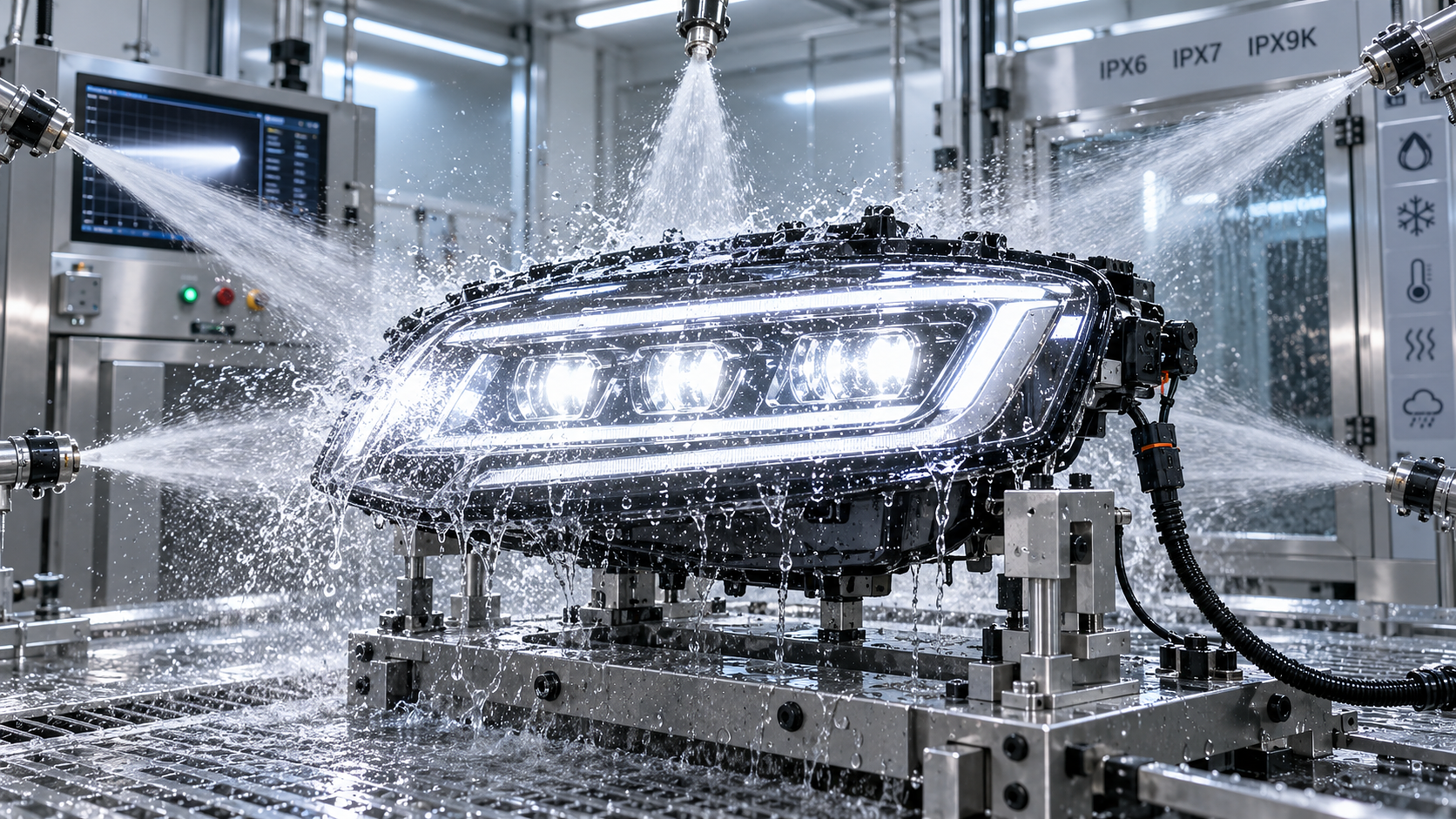
Spray testing is often the first proof point because it simulates the water a vehicle encounters every day: rain, wake from other traffic, tire spray, and washdown. The test setup may define nozzle geometry, water flow, spray angle, distance, duration, rotation, and sample orientation. These details matter. A lamp mounted upright on a test fixture can behave differently from one installed behind a grille opening, below a sharp hood edge, or close to a wheel arch.
After exposure, the evaluator should inspect more than the lens cavity. Check for moisture at connector seals, cap interfaces, vent membranes, PCB compartments, and drain paths. The assembly should then be functionally operated and, where required, rechecked for photometric performance. A lamp that illuminates immediately after the spray test but develops leakage-current faults after drying has not demonstrated robust sealing.
High-pressure water resistance
Pressure washing is a severe but realistic service scenario, particularly for commercial fleets, off-road vehicles, premium detailing environments, and winter road maintenance operations. High-pressure water can exploit marginal joints that survive normal rain simulation. It is especially revealing around decorative bezels, multi-part lenses, radar or camera-adjacent lamp structures, rear access covers, and wire harness exits.
For this reason, the test report should identify whether water pressure was applied directly to vulnerable zones or merely around the general housing. If a supplier presents a broad IP claim, ask for the complete test method, not only the final designation. The nozzle distance, pressure, flow rate, temperature, exposure duration, and preconditioning status all influence the result.
Immersion or temporary submersion testing
Immersion tests are useful when the lamp location may be exposed to deep standing water, flooded roads, or accidental submersion. However, they should be interpreted carefully. Slow static immersion does not reproduce the localized force of a pressure washer, and neither test fully represents thermal pumping caused by a hot lamp entering cold water.
Where immersion is relevant, the evaluation should include post-test electrical checks and internal inspection. Water may enter a non-optical chamber and remain unnoticed until it corrodes a terminal or migrates across a wiring path. A short-term pass is less meaningful if the assembly is not subsequently aged, energized, or thermally cycled.
Thermal cycling and thermal shock
Temperature variation is one of the most effective ways to expose weak seals. A lamp housing, polycarbonate lens, silicone gasket, metal heat sink, adhesive bead, and vent membrane do not expand at the same rate. Repeated hot-cold cycling can create micro-gaps at interfaces that appear sound during initial assembly inspection.
Thermal shock adds another layer of severity. Consider a headlamp operating at elevated temperature during rain, followed by a sudden cold-water splash. The resulting pressure shift can pull moist air or water through a marginal seal. For technical evaluators, the relevant question is whether water testing was performed only on new, room-temperature samples—or also after thermal conditioning. The latter is far more representative of road use.
Humidity and condensation evaluation
Humidity testing examines the lamp’s ability to tolerate moisture-laden air and repeated condensation conditions. It is particularly important for LED systems with enclosed electronic drivers, adaptive beam modules, printed circuit boards, and optical components that can be damaged by a thin but persistent moisture film.
Assessors should document where condensation appears, how quickly it disperses, whether droplets form in the effective luminous area, and whether water marks remain after the lamp returns to ambient conditions. A temporary haze near a non-critical edge may be operationally different from droplets across the projected beam path. The acceptance criteria must follow the applicable regulation and approved technical specification, rather than subjective visual judgment alone.
Dust, corrosion, and chemical exposure
Water rarely arrives clean. Road spray carries salt, fine grit, washer-fluid residues, de-icing chemicals, and pollutants. Coastal markets and winter-service regions are especially demanding. Salt and moisture together can attack connector plating, conductive paths, vent components, reflector coatings, screws, and ground connections.
Corrosion testing is therefore part of a meaningful sealing assessment. A housing may keep visible water out while allowing moisture to reach a connector cavity or metal interface. The eventual failure could present as flicker, CAN communication errors, reduced output, or an intermittent fault that is difficult to reproduce in the workshop.
Why functional and photometric checks must follow environmental exposure
A common validation mistake is to treat sealing as a visual inspection exercise: no obvious water inside the lens means pass. That is not enough for an ECE-regulated lighting device.
After water and environmental tests, the lamp should be evaluated for its intended functions. Depending on the product, that can include low beam, high beam, daytime running light, position lamp, direction indicator, stop lamp, rear fog lamp, reversing lamp, or adaptive lighting features. The assessment may involve illumination stability, electrical operation, diagnostic response, color consistency, beam pattern, luminous intensity, and aiming integrity.
For matrix LED headlamps, this is particularly important. Moisture can affect driver electronics, optical modules, internal shutters, pixel control, or communication circuits before a conventional visual inspection reveals a problem. A lamp may still switch on while failing to deliver reliable glare-free high beam masking or its required light distribution.
In other words, the strongest proof of waterproof performance is not “the enclosure remained dry.” It is “the assembly remained compliant in its safety function after environmental stress.”
Evidence a technical evaluator should request
When reviewing an ECE compliant lighting waterproof claim, request a traceable evidence package rather than a summary slide. The package should connect the tested sample to the production-intent design and to the correct regulatory application.
- The applicable UN/ECE regulation number, amendment series, lamp function, and approval scope.
- Test reports identifying laboratory, method, sample quantity, part number, revision level, and manufacturing configuration.
- Clear preconditioning and test sequence information, including whether water exposure followed vibration, thermal cycling, UV aging, or chemical exposure.
- Water test parameters: nozzle type, flow, pressure, distance, duration, sample orientation, water temperature, and areas targeted.
- Acceptance criteria for ingress, fogging, drainage, electrical operation, and post-exposure photometry.
- Post-test records, including photographs, electrical measurements, fault codes, photometric results, and teardown findings where applicable.
- Details of vents, gaskets, adhesives, rear covers, connector seals, and any critical-process controls used in serial production.
The final point is often underestimated. A robust design can fail in production if adhesive bead placement, gasket compression, welding energy, membrane installation, or connector seating is not controlled. Type approval demonstrates compliance for the approved configuration; ongoing conformity of production is what protects that compliance over the vehicle program’s life.
Frequent interpretation errors
“It has an IP rating, so it is ECE approved.” An ingress rating may support a durability argument, but it does not replace lamp-specific regulatory approval.
“There is no visible water after the test.” Water can remain behind a cover, inside a connector, or in a non-visible electronic compartment. Functional testing and, when needed, teardown are essential.
“Any condensation is a failure.” Not necessarily. Some vented lighting systems can show temporary condensation under defined conditions. What matters is the applicable acceptance requirement, the location of moisture, clearing behavior, and impact on light performance.
“The housing passed on a bench, so the vehicle system is safe.” Installation geometry, surrounding body panels, harness routing, wash-water trajectories, and thermal influence from nearby components can change real-world exposure.
A more reliable approval mindset
For automotive exterior and vision systems, sealing should be reviewed as part of the complete performance chain: aerodynamics influence water paths; thermal management influences pressure cycling; optical architecture determines the consequence of condensation; electronic design determines the consequence of moisture reaching internal circuits.
That systems view is especially valuable as vehicles move toward slimmer lamps, larger light signatures, integrated sensors, pixel-based optics, and tightly packaged front-end structures. The visual ambition of a modern vehicle must survive ordinary weather without becoming a service concern.
Technical evaluators should ask for test evidence early, compare it with the actual vehicle use case, and verify post-environmental function rather than relying on a broad waterproof claim. In ECE-regulated lighting, road-ready sealing is proven by a disciplined body of evidence: appropriate water exposure, thermal and humidity stress, corrosion resistance, post-test operation, and regulatory traceability. That is the difference between a lamp that appears sealed in the lab and one that remains dependable on the road.