Industry Portal
Related News
- 00
0000-00
NEV Industry Standards in China: Which Battery Safety Tests Are Required? - 00
0000-00
Automotive Exterior Lighting Systems: Lamp Types, Functions, and Placement - 00
0000-00
Choosing an Electric SUV Sunroof: Key Fit, Safety, and Weather-Sealing Factors - 00
0000-00
Pop-Up Automotive Sunroof Systems: Key Design Factors for Vehicle Integration - 00
0000-00
Automotive Product Comparison Charts: How Buyers Can Compare Specs, Cost, and Fit
How Tire Dynamics Shape Braking Distance, Stability, and ABS Performance
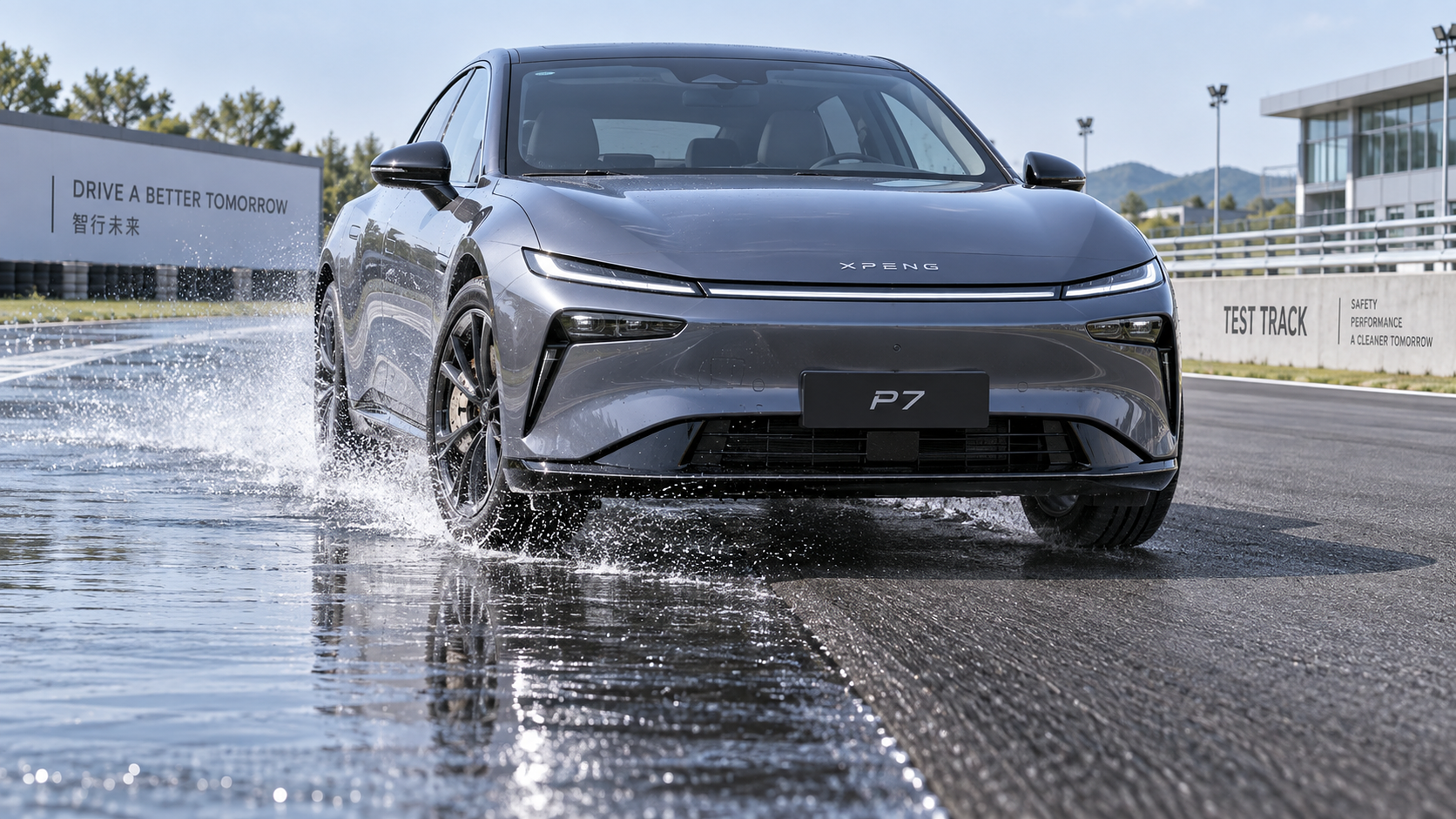
A braking system can only use the grip the tires can transmit. Larger rotors, stronger calipers, and more advanced control software may reduce the brake system's own limitations, but they cannot create longitudinal force once the tire-road interface has reached its limit. That is why tire dynamics braking must be evaluated as a vehicle-level behavior rather than as a tire catalog property or a brake-hardware specification.
For technical assessment, the central question is not simply whether a tire has high grip. It is whether it can generate predictable longitudinal force through changing load, temperature, road texture, water conditions, steering input, and wheel-slip control. That behavior determines stopping distance, yaw stability during a hard stop, brake-pedal consistency, and how effectively ABS can regulate each wheel.
Braking distance begins with the available friction envelope
During braking, the contact patch converts wheel braking torque into longitudinal force at the road. The tire can only transmit a finite combined force. When the driver brakes in a straight line, most of this available force is used longitudinally. When the vehicle is also turning, accelerating, or crossing a split-friction surface, the tire must divide its capacity between braking and lateral guidance.
This relationship is often described as the friction circle or friction ellipse. It explains why a vehicle can stop strongly in a straight, dry-line test yet become unstable when braking while entering a bend. A tire with useful peak grip but an abrupt breakaway can produce a short best-case stop while making the vehicle difficult to control near the limit. For production vehicles, predictable force build-up and a controllable transition beyond peak friction are often as important as the highest measured deceleration.
Road condition changes the available friction envelope more dramatically than many component comparisons suggest. On rough, dry asphalt, the tread compound can interlock with surface texture and develop strong adhesion. On a polished wet road, a water film reduces that interaction. On snow, loose gravel, or uneven pavement, the mechanism changes again: tread voids, block movement, local shear strength, and the ability to clear material from the contact patch become more influential.
A technical evaluation should therefore avoid treating a dry stopping result as a general braking rating. The relevant question is whether the tire maintains a usable and repeatable force curve in the conditions the vehicle is expected to encounter.
Why load transfer changes tire behavior under hard braking
Braking moves load from the rear axle toward the front axle. Front tires gain vertical load, while rear tires become more lightly loaded. This creates a basic challenge: the front axle must provide more braking force, but tire friction does not rise in perfect proportion to vertical load. As load increases, the tire's friction coefficient usually declines to some degree. This effect, commonly called load sensitivity, means the heavily loaded front tires do not gain grip at the same rate that they gain load.
Vehicle mass, center-of-gravity height, wheelbase, suspension geometry, and damping all influence the load-transfer pattern. Tire construction then determines how well each tire uses the changing load. A sidewall that deflects excessively may delay force build-up or create steering vagueness under braking. A very stiff construction may sharpen response but can be less compliant over broken pavement, where maintaining contact with the surface matters more than immediate steering precision.
Electric vehicles make this interaction especially relevant. Battery mass can raise total vehicle weight, while rapid torque response can expose traction and longitudinal-force transitions more quickly during deceleration and regeneration changes. The correct tire is not simply the one with the lowest rolling resistance or the widest tread. It needs sufficient load capacity, a stable carcass response, and a compound that remains predictable across the vehicle's operating temperature range.
Rear-axle behavior deserves equal attention. A rear tire with weak wet grip, unsuitable pressure, or degraded tread may lock or lose lateral authority early as rear axle load falls. ABS may prevent sustained lock, but it cannot fully remove the yaw disturbance caused by unequal rear-wheel grip or a rapidly changing friction surface.
Slip ratio is the link between tire grip and ABS performance
ABS does not aim for zero wheel slip. A freely rolling tire cannot generate maximum braking force. Under braking, the wheel must rotate slightly more slowly than its vehicle-speed-equivalent rotation, creating a controlled slip ratio. In the useful region, longitudinal force rises as slip increases. After a certain point, force reaches a peak and then falls as the tire approaches lockup.
The location and shape of this force-versus-slip curve are fundamental to ABS calibration. A tire with a broad peak gives the controller a larger operating window. The system can modulate brake pressure while remaining near effective braking force even when surface conditions change. A tire with a narrow, sharp peak may deliver high ultimate grip in one condition but demands more precise control and can produce more noticeable pressure cycling.
ABS estimation also depends on wheel-speed behavior. Tire effective rolling radius changes with load, inflation pressure, speed, temperature, and wear. On low-grip surfaces, wheel deceleration can be affected by local tread deformation and surface irregularity. Control software must distinguish a real lock tendency from normal wheel-speed variation. Tire properties are therefore part of the sensing problem, not merely the mechanical output.
When assessing ABS performance, brake-pedal pulsation alone is not a useful indicator. A system can feel active while delivering poor directional control, or operate smoothly while failing to maximize available friction. Evaluation should examine stopping distance, lane retention, yaw response, wheel-slip consistency, and recovery after transitions such as dry-to-wet or high-grip-to-low-grip surfaces.
Split-friction braking exposes the complete system
A split-friction stop, where left and right tires encounter different road grip, is one of the clearest ways to see the interaction between tires, brakes, suspension, and control logic. The high-grip side generates more braking force and creates a yaw moment toward that side. The vehicle must remain manageable while the system limits wheel slip independently at each corner.
Tread condition, tire matching, inflation pressure, and axle placement all matter here. Fitting tires with substantially different wet-grip behavior across an axle can make the vehicle harder to stabilize, even if each tire independently appears acceptable. Mixing designs between front and rear may also change transient balance because the tires build and release force at different rates.
Compound, tread, and construction affect different parts of the braking event
It is tempting to compare tires through one label such as “performance,” “touring,” or “low rolling resistance.” These categories are too broad for braking analysis. Three tires with similar nominal size may behave very differently because their compounds, tread patterns, belt packages, and internal damping targets differ.
Compound selection is a tradeoff among grip, temperature range, wear, rolling resistance, noise, and durability. A compound optimized for warm dry response may become less compliant in cold conditions. A design intended to reduce energy loss may require careful tread and construction tuning to preserve wet braking. There is no universal best solution because the vehicle duty cycle determines which compromise is appropriate.
Tread design is often oversimplified as a water-channel issue. Drainage is important, but the tread also controls block stiffness, pressure distribution, and how the contact patch changes as the tire is loaded. Large shoulder blocks can support precise dry braking and steering, while sipes and grooves can help create usable edges on wet or low-friction surfaces. Too much block movement, however, may reduce response consistency and increase the delay between brake-pressure application and tire-force development.
Thermal state can change braking balance during repeated stops
Tires are viscoelastic structures: their response changes with temperature. A tire that feels secure after several moderate stops may behave differently on the first cold stop, after a long highway run, or during repeated downhill braking. Heat comes from tread deformation, road friction, carcass flexing, and surrounding brake temperatures. The brake system may remain within its operating capability while the tire's friction behavior shifts.
This matters when evaluating high-torque, high-mass platforms. Repeated braking can increase tread temperature, alter inflation pressure, and change the shape of the contact patch. In some cases, higher temperature initially improves grip; beyond the tire's useful operating range, the force curve can become less stable, wear can accelerate, and braking consistency can decline. The result may be longer stops, less confidence during trail braking, or more frequent ABS intervention.
Testing should not rely only on a single initial stop. A meaningful program includes cold-condition behavior, stabilized-temperature behavior, repeated-brake consistency, and recovery after cooling. It should also record tire pressure before and after the sequence. Pressure is not an isolated maintenance value; it changes casing stiffness, footprint geometry, heat generation, and the slip characteristics seen by ABS.
Inflation pressure and wheel selection are system variables
Underinflation generally increases carcass deflection and heat generation. It can enlarge the nominal contact area, but that does not automatically improve braking. The pressure distribution may become less favorable, steering response can soften, and the tread may not work as intended. Excessive pressure can reduce compliance and concentrate loading in portions of the contact patch, particularly on uneven roads.
The correct assessment point is the vehicle manufacturer's specified pressure for the relevant load condition, followed by controlled deviations only when the development or validation process requires them. Comparing tires at arbitrary pressures can produce misleading conclusions. A tire that appears weak may simply be operating outside its intended load-pressure relationship.
Wheel width, rim contour, and assembly quality matter as well. A tire mounted on a wheel outside its approved fitment range can alter sidewall support and contact-patch behavior. For lightweight alloy-wheel programs, reducing unsprung mass may benefit ride and contact maintenance over rough surfaces, but the wheel must still provide adequate stiffness, impact resistance, and thermal durability. Brake airflow, wheel geometry, and tire heat exposure should be considered together rather than assigned to separate component teams.
A practical evaluation sequence for tire and brake integration
Component selection becomes more reliable when the evaluation order follows the physics of the vehicle rather than a single headline metric.
- Define the operating envelope. Identify vehicle mass range, axle loads, drive layout, expected ambient conditions, road mix, towing or payload cases, and the intended balance between range, comfort, noise, and braking performance.
- Confirm fitment fundamentals. Check load capability, approved wheel range, pressure specification, speed capability, and compatibility with the vehicle's brake, suspension, and clearance requirements.
- Measure force behavior, not only distance. Review deceleration build-up, wheel-slip traces, steering correction demand, yaw response, and stop-to-stop repeatability.
- Test friction transitions. Include wet surfaces, uneven pavement, split-friction conditions, and braking with steering input where relevant to the vehicle's use case.
- Evaluate thermal and wear state. Compare new, conditioned, and worn-tread behavior. A replacement strategy should not assume that new-tire results represent the full service life.
- Calibrate controls around the approved tire family. ABS, stability control, regenerative braking blending, and tire-pressure monitoring assumptions must be verified against the tire's actual rolling and slip behavior.
A common mistake is to treat a tire change as a purely aftermarket decision once size and load rating appear correct. On modern vehicles, especially EVs, the tire influences longitudinal control, stability intervention timing, energy use, cabin noise, and perceived steering quality. A replacement tire can be legally compatible yet still shift the vehicle's braking balance and control-system behavior in conditions that matter.
What to prioritize when tradeoffs are unavoidable
If the vehicle operates mainly in warm, dry conditions with controlled loads, dry grip, brake response, and thermal repeatability may receive more weight. For mixed-weather passenger use, wet braking progression and predictable ABS behavior are usually more valuable than a marginal gain in dry peak grip. Fleet or commercial applications may place greater emphasis on load robustness, wear stability, and the ability to retain predictable braking across variable inflation and pavement conditions.
For performance-oriented EV platforms, avoid assuming that a low-rolling-resistance tire and a high-grip tire are mutually exclusive categories. The better question is whether the candidate tire preserves sufficient wet and thermal braking capability while meeting range and noise targets. The platform's mass, regenerative-braking strategy, and wheel design can change that answer substantially.
AEVS analysis of high-performance ground-contact systems is most useful when tires are considered alongside lightweight wheels, brake thermal paths, and vehicle-control requirements. That integrated view reflects the reality of tire dynamics: braking performance is not supplied by one component. It is produced by the tire-road contact patch, the forces arriving at it, and the control system's ability to use those forces without exhausting stability reserve.
The most defensible tire decision is therefore based on the conditions where braking must remain predictable, not the conditions where a single test result looks strongest. Establish the vehicle's load, road, temperature, and control-system envelope first; then select and validate the tire as a functional part of the braking system.