
Industry Portal
Related News
- 00
0000-00
NEV Industry Standards in China: Which Battery Safety Tests Are Required? - 00
0000-00
Automotive Exterior Lighting Systems: Lamp Types, Functions, and Placement - 00
0000-00
Choosing an Electric SUV Sunroof: Key Fit, Safety, and Weather-Sealing Factors - 00
0000-00
Pop-Up Automotive Sunroof Systems: Key Design Factors for Vehicle Integration - 00
0000-00
Automotive Product Comparison Charts: How Buyers Can Compare Specs, Cost, and Fit
How to Specify an Electric Sunroof for Passenger Cars: Key Design and Safety Factors
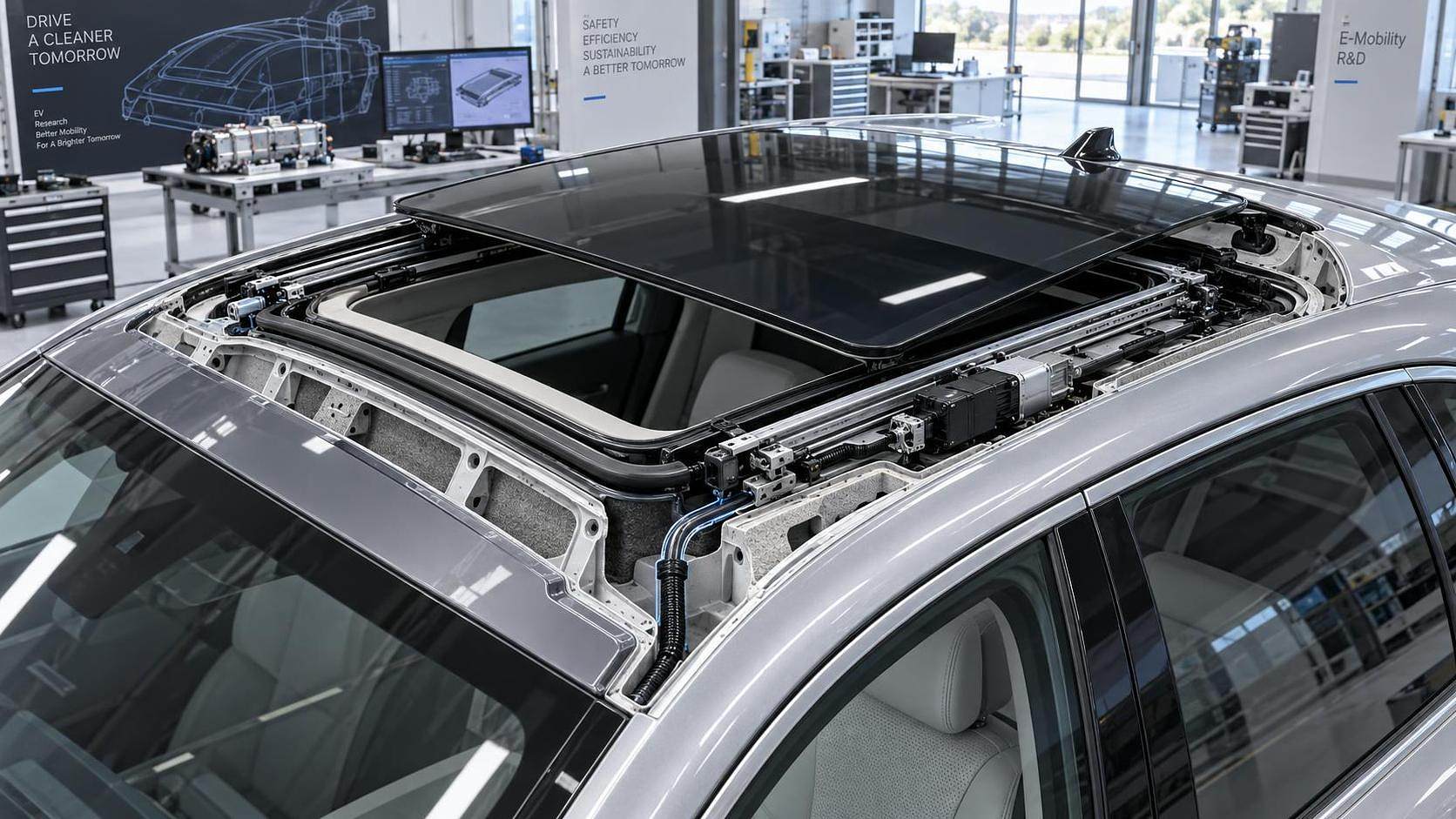
An electric sunroof for passenger cars should be specified as a roof-system integration decision, not as a glass option. The visible opening is only one part of the system. Its long-term quality depends on how the cassette, roof structure, drainage paths, seals, drive unit, controls, and validation plan work together under real vehicle conditions.
For technical evaluation, the most useful starting point is to define the vehicle package and ownership target before comparing supplier catalogues. A compact urban vehicle, a premium sedan, and a large electric SUV can all use a sliding glass roof, yet their engineering priorities differ substantially. Roof curvature, headroom, battery mass, expected cabin quietness, climate exposure, body stiffness targets, and desired feature content should shape the specification from the beginning.
Choose the roof concept from the vehicle package, not the visual brief
The first decision is the opening architecture. A conventional tilt-and-slide unit usually offers a balanced solution where an operable opening is important but roof area, mass, and cost must remain controlled. A panoramic system creates a stronger sense of space and can improve perceived cabin quality, but it puts more pressure on body-in-white integration, head impact packaging, solar management, and noise performance.
A fixed glass roof with an integrated shade is sometimes the better option when the design brief prioritizes light and openness over ventilation. It removes moving-panel mechanisms and some leakage risks, but it does not remove the need for careful glass, thermal, and shade selection. A fixed roof can still add considerable mass high in the vehicle and can create passenger discomfort if solar load is poorly managed.
A larger aperture is not automatically a better passenger experience. If the sunshade is weak, the glass lacks suitable solar-control properties, or the roof frame intrudes into rear-seat headroom, the visual benefit may be outweighed by heat, glare, and packaging compromises. The specification should state the intended occupant benefit in practical terms: ventilation, daylight, rear-seat openness, premium appearance, or a combination of these.
Protect the roof structure before optimizing the opening
Cutting a large opening into the roof changes the load path of the body. The sunroof cassette and local reinforcements must therefore be considered alongside the roof rails, cross-members, curtain airbag deployment zones, interior trim, and roof crush strategy. Treating the module as a late-stage add-on often produces avoidable compromises in headroom or reinforcements that erase lightweighting gains.
This is particularly relevant for battery-electric passenger cars. The battery pack lowers the vehicle center of gravity, but it also increases curb mass. That does not mean the upper body can be treated casually. Glass, frame, guide rails, drive cables, motors, and shades all add mass above the beltline. A good evaluation looks at the total system mass and the secondary mass created elsewhere in the body, rather than focusing only on the glass panel.
Material selection should follow the load case. Aluminum, high-strength steel, reinforced polymer components, and mixed-material cassette structures can all be appropriate. The better choice depends on stiffness, corrosion exposure, thermal expansion behavior, joining method, production volume, repair expectations, and the surrounding roof construction. A low component mass is of limited value if it introduces dimensional instability, difficult bonding control, or persistent rattles over time.
Water management is a system function
Leakage complaints are often blamed on the perimeter seal, but a sunroof is normally designed to manage a controlled amount of water that passes beyond the outer seal. The cassette collects that water and directs it through drain channels and tubes to safe exit points. This means the critical question is not simply whether the seal looks robust; it is whether the entire drainage route remains effective when the vehicle is parked on an incline, driven through heavy rain, exposed to dirt, or assembled with normal production variation.
Drain outlets need to be reachable in the vehicle architecture and protected from kinks, crushing, contamination, or backflow. Routing them through crowded A-pillars or rear quarter areas can conflict with wiring, trim clips, airbags, and body seams. During evaluation, ask for the drain-path concept, retention method, outlet location, and inspection logic. A system that drains well on a horizontal test fixture may behave differently once installed in a complete vehicle.
Sealing also needs a balanced friction target. Excessive contact force can raise motor load, increase wear, and make closing feel harsh. Insufficient contact can worsen wind noise and water intrusion. The seal material, flock treatment, joint design, glass edge condition, and lubrication strategy should be assessed together, especially for vehicles expected to operate across hot, cold, dusty, or humid environments.
NVH quality comes from the interfaces around the glass
Passengers notice sunroof quality most readily through wind rush, buffeting, squeaks, rattles, and shade noise. These issues rarely have a single cause. Aerodynamic noise depends on roof contour, glass height relative to the outer panel, deflector shape, opening position, and the flow field created by roof rails or roof-mounted accessories. A wind deflector can reduce buffeting at certain opening positions, but it should be assessed as part of the vehicle rather than in isolation.
Rattle control is equally cross-functional. The cassette must maintain alignment through body flex, temperature changes, and repeated cycling. Interfaces between the guide rails, moving panel, shade, headliner, and roof reinforcement need appropriate tolerance control and anti-fret measures. A system can feel quiet in an unloaded static vehicle yet develop intermittent noise on rough roads because the body and module respond differently to torsional input.
For refined passenger cars, request a validation plan that covers closed-roof wind noise, open-roof buffeting, rough-road rattle, repeated opening cycles, temperature exposure, and cabin sound behavior with the shade both open and closed. The point is not to demand one universal target from every vehicle class. It is to make sure the supplier test plan reflects the actual vehicle mission and perceived-quality target.
Specify the drive system for misuse, not just normal operation
The electric drive must reliably move the panel and shade against friction variation caused by temperature, contamination, seal compression, and vehicle aging. Motor sizing, cable or gear design, guide geometry, position sensing, and control calibration all affect this outcome. A mechanism that operates smoothly when new may stall or become noisy when lubricant behavior changes or debris enters the rail area.
Anti-pinch protection deserves specific attention. The closing function needs to identify an obstruction and reverse or stop with dependable behavior across different conditions. This includes low-temperature operation, low system voltage, seal resistance, and component wear. It should also distinguish between expected compression loads at the seal and a genuine obstruction. Overly sensitive calibration can cause nuisance reversals; insufficient sensitivity creates an occupant-safety risk.
Control logic should be defined early for one-touch operation, key-off behavior, remote closure where supported, fault recovery, and interaction with body control modules. A sunroof may be mechanically sound but still create warranty concerns if it loses position memory, performs an unexpected relearn procedure, or gives the driver unclear behavior after a low-voltage event.
Glass and shade selection determine comfort as much as appearance
Dark-tinted glass alone is not a complete thermal-comfort strategy. The relevant combination includes solar-control glass properties, glass area, interior color, cabin ventilation performance, vehicle glazing package, and the shading solution. For a large panoramic opening, the shade must be evaluated for heat reduction, opacity, noise, sag resistance, and opening speed. A thin shade that saves mass may not deliver the cabin comfort expected from a premium glass roof.
Electrochromic dimming can offer a clean visual solution and adjustable light transmission, particularly where a conventional shade compromises design or headroom. Its value depends on the intended use case and electrical architecture. It should be assessed for switching behavior, optical uniformity, thermal exposure, diagnostics, fail-state behavior, and the residual heat load it leaves for the climate system. It is not a universal substitute for every mechanical shade.
Glass fracture behavior, edge protection, bonding quality, and compatibility with roof-mounted sensors or antennas also belong in the specification. A roof system can affect visibility-related functions indirectly when its electrical routing, electromagnetic environment, or installation constraints interfere with adjacent roof hardware.
Use a requirements matrix before selecting a supplier
The most practical way to compare an electric sunroof for passenger cars is to convert subjective expectations into traceable engineering requirements. Separate mandatory packaging and safety constraints from vehicle-specific refinement goals. Then evaluate suppliers against the complete module, installation concept, and validation evidence rather than against panel size or feature count alone.
- Define roof aperture, headroom envelope, roof curvature, and allowable system mass.
- Map structural interfaces, airbag zones, wiring paths, roof trims, and drain exits before freezing the cassette package.
- Set measurable functional expectations for opening, closing, anti-pinch response, low-voltage behavior, and fault recovery.
- Assess water management under vehicle attitudes and contamination conditions, not only under a simple spray test.
- Review NVH performance in the complete vehicle, including road excitation and the intended range of opening positions.
- Confirm service access for glass replacement, drain inspection, motor service, initialization, and trim removal.
- Require a clear change-control process for glass, seal, lubrication, motor, and software calibration changes.
Serviceability is often undervalued during the concept phase. A highly integrated roof module may look efficient on the assembly line but become expensive to diagnose or repair if drain connections, fasteners, or electronic components are inaccessible. The right balance depends on the vehicle's ownership model and service network, but the repair path should be understood before nomination.
Where the decision usually goes wrong
The common mistake is selecting the largest, most feature-rich roof that fits the styling surface. This approach overlooks the consequences for roof reinforcement, center-of-gravity management, climate performance, noise, and maintenance. Another error is evaluating sealing as a static component test rather than evaluating drainage, body movement, and assembly variation together.
It is also risky to treat premium features as interchangeable. A panoramic opening roof, acoustic laminated glass, powered shade, and electrochromic glazing each solve different problems. Combining them may be appropriate for a high-content vehicle, but each adds mass, controls, interfaces, and validation work. The better specification identifies which passenger benefit is essential and avoids complexity that does not support that benefit.
AEVS tracks electric sunroof systems alongside other exterior and vision technologies because roof decisions increasingly interact with lightweighting, cabin comfort, electrical architecture, and perceived vehicle quality. For a technical review, that broader view is useful: a sunroof should be assessed not as an isolated accessory, but as a structural, aerodynamic, thermal, electronic, and serviceable part of the passenger-car platform.
The final selection should be the system that meets the vehicle's intended comfort and design promise while preserving robust water control, safe operation, durable NVH performance, and a manageable integration burden. That is a stronger basis for specification than choosing by glass area or feature list alone.