Industry Portal
Related News
- 00
0000-00
NEV Industry Standards in China: Which Battery Safety Tests Are Required? - 00
0000-00
Automotive Exterior Lighting Systems: Lamp Types, Functions, and Placement - 00
0000-00
Choosing an Electric SUV Sunroof: Key Fit, Safety, and Weather-Sealing Factors - 00
0000-00
Pop-Up Automotive Sunroof Systems: Key Design Factors for Vehicle Integration - 00
0000-00
Automotive Product Comparison Charts: How Buyers Can Compare Specs, Cost, and Fit
European mmWave Sensor Market: Automotive Demand, Regulation, and Supply Risks
European mmWave Sensor Market: Automotive Demand, Regulation, and Supply Risks
The European mmWave sensor market is entering a decisive growth phase. What was once a relatively contained radar category—largely associated with adaptive cruise control and blind-spot detection—is becoming a core sensing layer for vehicle safety, parking automation, exterior intelligence, and assisted driving. For business evaluators examining mm wave sensors Europe, the central question is no longer whether demand will grow. The more valuable question is where durable value will be created as regulation, vehicle architecture, semiconductor availability, and Tier 1 sourcing strategies evolve together.
Across Europe, automakers are under pressure to deliver more safety capability without allowing sensor cost, styling constraints, or validation complexity to overwhelm already stretched vehicle programs. A radar module hidden behind a painted bumper may look inconspicuous, but its performance depends on a chain of decisions: RF semiconductor selection, antenna design, radome material, bumper paint formulation, calibration process, software stack, and regulatory evidence. This is why the market deserves to be assessed as an automotive systems opportunity rather than a simple component-volume story.
Why European vehicle programs are pulling radar into more use cases
Millimeter-wave radar has established itself in European passenger vehicles because it operates in conditions that regularly challenge optical sensing. Rain, fog, road spray, darkness, glare from low winter sun, and contamination around the vehicle perimeter can degrade camera-based perception. Radar does not eliminate the need for cameras or ultrasonic systems, but it offers a complementary capability: measuring range and relative speed with strong performance across a broad range of weather and lighting conditions.
The most familiar application remains front radar for adaptive cruise control, collision warning, and automatic emergency braking support. Yet the demand picture is becoming broader. Corner radars are increasingly integrated into blind-spot monitoring, rear cross-traffic alert, lane-change assistance, and exit warnings. Short-range radar supports automated parking functions and low-speed maneuvering. Higher-resolution imaging radar is being explored for more detailed object discrimination, particularly where automated driving functions demand perception redundancy.
This expansion matters commercially. A vehicle platform may move from one radar sensor to several, while the performance requirements for each position become more distinct. Front-facing long-range units, side-facing radar, rear detection modules, and in-cabin or near-field sensing applications do not share identical cost targets or engineering priorities. Procurement teams should therefore avoid treating “radar content per vehicle” as a single, uniform figure.
European premium brands were early adopters of advanced driver-assistance systems, but the next wave of volume is likely to come from broader adoption across compact EVs, crossovers, light commercial vehicles, and fleet-oriented platforms. Electric vehicles add another layer of interest. Their quiet operation, rapid torque delivery, heavier curb weights, and strong dependence on efficient packaging make low-speed awareness, parking confidence, and active safety features especially important to the ownership experience.
Regulation is raising the floor, not prescribing one sensor
European safety regulation is a major market catalyst, although it should not be interpreted as a direct mandate for a particular radar architecture. The EU General Safety Regulation has progressively strengthened requirements around features such as intelligent speed assistance, advanced emergency braking, lane-related safety assistance, driver availability awareness, and reversing safety. These requirements increase the need for reliable environmental perception, but manufacturers retain flexibility in how they meet the relevant performance objectives.
UNECE regulations are equally influential in the development cycle. Depending on the function and vehicle category, engineering teams may need to consider frameworks linked to steering assistance, emergency braking, reversing maneuver detection, blind-spot information, lane-change support, cybersecurity, and software updates. UNECE R155 on cybersecurity management and R156 on software update management are particularly important because radar is no longer a self-contained hardware device. It is part of a connected electronic control environment that must remain traceable, maintainable, and protected over the vehicle lifecycle.
For investors and sourcing teams, the practical implication is clear: compliance risk sits above the component level. A sensor supplier may deliver capable hardware, yet the vehicle program can still face delays if object classification, diagnostic coverage, functional safety evidence, electromagnetic compatibility, software configuration, or vehicle-level calibration is not mature.
There is also a European nuance often missed in high-level market reports. Regulations provide the minimum framework, while Euro NCAP ratings, consumer expectations, fleet safety policies, and brand positioning frequently push manufacturers toward more capable sensing configurations. A technology may not be explicitly mandatory, but become commercially difficult to omit when competitors make safer parking, cross-traffic awareness, or assisted lane-change behavior visible to buyers.
Frequency, resolution, and exterior design are becoming linked decisions
Most automotive radar development in Europe is centered on the 76–81 GHz band, commonly described as 77 GHz radar. This range has become the mainstream choice for vehicle radar because it supports compact antennas and improved range resolution relative to older approaches. It is well suited to exterior perception tasks, from forward-looking collision support to side and rear monitoring.
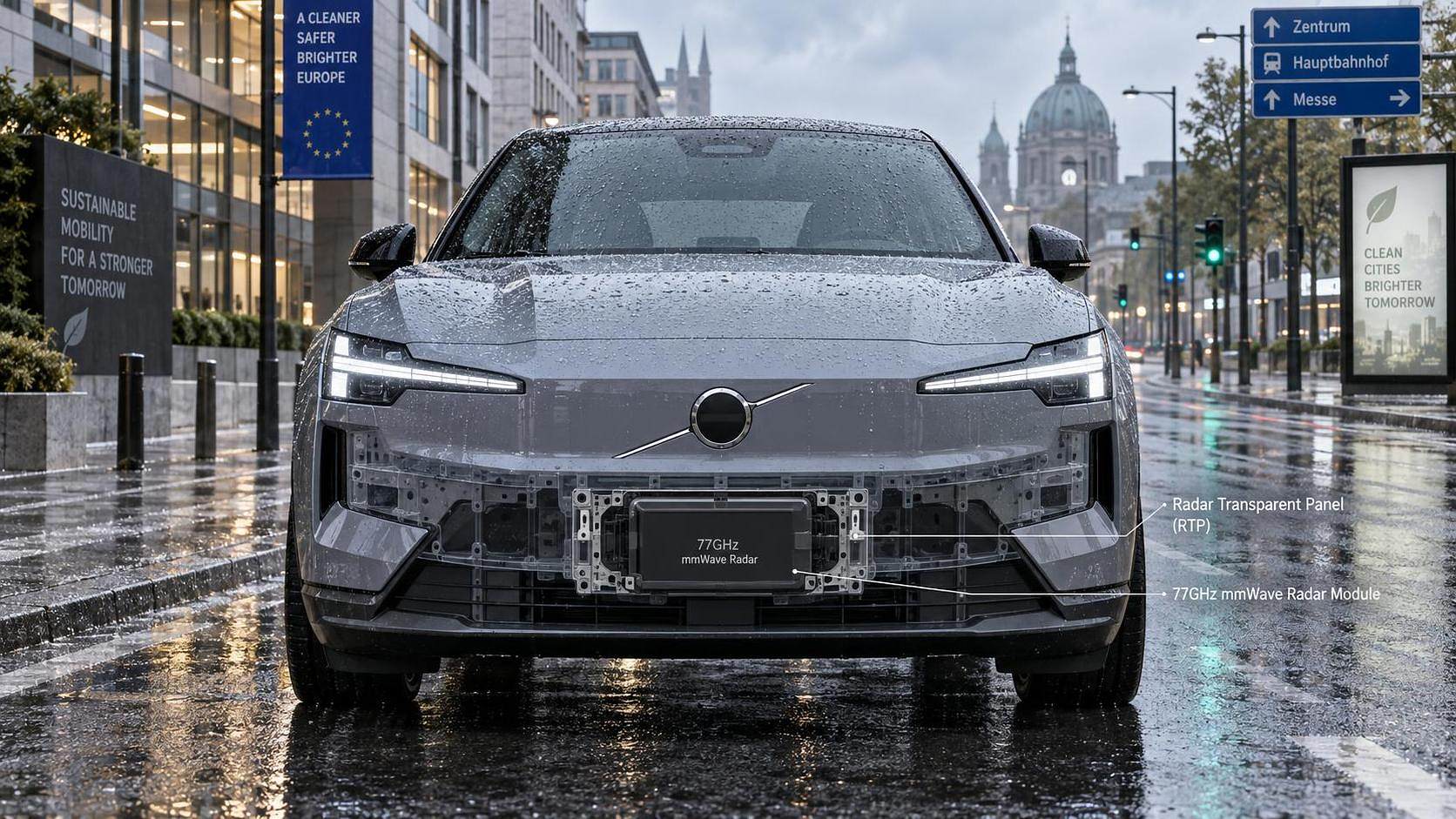
But a radar sensor is not merely an electronics box mounted behind a bumper. It must coexist with the visual language and material strategy of the vehicle exterior. Painted fascia, metallic pigments, decorative films, logos, grille elements, water ingress protection, mounting brackets, and panel curvature may all influence signal transmission or create reflections that complicate validation.
For AEVS readers working at the intersection of vehicle aesthetics and driving perception, this is an increasingly important design reality. A clean, low-drag front end for an EV may remove traditional grille openings; a radar-transparent emblem may become a functional component; a stylized bumper insert may need material control as carefully as an optical lens. The handoff between exterior designers, material engineers, radar specialists, and manufacturing teams cannot wait until late-stage validation.
In practical terms, buyers should ask whether a supplier has demonstrated performance with the intended radome stack-up, paint chemistry, bumper thickness variation, and mounting geometry—not only with a laboratory reference panel. Costly rework often begins when a sensor selected on RF specifications is later paired with an exterior treatment that was never fully characterized.
The supply chain has improved, but resilience remains uneven
The semiconductor shortages of recent years made one lesson unavoidable: automotive radar availability depends on far more than the final module assembler. The supply chain begins with RF-capable silicon, wafers, packaging capacity, passive components, antenna substrates, printed circuit boards, connectors, shielding materials, and specialized automated test equipment. A delay at any point can affect production schedules for a whole vehicle platform.
Many radar solutions now rely on highly integrated RF CMOS devices, helping reduce footprint and improve manufacturability. However, integration can create concentration risk when a particular chipset family is qualified across multiple vehicle programs. Changing a radar semiconductor after validation is not equivalent to substituting a generic electronic part. It may require software adaptation, renewed electromagnetic testing, functional safety analysis, vehicle calibration, and homologation review.
European automotive groups source globally, and that remains unavoidable in a semiconductor ecosystem with significant Asian and North American manufacturing exposure. The key business issue is not geographic diversification as a slogan; it is visibility. Evaluators need to understand where critical process steps occur, which components are single-sourced, whether capacity is contractually reserved, and how quickly the supplier can respond to allocation changes.
Packaging and test deserve particular attention. Automotive radar modules require consistency in RF performance at high volume, across temperature ranges and over long service lives. A supplier may have access to a competitive radar IC yet still struggle if its test throughput, calibration automation, or end-of-line traceability is weak. Yield losses at this stage can quietly erode the apparent savings of a low-priced design.
Supply risks that deserve a place on the sourcing dashboard
- Chipset concentration: Identify whether several modules depend on the same RF transceiver family or foundry route.
- Qualification lock-in: Measure the time and cost required to validate a second source, rather than assuming an approved alternative is immediately deployable.
- Substrate and radome dependencies: Radar performance can be affected by specialized PCB materials, plastics, coatings, and metal-free decorative components.
- Software ownership: Clarify who controls signal-processing algorithms, diagnostic logic, cybersecurity updates, and data interfaces.
- Regional service capacity: European OEM programs benefit from local application engineering, failure analysis, and rapid support during launch.
- Trade and compliance exposure: Monitor export controls, customs disruption, REACH-related material constraints, and evolving sustainability reporting demands.
Tier 1 suppliers face a changing competitive equation
The competitive landscape for mmWave sensors in Europe is not defined solely by radar accuracy. Established automotive suppliers bring vehicle integration experience, functional safety processes, program-management depth, and long-standing OEM relationships. Semiconductor companies, meanwhile, are pushing more capability into integrated radar chipsets and development platforms. New entrants can innovate quickly in imaging radar, perception software, or compact sensor modules, but they must prove automotive-grade durability and industrial scale.
This creates a more layered value chain. Some OEMs prefer a full Tier 1 module with software, housing, validation support, and system responsibility. Others seek greater influence over perception software and may source hardware around a more open electronic architecture. Neither approach is automatically superior. The right model depends on the OEM’s internal software capability, platform standardization, planned feature roadmap, and appetite for supplier dependency.
Business evaluators should be cautious about comparing suppliers only by nominal range, field of view, or unit price. These figures can be useful, but they do not reveal how a module behaves behind a real bumper in heavy rain, around metallic road furniture, or when multiple sensors operate nearby. Nor do they show the cost of calibration, diagnostic handling, software maintenance, and warranty exposure.
How to evaluate a European mmWave radar opportunity
A disciplined review should begin with the vehicle function, not the sensor catalogue. Is the requirement blind-spot monitoring, automated parking, front collision support, rear cross-traffic protection, trailer-aware maneuvering, or a future assisted-driving feature? Each use case has different needs around range, angular resolution, latency, field of view, object classification, and failure response.
From there, assess the system in five connected layers.
- Function and safety case: Determine how the sensor contributes to the intended driving function and what fallback behavior is required if performance is degraded.
- Vehicle integration: Review bumper materials, styling constraints, thermal conditions, cleaning strategy, water management, vibration exposure, and service access.
- Regulatory readiness: Request evidence that the supplier understands applicable UNECE, EU, electromagnetic compatibility, cybersecurity, and software-update obligations.
- Supply resilience: Look beyond the module factory to semiconductor sourcing, packaging, test capacity, and continuity planning.
- Lifecycle economics: Include engineering change management, calibration, software support, field diagnostics, replacement parts, and warranty—not just purchase price.
A useful procurement conversation also asks what happens when the radar is not working perfectly. Can the system recognize blockage or misalignment? How are fault codes exposed to service networks? Can software updates improve false-positive behavior without introducing new safety or cybersecurity concerns? These details often separate a promising demonstration from a production-ready automotive solution.
Where value may emerge next
The strongest opportunities in the European mmWave sensor market are likely to sit where regulation, user experience, and vehicle architecture reinforce one another. Parking automation is one example: urban vehicle ownership, tight parking environments, expensive cosmetic repairs, and the growing size of many EVs make low-speed perception a tangible customer benefit. Side and rear sensing is another, especially as vulnerable road-user protection and lane-change support receive greater attention.
Higher-resolution radar may also gain relevance where automakers seek redundancy alongside cameras and other sensor types. The opportunity should be viewed realistically. More resolution can increase computing, data-processing, validation, and cost requirements. Its commercial case will depend on whether it helps an OEM achieve a meaningful safety function, a stronger rating, a simpler sensor suite, or more robust performance in difficult conditions.
For the exterior systems ecosystem, sensor integration will become a design discipline of its own. Radar-transparent materials, concealed sensor zones, lighting signatures, camera wash systems, aerodynamic bumper geometry, and repairability will increasingly be designed together. The future vehicle exterior is not simply a surface to style; it is a perception interface.
A market where execution matters more than headline demand
Demand for mm wave sensors Europe is supported by a durable mix of ADAS adoption, safety expectations, evolving regulation, and smart exterior functions. Yet the market will not reward every participant equally. Sustainable value will favor suppliers and buyers that can combine radar performance with dependable semiconductor access, vehicle-level validation, software governance, and thoughtful exterior integration.
For business evaluators, the most credible opportunities are rarely the ones described by a single performance metric or an aggressive volume forecast. They are found in programs where the sensing function is clearly defined, the compliance path is understood, the supply chain is visible, and the sensor can survive the realities of European roads, weather, styling demands, and long vehicle lifecycles. That is where radar moves from a promising technology category to a dependable part of connected mobility.