Industry Portal
Related News
- 00
0000-00
NEV Industry Standards in China: Which Battery Safety Tests Are Required? - 00
0000-00
Automotive Exterior Lighting Systems: Lamp Types, Functions, and Placement - 00
0000-00
Choosing an Electric SUV Sunroof: Key Fit, Safety, and Weather-Sealing Factors - 00
0000-00
Pop-Up Automotive Sunroof Systems: Key Design Factors for Vehicle Integration - 00
0000-00
Automotive Product Comparison Charts: How Buyers Can Compare Specs, Cost, and Fit
Which ISO Standards Govern Vehicle Lightweighting Materials and Validation Testing?
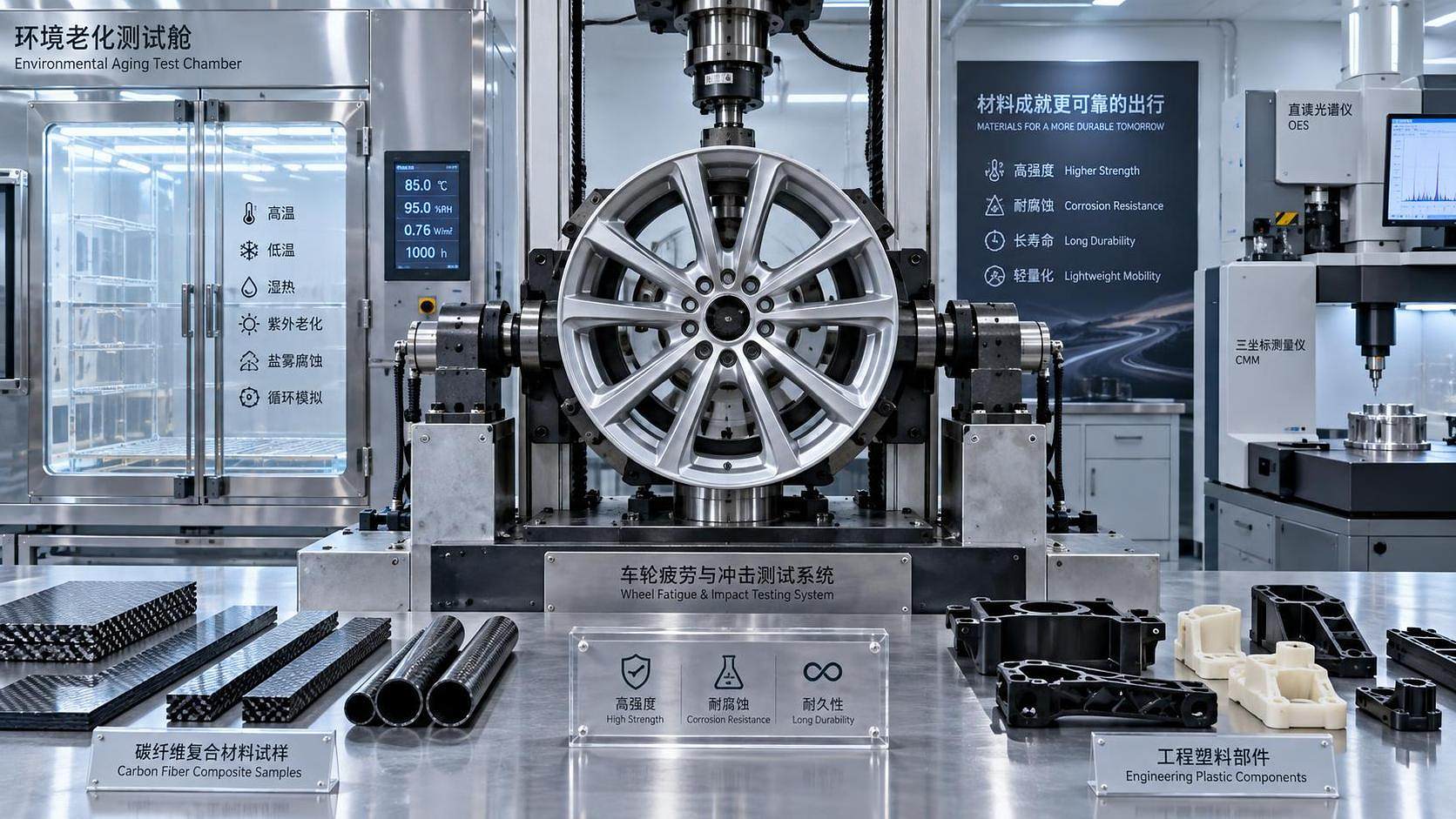
There is no single ISO standard that “certifies” a lightweight vehicle material as suitable for automotive use. Aluminum, magnesium, steel, thermoplastics, fibre-reinforced composites and hybrid structures are qualified through a chain of standards covering material identity, mechanical properties, environmental resistance, component durability and, where relevant, vehicle-level performance.
The critical distinction is between a material test standard and a component validation requirement. A tensile test may establish the yield strength of an aluminum alloy coupon, but it does not prove that a forged wheel, composite roof panel or polymer sensor housing will survive fatigue, corrosion, stone impact, thermal cycling and assembly loads. Vehicle lightweighting ISO standards therefore need to be read as an evidence framework rather than a short compliance checklist.
ISO standards do not replace vehicle regulations or OEM specifications
ISO standards define repeatable test methods, terminology, dimensions, conditioning methods and reporting practices. They make results comparable when laboratories, suppliers and vehicle manufacturers are evaluating the same material or component.
They do not, by themselves, establish legal road approval. Regulatory requirements may instead come from UNECE regulations, US Federal Motor Vehicle Safety Standards, regional chemical restrictions, national type-approval rules, or component-specific rules. A headlamp housing, for example, must satisfy optical and functional regulatory requirements beyond polymer tensile strength. A replacement wheel may be subject to regional approval requirements even when its laboratory fatigue and impact tests follow ISO-based methods.
OEM engineering standards add another layer. Manufacturers commonly specify their own load spectra, corrosion cycles, vehicle mounting conditions, cosmetic acceptance criteria, statistical sampling plans and pass/fail thresholds. These internal requirements may reference ISO methods, modify them, or require additional vehicle-specific testing. The test method and the acceptance criterion must therefore be reviewed separately.
Material characterization: the first evidence layer
For metallic lightweighting materials, ISO mechanical test methods establish the baseline from which design allowables and supplier certificates are evaluated. The most frequently encountered standards include:
- ISO 6892-1 — tensile testing of metallic materials at room temperature. It is central to verifying proof strength, yield strength, tensile strength, elongation and, where applicable, the stress-strain curve of aluminum alloys, high-strength steels and metallic castings.
- ISO 6506, ISO 6507 and ISO 6508 — Brinell, Vickers and Rockwell hardness testing respectively. Hardness is useful for lot control and heat-treatment verification, but it should not be treated as a substitute for tensile, fatigue or fracture characterization.
- ISO 148-1 — Charpy pendulum impact testing of metallic materials. This can support low-temperature toughness assessment, although coupon impact data do not directly predict the crash response of a formed or cast automotive component.
- ISO 7438 — bend testing for metallic materials. It is particularly relevant where forming quality, cracking susceptibility or local ductility must be assessed.
For aluminum-intensive designs, the alloy designation, temper, product form and sampling direction matter as much as the nominal alloy family. Sheet, extrusion, forging and casting products can have materially different anisotropy, porosity sensitivity, elongation and fatigue behavior. A certificate stating compliance with ISO 6892-1 is only meaningful when it identifies the tested material condition, specimen orientation, gauge location and heat-treatment state.
Cast aluminum requires additional scrutiny because local defects can govern performance. Tensile data from separately cast test bars may not represent the microstructure in a thick hub, spoke junction or mounting flange. Where fatigue-critical sections are involved, the validation plan should define how casting quality, porosity limits, radiographic or CT inspection criteria, machining effects and specimen extraction location relate to the final component.
Polymer and composite testing requires conditioning discipline
Lightweight exterior systems increasingly combine engineering thermoplastics, reinforced polymers, elastomers and fibre-reinforced laminates. Their mechanical response is more dependent on temperature, humidity, loading rate and fibre orientation than that of most metallic materials. Comparing data sheets without matching test conditions can produce misleading conclusions.
Core ISO methods for polymeric materials include:
- ISO 527 — tensile properties of plastics. Different parts of the series address general principles and specific material categories, including fibre-reinforced plastic composites.
- ISO 178 — flexural properties of plastics.
- ISO 179 and ISO 180 — Charpy and Izod impact strength methods for plastics.
- ISO 6603 — instrumented puncture impact testing of rigid plastics, useful where localized impact resistance is relevant.
- ISO 6721 — determination of dynamic mechanical properties, supporting evaluation of stiffness and damping as temperature changes.
For structural fibre-reinforced composites, relevant methods include ISO 14125 for flexural properties, ISO 14126 for compressive properties, ISO 14129 for in-plane shear response, ISO 14130 for apparent interlaminar shear strength, and ISO 13003 for cyclic loading conditions and fatigue testing of fibre-reinforced plastics.
These standards characterize coupons, not finished structures. A composite exterior panel may pass ISO 14125 flexural testing yet still fail around fastener holes, bonded inserts, edge seals or local reinforcement transitions. For composite validation, the test pyramid should move from laminate coupon to bonded or bolted joint, subcomponent and full component. Moisture conditioning and thermal exposure should be applied before mechanical testing where the material’s intended service environment can alter its properties.
Environmental aging is often the deciding factor for exterior lightweight parts
Weight reduction can introduce durability risks that are not visible in initial mechanical results. Aluminum can lose corrosion resistance through unsuitable alloy selection, coating damage or galvanic coupling. Polymers can fade, embrittle, creep or crack after ultraviolet and thermal exposure. Composites can absorb moisture, while adhesive joints may weaken under a combined temperature-and-humidity history.
ISO 4892 is the principal ISO series for artificial weathering of plastics using laboratory light sources. It is widely relevant to exterior polymer components, coatings and decorative surfaces. The method must identify the exposure source, cycle, irradiance control, temperature and moisture conditions. A stated number of exposure hours alone is not enough to compare programs, because different light sources and cycle settings can produce very different aging mechanisms.
ISO 9227 specifies salt spray tests, including neutral salt spray. It is commonly used to compare corrosion resistance of metallic materials, coatings, fasteners and coated assemblies. However, salt spray is an accelerated laboratory exposure, not a direct model of real vehicle service life. It is best used as a controlled comparative or screening method. Correlation to field performance depends on the coating system, crevice geometry, drainage, dissimilar-metal contact, chloride retention and damage condition.
For aluminum and aluminum alloys, ISO 11846 addresses assessment of resistance to intergranular corrosion. This is particularly relevant when alloy chemistry, heat treatment and processing history create susceptibility to corrosion along grain boundaries. In applications where surface finish and structural integrity both matter, corrosion evaluation should also consider filiform corrosion, coating adhesion loss, stone-chip damage and galvanic interfaces rather than relying on one immersion or spray method.
Coating degradation can be evaluated using relevant parts of ISO 4628, which provide methods for assessing defects such as blistering, rusting, cracking and flaking. ISO 2409, the cross-cut test, may be used to evaluate coating adhesion under defined conditions. Neither method alone establishes the long-term corrosion performance of an exterior coated assembly; they are pieces of a broader coating validation program.
Automotive environmental validation: ISO 16750 is highly relevant, but not universal
The ISO 16750 series, Road vehicles — Environmental conditions and testing for electrical and electronic equipment, is especially important where lightweighting affects exterior electrical assemblies: LED lamps, sensor housings, roof modules, powered shutters, switches and integrated wiring systems.
Its relevant parts address climatic loads, mechanical loads and chemical loads. Depending on the component, testing may involve thermal cycling, high- and low-temperature storage, temperature change, vibration, mechanical shock, splash water, dust, chemical exposure or ice-related conditions. These tests are not designed as general structural-material standards. They apply to electrical and electronic equipment and must be selected according to mounting location and functional risk.
A lightweight headlamp housing illustrates the boundary. ISO 527 data may establish polymer tensile properties; ISO 4892 may assess light aging; ISO 16750 may evaluate environmental conditions affecting the assembled electrical equipment. Yet complete headlamp approval and performance also require applicable lighting regulations and vehicle manufacturer requirements. No isolated ISO test can cover the full function of the assembly.
Wheels require component-level fatigue and impact validation
For passenger-car road wheels, ISO 3006 specifies test methods. It is particularly relevant to aluminum alloy wheels because wheel lightweighting directly affects stress distribution, fatigue margin and impact tolerance. The standard addresses tests such as dynamic cornering fatigue, radial fatigue and impact resistance under defined laboratory conditions.
The test result must be interpreted in the context of the actual wheel design. Nominal mass reduction does not indicate whether a wheel has adequate fatigue performance. Critical variables include spoke geometry, hub transition thickness, rim contour, material condition, casting or forging route, residual stress, machining, bolt-seat design and the load rating defined for the intended vehicle application.
Wheel testing also demonstrates why material certificates are insufficient. A wheel may be made from an alloy with verified tensile properties and still fail component testing because fatigue cracks initiate at a local geometric concentration or manufacturing discontinuity. Conversely, a heavier section added only at a fatigue-critical junction may be more effective than increasing wall thickness throughout the design.
Bonded and hybrid lightweight structures need joint-specific evidence
Vehicle mass reduction increasingly depends on mixed-material joints: aluminum-to-steel, aluminum-to-composite, polymer-to-metal and bonded insert designs. The governing failure mode is frequently the joint rather than the bulk material.
ISO 4587 specifies determination of tensile lap-shear strength of rigid-to-rigid bonded assemblies. ISO 11339 specifies the T-peel test for flexible-to-rigid bonded assemblies. These are valuable comparative methods for adhesive selection and process control, but their geometry does not replicate every automotive joint. Real assemblies may be governed by peel loading, cleavage, thermal expansion mismatch, corrosion beneath the bond line, adhesive thickness variation or surface-preparation consistency.
Where aluminum is joined to carbon-fibre composite, galvanic corrosion must be considered. Carbon fibres are electrically conductive, and direct conductive contact with aluminum in the presence of an electrolyte can create an unfavorable galvanic couple. Barrier layers, coatings, adhesive isolation and sealing details should be validated as part of the assembled joint. Testing the aluminum and composite separately will not reveal this interface risk.
What a defensible validation file should show
A credible assessment of vehicle lightweighting materials links each test to a defined failure risk. The documentation should identify the material specification and production state; the ISO test method and revision; specimen geometry; conditioning; test temperature; loading rate; number of specimens; acceptance criteria; deviations from the method; and the relationship between coupon, subcomponent and finished-part evidence.
It should also distinguish between design validation and production conformity. Design validation asks whether a material and component concept meets required performance under defined loads and environments. Production conformity verifies that serial parts continue to match the validated condition. A one-time laboratory report cannot control alloy temper drift, resin moisture content, fibre volume fraction, coating cure, adhesive surface preparation or casting defect variation in production.
Quality-management certification should not be confused with product qualification. ISO 9001 and IATF 16949-based quality systems can demonstrate process-management discipline, but they do not certify that a particular lightweight part meets a specific vehicle application’s mechanical, environmental or regulatory requirements.
The practical standard-selection question
The correct question is not “Which ISO standard governs lightweighting?” It is: which failure mechanisms must be demonstrated for this material in this component, mounting position and vehicle duty cycle?
For an aluminum wheel, the evidence chain may emphasize material properties, corrosion behavior, component fatigue and impact testing. For a reinforced polymer sensor housing, environmental aging, chemical exposure, ingress protection, vibration and dimensional stability may be more important than bulk tensile strength. For a composite roof or closure panel, laminate behavior, joint durability, moisture conditioning, crash-relevant load paths and surface finish retention can dominate the validation plan.
ISO standards provide the common technical language for that assessment. Their value lies not in accumulating test reports, but in ensuring that each reported result is traceable to a relevant material condition, realistic exposure and identifiable component risk.